The rapid spread of artificial intelligence across the workforce has happened in an unusual way.
In many organizations, employees did not wait for formal training programs. They opened ChatGPT, Copilot, and other AI tools and began experimenting. They learned through trial and error, watched tutorials, exchanged prompts with colleagues, and gradually identified ways to incorporate AI into their work.
That bottom-up learning has helped organizations move quickly.
But as AI becomes more deeply embedded in business processes, relying primarily on employees to teach themselves may become increasingly difficult to sustain.
According to the 2026 Corporate AI Talent Study, 56% of respondents say employees are primarily learning AI on their own. Internal training programs are the primary learning method at only 23% of organizations, while peer learning, external certifications, and vendor training account for much smaller shares.
The results suggest that employee initiative has been a major force behind enterprise AI adoption. The next challenge is turning that individual experimentation into a more consistent organizational capability.
Self-Directed Learning Dominates AI Development
When respondents were asked how employees are primarily learning AI today, the results were:
- 56% Self-taught
- 23% Internal training programs
- 10% Peer learning
- 7% External AI certifications
- 4% Vendor training
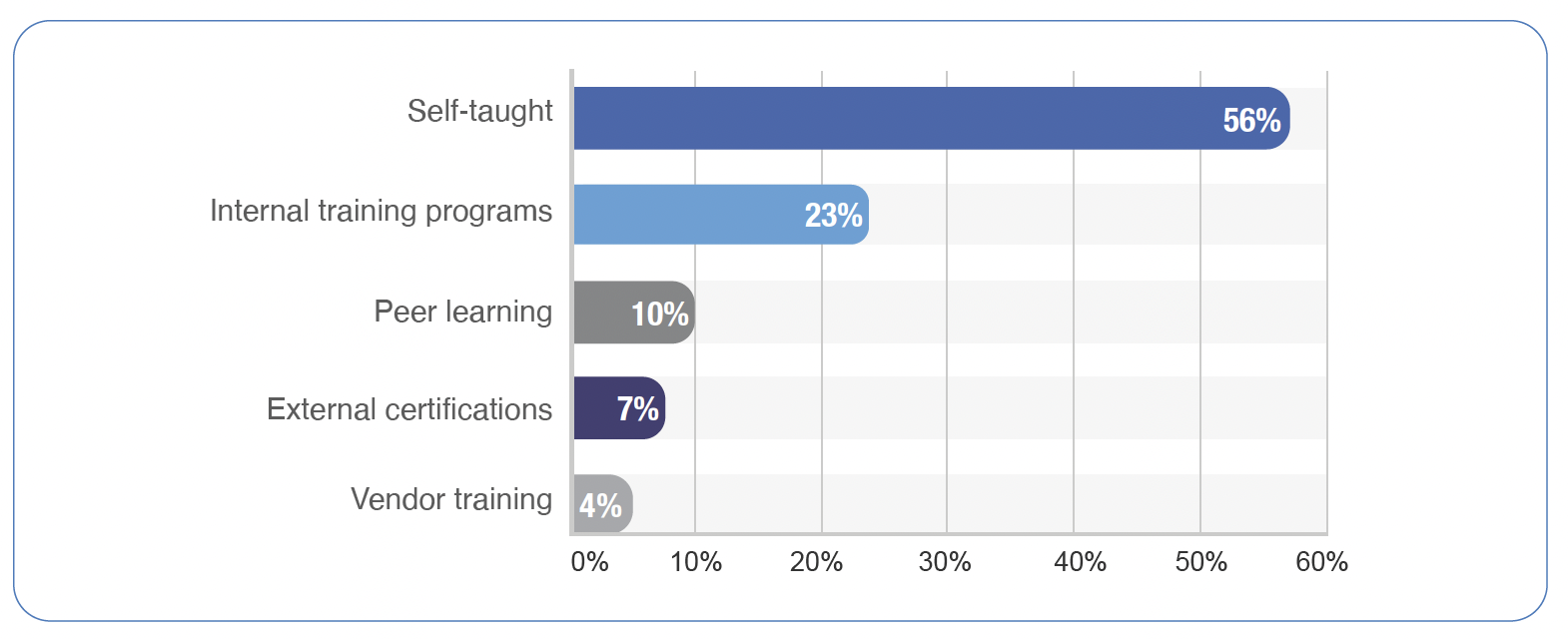
The difference between the first and second responses is substantial.
More than twice as many organizations say employees primarily teach themselves AI as rely on internal training programs.
This helps explain how AI has spread so quickly.
Employees do not necessarily need an organization to purchase a complex enterprise system, schedule a training program, or redesign a process before they can begin experimenting with generative AI. Many tools are immediately accessible and intuitive enough for an employee to start using within minutes.
That accessibility has fundamentally changed how a new technology enters the workforce.
Self-Directed Learning Has Been an Important Adoption Engine
Organizations should not dismiss self-taught AI usage as a weakness.
It has created considerable value.
Employees who understand their own work are often well positioned to identify practical AI applications. A finance professional may recognize an opportunity to accelerate analysis. A marketer may find a faster way to develop first drafts. An operations employee may identify a repetitive process that could be automated. An IT professional may discover ways to improve documentation or troubleshooting.
These use cases can emerge before a centralized AI team even knows the opportunity exists.
Self-directed learning also creates motivated early adopters.
Employees experiment because they see an immediate benefit. They develop techniques through repeated use and often share what works with colleagues.
In the early stages of AI adoption, this type of decentralized experimentation can be exactly what an organization needs.
The problem is not that employees are learning independently.
The problem arises when independent learning becomes the organization’s primary long-term workforce development strategy.
Self-Taught AI Creates Uneven Capability
When employees are responsible for teaching themselves, capability develops unevenly.
One employee may use AI every day and become highly proficient. Another may occasionally use it for simple questions. Another may avoid it because they are uncertain about company policy. A fourth may use it frequently but have developed poor practices around validation or data handling.
All four employees can work for the same organization, have access to the same tools, and technically be considered AI users.
Their actual capabilities may be dramatically different.
This creates a challenge as AI becomes part of business operations.
Organizations need some consistency around what employees understand, particularly when AI is used for consequential work.
Do employees know how to verify AI-generated information?
Do they understand what data can be shared with an AI system?
Can they distinguish an appropriate use case from one that creates unnecessary risk?
Do they know when human review is required?
Can they recognize when an AI response is incomplete, misleading, or simply wrong?
Self-directed learning may answer some of these questions for some employees.
It cannot guarantee a common standard across the workforce.
The Training Data Shows the Same Pattern
The previous question in the Talent Study reinforces this finding.
Only 37% of organizations provide formal AI training, including 17% with company-wide programs and 20% that provide formal training to selected roles.
Another 42% rely on informal or ad hoc training, while 21% provide no AI training.
Taken together, Questions #10 and #11 reveal a workforce-development model that remains highly decentralized.
Employees are largely teaching themselves, while organizations are still developing the structures needed to guide that learning.
This may have been sufficient while AI was primarily experimental.
It becomes more difficult as AI enters production environments and begins affecting established workflows, customer interactions, analysis, decision-making, and automation.
Informal Learning Becomes More Consequential as AI Scales
The Talent Study found that 54% of organizations now have AI operating in production, including limited deployments and AI scaled across multiple functions.
At that point, workforce proficiency becomes more than an individual productivity issue.
It can influence operational performance.
Imagine an employee using AI to generate ideas for an internal presentation. The consequences of imperfect technique are relatively limited.
Now consider an employee using AI to interpret financial information, respond to a customer, automate part of an operational workflow, review a contract, analyze sensitive information, or support a management decision.
The standard should be different.
As the consequence of the use case increases, organizations need greater confidence that employees understand how the technology should be used.
That is difficult to achieve when every employee follows a different learning path.
The Goal Should Be to Preserve Experimentation While Adding Structure
Organizations do not need to choose between self-directed learning and formal development.
The strongest model may combine them.
Employees should continue experimenting with approved technologies, discovering use cases, sharing techniques, and learning from their own work.
The organization can provide the structure around that experimentation.
That structure might include foundational AI literacy training, role-specific learning, clear usage policies, approved use cases, practical workshops, internal communities of practice, certification programs, and libraries of effective workflows or examples.
For professionals seeking a more structured path, the IT Executives Council’s AI Certifications provide practical training focused on AI prompting and automation that can complement internal workforce development programs.
The objective is to create a learning environment in which individual experimentation contributes to institutional knowledge.
Peer Learning Is Underutilized
One particularly interesting finding is that only 10% of respondents identify peer learning as employees’ primary method of learning AI.
That may represent an opportunity.
Organizations likely already have employees who have developed valuable AI expertise independently. The challenge is capturing and distributing that knowledge.
An employee may have developed an effective method for researching accounts, automating a recurring task, validating information, creating reports, or analyzing documents.
If that knowledge stays with one employee, the organization receives a localized productivity benefit.
If the technique is reviewed, refined, documented, and shared, it can become an organizational capability.
Communities of practice can help facilitate this.
Teams can periodically share successful use cases, lessons learned, mistakes, and new capabilities. Advanced users can demonstrate practical applications. Functional groups can maintain examples tailored to their own work.
This can preserve the speed of informal learning while making knowledge more transferable.
Organizations Need a Way to Separate Good Practices From Popular Practices
There is another challenge with bottom-up AI learning: techniques can spread before anyone determines whether they are good.
Employees naturally share shortcuts that save time.
A prompt produces a useful result, so it gets copied to colleagues. Someone finds an automation that removes several manual steps, so another department adapts it. A new AI application becomes popular because employees find it convenient.
That organic spread can be valuable.
It can also create risk.
A workflow may save time while introducing an information-security issue. A prompt may produce persuasive results without adequate validation. An automation may remove a human review step that existed for an important reason.
Organizations therefore need some mechanism for evaluating what employees discover.
Successful practices should be tested against security, data, governance, accuracy, and operational requirements before they become organizational standards.
The goal is to allow innovation to move upward from employees while ensuring that proven practices move back downward in a more reliable form.
AI Learning Needs to Move From Tips to Capabilities
A great deal of informal AI education currently revolves around tips.
Try this prompt structure. Use this feature. Add this instruction. Use this tool for this particular task.
Those techniques are useful, but they are not the same as developing durable AI capability.
The Talent Study found that organizations place the greatest value on critical thinking and validation at 65% and automation and workflow design at 61%.
Those skills require more than a collection of prompts.
Critical thinking requires employees to evaluate outputs, challenge assumptions, apply context, recognize limitations, and decide when human judgment is required.
Workflow design requires employees to understand how work currently happens and determine how AI and automation can change the process.
Those are capabilities developed through practice, feedback, examples, and application to real work.
Organizations should therefore think beyond teaching employees individual AI techniques.
The more important question is whether employees are becoming better at solving problems with AI.
Managers Can Help Turn Individual Learning Into Organizational Learning
Managers have an important role in this transition.
They are often closest to the work employees perform and can identify where AI experimentation is producing meaningful results.
Managers can ask employees what they are using AI for, which tasks have improved, where they encounter limitations, and which practices could be shared across the team.
They can also identify where employees need additional guidance.
An employee may be using AI frequently but inefficiently. Another may have developed an excellent workflow that nobody else knows about. Another may be avoiding AI because they do not understand where it is appropriate.
Managers can help surface those differences.
This makes AI development part of regular workforce management rather than a separate technology initiative.
Over time, organizations may need managers to evaluate AI proficiency in the same way they evaluate other capabilities relevant to an employee’s role.
Learning Should Become More Role-Specific
One limitation of self-directed learning is that employees often learn whatever information is easiest to find.
That does not necessarily correspond to what is most valuable for their jobs.
A finance professional does not need the same AI development path as a marketer.
An operations leader needs different capabilities from a software engineer.
A manager supervising AI-enabled work has different responsibilities from an individual contributor using AI as a productivity tool.
Organizations can add considerable value by helping employees focus their development.
A common AI literacy foundation may be appropriate for everyone. Beyond that foundation, learning should increasingly align with roles, workflows, data, decisions, and risk.
That makes development more relevant and helps organizations direct limited training resources toward capabilities that can create measurable value.
The Organization Needs to Become a Learning System
The longer-term challenge goes beyond offering more courses.
AI is changing too quickly for organizations to rely entirely on periodic formal training.
New models, features, applications, and automation capabilities will continue to emerge.
Organizations therefore need a system for continuously learning about AI.
Employees experiment.
Teams identify useful applications.
Specialists evaluate risk and technical feasibility.
Successful practices are documented.
Training incorporates what has been learned.
Managers reinforce those practices.
Employees identify the next set of opportunities.
That creates a feedback loop between experimentation and organizational development.
Self-directed learning still plays an important role, but it is no longer isolated.
It becomes one input into a broader learning system.
AI Talent Strategy Depends on This Transition
This is particularly important because 44% of respondents identify upskilling existing employees as their primary AI talent strategy.
Upskilling cannot succeed if the organization simply expects employees to figure AI out on their own.
If existing employees are the primary source of future AI capability, organizations need a deliberate way to develop them.
That does not necessarily require extensive classroom training.
It requires clear expectations, accessible resources, opportunities to practice, role-specific development, feedback, knowledge sharing, and ways to recognize growing proficiency.
Otherwise, “upskilling” risks becoming another term for self-service learning.
The distinction matters.
Self-directed learning depends largely on individual initiative.
A workforce strategy creates the conditions for capability to develop across the organization.
What This Means for AI Leaders
The fact that 56% of employees are primarily learning AI on their own is evidence of how accessible and compelling the technology has become.
It is also a signal that organizational development models have not fully caught up.
For AI leaders, the next questions should include:
- What are employees currently teaching themselves?
- Which AI practices are already spreading organically?
- Do we know which employees have developed advanced capabilities?
- How can effective individual practices be evaluated and shared?
- Are employees learning critical thinking and validation alongside tool usage?
- Do we have role-specific development paths?
- Can employees access structured learning when they want to advance beyond experimentation?
- Are managers helping identify and develop AI capabilities within their teams?
- How are we turning individual discoveries into repeatable organizational practices?
- Does our upskilling strategy rely too heavily on employees taking the initiative themselves?
Organizations should not try to eliminate self-directed learning.
It has been one of the forces accelerating AI adoption and will remain valuable as the technology evolves.
The opportunity is to connect that energy to a more deliberate workforce strategy.
Employees have already demonstrated that they are willing to learn AI. The next challenge for organizations is ensuring that what they learn becomes consistent, transferable, and valuable at scale.
Explore the Full 2026 Corporate AI Talent Study
How employees learn AI is one part of the broader workforce readiness challenge. The 2026 Corporate AI Talent Study examines how more than 300 executives are approaching AI adoption, talent strategy, specialized hiring, skills gaps, employee confidence, training, job redesign, and future workforce planning.
Download the full 2026 Corporate AI Talent Study to explore the complete findings and benchmark how your organization is developing the skills required for an AI-enabled workforce.