
As part of our ongoing deep dive into the 2026 Corporate AI Outlook Study, we are examining individual survey questions to better understand what is helping or hindering AI progress across organizations. In this post, we focus on one of the most important areas of the study: the challenges and barriers that continue to slow AI adoption, even as interest and investment remain strong.
The biggest AI barriers are not technical
One of the clearest signals from the survey is that AI adoption is being constrained more by organizational factors than by technology. The most frequently cited barrier is a lack of internal skills or talent, followed by cost considerations and governance-related concerns. Organizational resistance and data quality issues also rank highly.
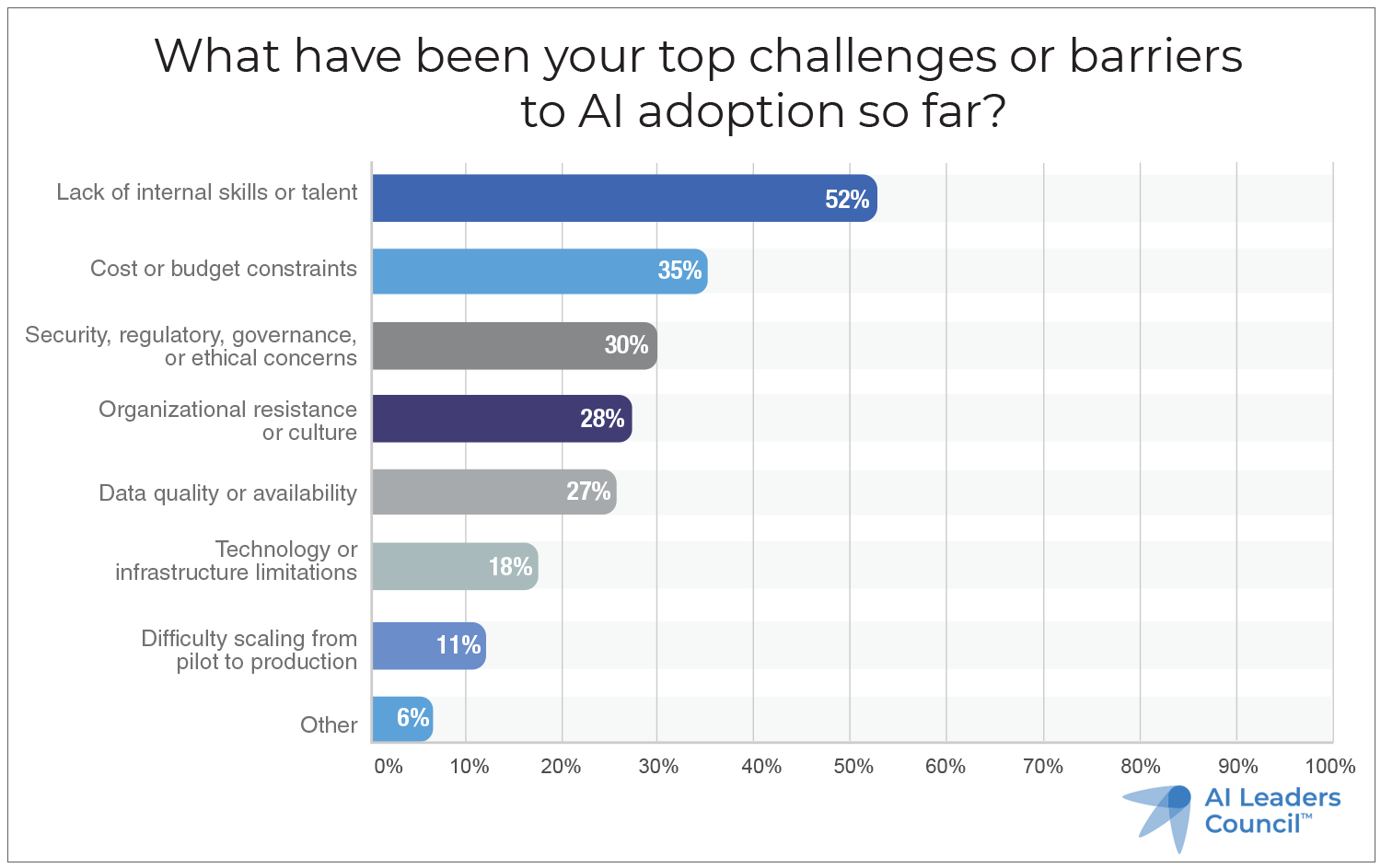
Technology and infrastructure limitations appear further down the list. This matters because it challenges a common assumption that AI progress is primarily gated by tools or platforms. In reality, most organizations already have access to AI technologies. The difficulty lies in putting them to work consistently and responsibly.
- Lack of internal skills or talent: 52%
- Cost or budget constraints: 35%
- Security, regulatory, governance, or ethical concerns: 30%
- Organizational resistance or culture: 28%
- Data quality or availability: 27%
- Technology or infrastructure limitations: 18%
- Difficulty scaling from pilot to production: 11%
- Other: 6%
Why skills and culture matter so much
AI initiatives introduce new ways of working, new decision dynamics, and new risk considerations. When teams lack confidence in how AI works or how it should be used, adoption slows. In some cases, this shows up as hesitation. In others, it results in fragmented or unsanctioned usage that creates governance risk.
Skills gaps are not limited to technical roles. Leaders often need broader AI literacy across business teams so that expectations, limitations, and responsibilities are understood. Without this foundation, even well-designed AI initiatives struggle to gain traction.
Governance concerns reflect growing maturity
Security, regulatory, governance, and ethical concerns rank prominently among reported barriers. Rather than signaling resistance, this often reflects increasing maturity. As AI moves closer to core operations, leaders become more attentive to how decisions are made, how outputs are validated, and how risk is managed.
Organizations that encounter these concerns earlier in their AI journey may ultimately be better positioned to scale. Addressing governance intentionally, rather than reactively, helps build trust and enables broader adoption over time.
“If you don’t create that culture within the company, within the organization, they are not going to learn. And if they don’t learn, they will use the AI without governance.”
This perspective highlights why culture, learning, and governance are inseparable. Adoption is not just about deploying tools. It requires leadership commitment to education, accountability, and shared expectations around responsible use.
Turning AI barriers into enablers
The challenges highlighted in the study are not insurmountable, but they do require deliberate leadership. Organizations that invest in skills development, clarify governance early, and address change management alongside deployment are better positioned to move beyond stalled pilots. The 2026 Corporate AI Outlook Study explores these barriers in detail and connects them to investment priorities, risk considerations, and adoption plans for 2026. Download the full report to understand what is holding organizations back and how leaders are responding.