AI is moving fast — but people and organizations don’t always move at the same pace. For CIOs, this creates a unique leadership challenge: how to guide your organization through AI transformation while aligning with the human side of change.
The recent Salesforce CIO report reveals the tension many CIOs are navigating:
- 61% feel pressure to be AI experts, even when they’re still learning.
- 84% believe AI is as transformative as the internet, yet 67% are taking a cautious approach.
- CIOs are investing 4x more in data infrastructure than in AI, with security and data trust as top concerns.
- 68% say business stakeholders have unrealistic ROI expectations.
These findings echo what we’ve seen across industries: AI adoption is not just a tech rollout — it’s a cultural shift. And CIOs can’t do it alone.
Why CIOs Must Partner with People Leaders
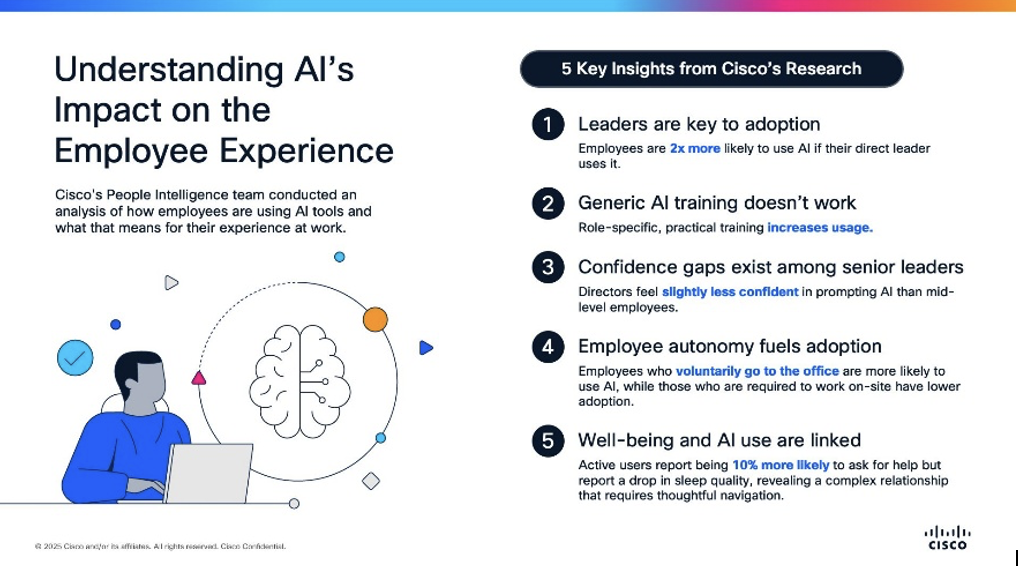
Kelly Jones, Chief People Officer at Cisco, shared powerful insights from their internal research that highlight the human dynamics of AI adoption:
“Employees are 2x more likely to use AI if their leader uses it.”
— Kelly Jones, Chief People Officer, Cisco
Cisco’s research also found that:
- Training must start broad, then go deep — general AI literacy is essential before role-specific tools can take hold.
- Confidence gaps exist at the top — directors often feel less confident than mid-level staff.
- Return-to-office mandates reduce AI adoption, while voluntary in-office work increases it.
These insights are a call to action for CIOs: collaborate with HR and people leaders to ensure AI adoption is not just technically sound, but culturally sustainable.
What This Means for CIOs
Here are five ways CIOs can lead AI adoption with clarity and collaboration:
1. Sharpen the Saw — Don’t Just Keep Cutting
If your team is only using AI for basic tasks, it’s time to pause and reassess. Like the lumberjack who won’t stop to sharpen his saw, CIOs must partner to invest in foundational AI literacy and cross-functional alignment to unlock long-term value. AI assisted software development is radically changing how work is executed.
2. Fall in Love with the Problems, Not the Strategy
Flashy AI strategies and solutions are everywhere. But real impact comes from identifying the right problems — where AI can reduce friction, improve decisions, or scale capabilities. Partner with business to surface these opportunities. Make sure AI is not see as “an IT initiative” but a part of business transformation.
3. Balance Data Readiness with AI Ambition
With 20% of IT budgets going to data infrastructure, CIOs must ensure that data quality, governance, and accessibility are ready to support AI. Without trusted data, even the best models fall short. But on the other hand, many organizations also stall out with long projects to get perfect data before touching AI. Don’t miss this golden era of AI; begin moving your organization along the learning curve.
4. Reset Expectations with Business Partners
AI ROI takes time. Organizations that deploy general AI tools without proper training and adoption will NOT see the ROI. CIOs must help business leaders understand the phased nature of AI value — from experimentation to integration to transformation — and align timelines accordingly.
5. Build the Right Talent Mix
Successful AI adoption requires a blend of:
- Business acumen
- Growth mindset
- AI fluency
Assess your current team and identify gaps. Whether through hiring, training, or partnerships, build the capabilities needed to lead confidently in the AI era.
Final Thought
Imagine a CIO in the late 1990s focused solely on optimizing IT infrastructure — without considering how the internet was reshaping business models, customer expectations, and competitive dynamics. What advice would you give them?
That same advice applies today:
“This technology is changing the world and how business will be done. What can I do to start moving my organization up the curve of AI literacy and adoption?”
AI is not just another wave of innovation — it’s a shift in how work, decisions, and value creation happen. CIOs who embrace this shift — and collaborate across the C-suite — will be the ones who shape the future of enterprise leadership.