
As part of our ongoing deep dive into the 2026 Corporate AI Outlook Study, we are examining how AI leaders expect adoption to change over the coming year. Understanding not just where organizations are today, but how they plan to move forward, provides important insight into confidence levels, risk tolerance, and execution priorities.
In this post, we focus on how executives expect AI adoption to evolve in 2026 and what those expectations reveal about the next phase of enterprise AI.
AI expansion is expected, but caution remains
Survey results show that a clear majority of organizations expect AI adoption to expand in 2026. This includes plans for additional pilots, broader deployment across select functions, and in some cases, enterprise-wide expansion. Very few respondents anticipate AI efforts slowing or declining.
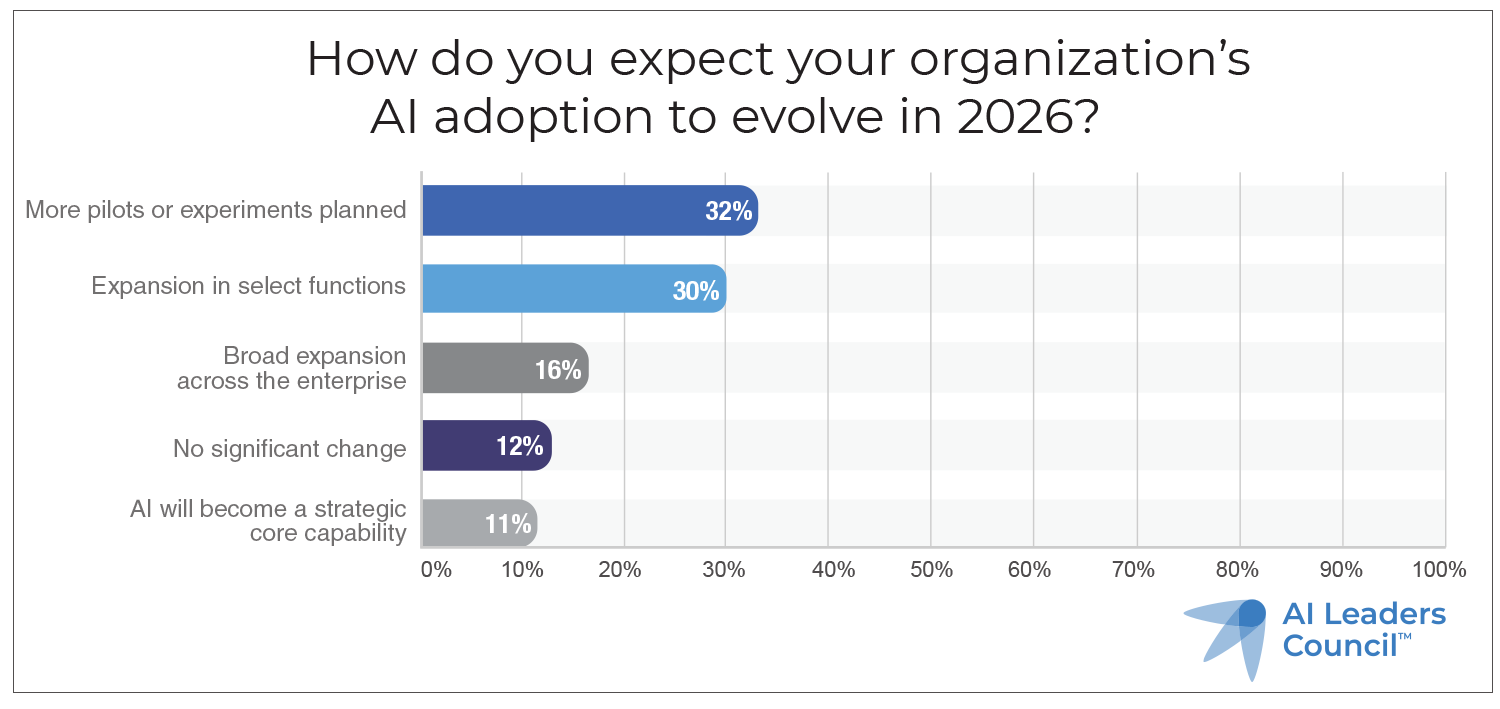
At the same time, the emphasis on pilots and selective expansion suggests that many organizations remain cautious. Leaders appear committed to AI, but deliberate about where and how quickly they scale. This reflects a growing awareness that rapid expansion without discipline can create governance, adoption, and measurement challenges.
- No significant change: 12%
- More pilots or experiments planned: 32%
- Expansion in select functions: 30%
- Broad expansion across the enterprise: 16%
- AI will become a strategic core capability: 11%
Why AI pilots are not a sign of hesitation
Continued reliance on pilots does not necessarily indicate uncertainty about AI’s value. In many cases, pilots serve as a mechanism for learning, refinement, and internal alignment. Organizations use them to test assumptions, understand change impacts, and build confidence before committing to broader rollout.
As AI use cases become more embedded in daily work, leaders are increasingly focused on sequencing. Decisions about where to expand next are shaped by data readiness, workforce capability, and risk considerations rather than enthusiasm alone.
AI execution discipline will define progress in 2026
Moving from selective adoption to broader deployment requires more than technical readiness. It demands leadership alignment, clear ownership, and consistent communication. Organizations that struggle to expand often do so because foundational questions around governance, accountability, and success metrics remain unresolved.
“Find those small projects that are going to be quick wins. Don’t try to eat the elephant all at once. The more you get buy-in and understanding, the more you’re able to take on bigger projects.”
This perspective captures why many organizations favor incremental expansion. Building trust and understanding through early wins creates the conditions necessary for sustained scale.
Turning AI momentum into measurable progress
The survey suggests that 2026 will be a transition year for many organizations. Momentum is present, budgets are increasing, and use cases are expanding. The differentiator will be how effectively leaders convert that momentum into repeatable execution.
Organizations that treat AI expansion as an operating challenge, not just a technical one, are better positioned to scale responsibly. This includes investing in people, clarifying decision rights, and aligning AI initiatives with broader business priorities.
See how leaders are planning for AI in 2026
The 2026 Corporate AI Outlook Study explores how organizations expect AI adoption to evolve and how these expectations connect to investment plans, risk concerns, and business objectives. Download the full report to understand how AI leaders are preparing for the next phase of adoption.