As artificial intelligence investment expands, it would be reasonable to expect a corresponding surge in hiring for dedicated AI positions.
The 2026 Corporate AI Talent Study tells a different story.
When executives were asked which AI-related roles their organizations are actively hiring, 73% said they are not currently hiring any of the specialized AI roles included in the study. Among those that are recruiting, AI Engineers and Machine Learning Engineers lead at just 12%, followed by AI Governance and Risk roles at 7% and Data Scientists at 6%.
This does not mean organizations have stopped building AI capabilities. In fact, the broader study shows exactly the opposite: 54% already have AI operating in production in some capacity.
Instead, the findings suggest that the AI workforce may be developing differently than many expected. Rather than creating large numbers of jobs explicitly labeled “AI,” organizations appear to be adding AI capabilities to existing teams, developing current employees, and selectively hiring specialists where deeper expertise is required.
Specialized AI Hiring Remains Limited
The hiring results are striking:
- 73% are not currently hiring specialized AI roles
- 12% are hiring AI Engineers or Machine Learning Engineers
- 7% are hiring AI Governance or Risk professionals
- 6% are hiring Data Scientists
- 4% are hiring AI Product Managers
- 3% are hiring Prompt Engineers or AI Specialists
- 3% are hiring other AI-related roles
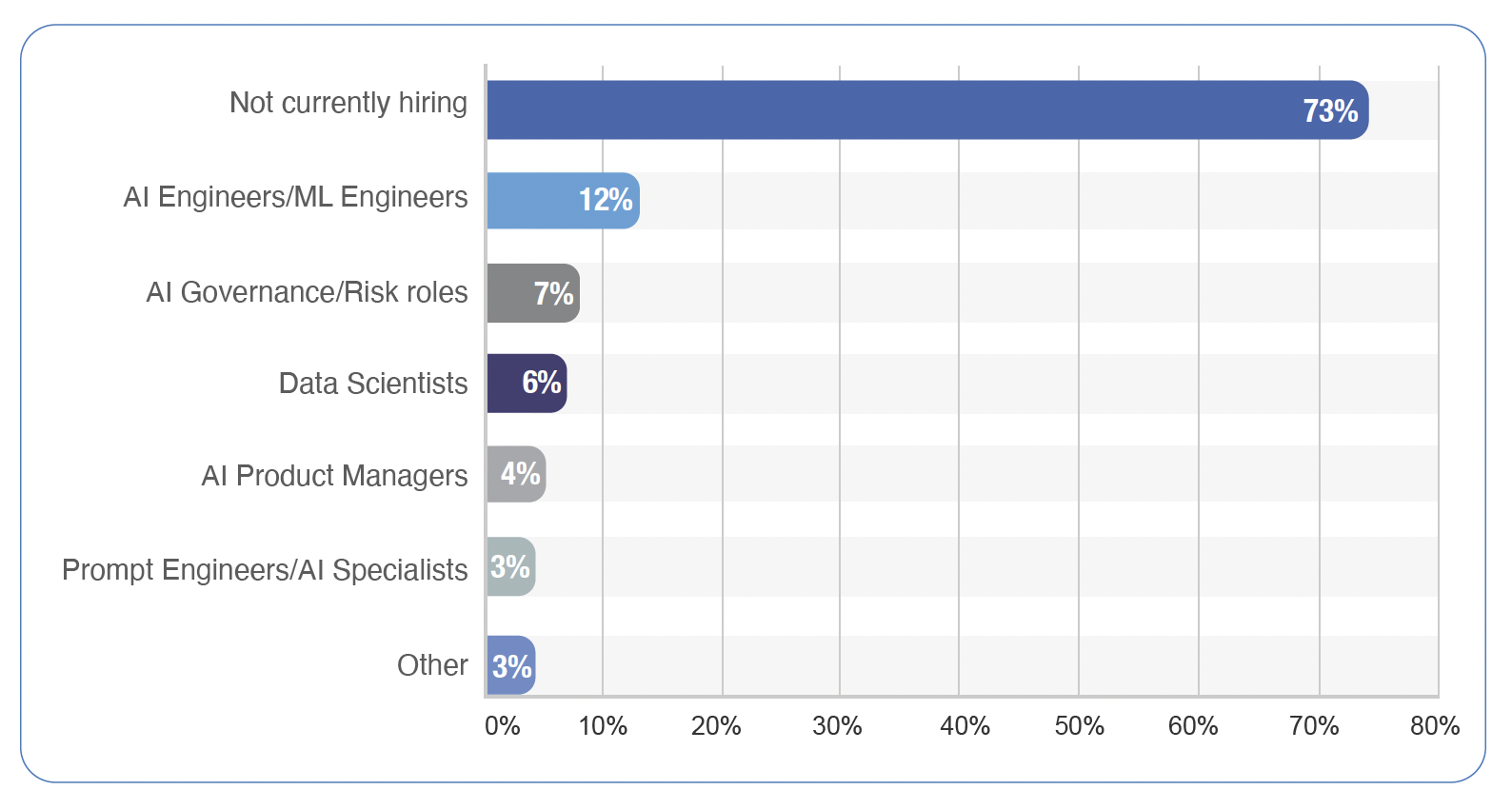
Respondents could identify the AI-related positions they were actively recruiting, so these results reflect the prevalence of hiring for each category rather than a distribution of all AI hiring.
The immediate takeaway is clear: dedicated AI recruiting is not yet the primary way most organizations are building their AI workforce.
That conclusion becomes even more significant when compared with the study’s talent strategy findings. In Question #4, 44% of respondents identified upskilling existing employees as their primary strategy, while another 17% are combining hiring with upskilling. Only 4% said external AI hiring is their primary approach.
AI capabilities are growing. AI-specific headcount is not necessarily growing at the same rate.
AI May Be Changing Existing Jobs Faster Than It Creates New Ones
One explanation is that AI work does not always require a new AI job.
A software engineer can begin using AI throughout development without becoming an “AI Engineer.” A financial analyst can use AI for analysis without becoming an “AI Analyst.” An operations professional can design AI-enabled workflows without receiving a new title. A marketing professional can incorporate generative AI into research and content processes while remaining in the same role.
This distinction matters because discussions about the AI labor market often focus heavily on newly created occupations.
The study suggests that a substantial portion of AI’s workforce impact may be occurring inside existing job categories.
Later in the research, 37% of respondents say AI is already changing existing roles, while only 6% report that AI is creating new roles.
Taken together with the hiring data, that points toward a workforce transformation that may be easier to see in changing responsibilities than in changing job titles.
An organization’s AI workforce may therefore be much larger than the number of employees with “AI” in their titles.
The Prompt Engineer Finding Is Particularly Revealing
Few AI-related occupations received as much attention during the early generative AI boom as the prompt engineer.
Yet only 3% of respondents say they are actively hiring Prompt Engineers or AI Specialists.
That does not mean prompting has become irrelevant. Employees still need to understand how to communicate effectively with AI systems and obtain useful results.
What the finding may indicate is that organizations increasingly view prompting as a skill rather than a standalone occupation.
The skills results elsewhere in the study support that interpretation.
Prompt engineering was selected by 33% of respondents as a critical workforce skill for the AI era. However, it ranked behind critical thinking and validation at 65%, automation and workflow design at 61%, and AI tool usage at 43%.
The distinction between a skill and a role is important for workforce planning.
As AI interfaces become more intuitive, employees across many functions may need prompting capabilities without organizations needing a separate workforce of professional prompt engineers. The more durable advantage may come from employees who understand their business domain and can combine that expertise with AI usage, critical evaluation, and workflow design.
The AI Workforce May Be More Embedded Than Separate
The hiring results point toward a broader question: Should organizations be building separate AI teams or embedding AI expertise throughout existing functions?
In practice, many organizations will likely need elements of both.
Certain capabilities require specialized expertise. Building AI systems, managing complex data environments, designing architecture, overseeing security, establishing governance, and evaluating model performance may require dedicated professionals.
But the functional adoption data shows AI already being used well beyond technical teams. Operations reports 49% usage, executive decision-making 45%, sales and marketing 42%, finance and accounting 35%, customer support 31%, and HR 29%.
It would be difficult for a centralized AI team to possess enough domain knowledge to identify, design, and manage every valuable application across all of those functions.
The emerging model may therefore resemble a hub-and-spoke capability even when organizations do not formally call it that.
A centralized group can provide technical depth, architecture, governance, standards, and specialized support. Functional teams can contribute process expertise, identify use cases, drive adoption, and determine how AI should change day-to-day work.
In that environment, the organization does not need every function to hire its own AI specialist. It needs enough AI fluency within each function to work effectively with specialized resources when necessary.
Business Knowledge Is Becoming Part of the AI Talent Equation
The study’s talent-gap findings help explain why this model makes sense.
When respondents were asked about their biggest AI talent gap, business translation and use-case design ranked first at 31%. Technical expertise in machine learning and engineering ranked considerably lower at 15%.
This suggests organizations are struggling not only with how to build AI, but with determining what should be built and how it should fit into the business.
That capability often requires employees who understand the processes being changed.
Consider an experienced operations manager who understands every step, exception, bottleneck, and dependency within a workflow. That person may not know how to build an AI model. But with sufficient AI literacy, they may be much better positioned to recognize where AI could eliminate unnecessary work or improve a decision than an external specialist who has no experience with the process.
The same principle applies across finance, sales, HR, customer service, supply chain, and other functions.
AI expertise and domain expertise are complementary. Organizations need ways to bring them together.
That is one reason developing existing employees can be so valuable. Upskilling adds AI capability to people who already possess organizational context rather than attempting to build that context from scratch.
Not Hiring Does Not Necessarily Mean AI Talent Is Easy to Find
There is another important consideration before interpreting the 73% figure.
The next question in the study asked organizations how difficult it is to hire AI talent. A majority, 60%, gave a neutral response, while 26% described hiring as difficult and another 10% as very difficult. Only 4% described it as somewhat easy, and no respondents characterized AI hiring as very easy.
The large neutral response needs to be viewed in the context of Question #5. If 73% are not actively recruiting the specialized roles identified in the study, some organizations may have limited recent experience on which to judge the market.
Among those expressing a view, however, difficulty substantially outweighs ease.
That provides another reason organizations may not want their AI strategy to depend entirely on external recruiting.
The combination of limited specialized hiring, perceived recruiting difficulty, and a strong preference for upskilling suggests that internal talent development is not simply a temporary solution. It may become a core component of how organizations build AI capability over the long term.
Organizations Need to Decide Where Specialists Actually Matter
The finding that most organizations are not hiring dedicated AI roles should not lead to the conclusion that specialists are unnecessary.
The more useful question is where specialized expertise creates the greatest value.
For some organizations, AI Engineers or Machine Learning Engineers may be essential because they are building proprietary models, applications, or sophisticated automation environments. Others may rely heavily on commercial AI platforms and need fewer employees focused on model development.
Organizations operating in highly regulated environments may require dedicated governance, risk, privacy, or compliance expertise. Companies with complex AI product strategies may need AI Product Managers who can bridge technical development and market requirements.
The appropriate talent model will depend on what the organization is trying to accomplish.
This is why starting with job titles can be misleading.
Leaders should begin with capabilities.
What AI capabilities does the organization need to build, operate, govern, and scale? Which require deep specialist knowledge? Which can be developed within existing roles? Which require a combination of technical and functional expertise?
Only then should the organization determine whether those capabilities require new hires, internal development, external partners, or some combination.
Job Architecture May Need to Change Before Headcount Does
There is also a longer-term workforce implication.
If AI responsibilities are increasingly being incorporated into existing jobs, organizations may eventually need to update how those jobs are defined.
An analyst who is expected to use AI for research, validate generated outputs, automate portions of a workflow, and oversee AI-assisted work is performing a different role than an analyst whose job description was written five years ago.
The title may remain unchanged, but the required competencies are changing.
This has implications for job descriptions, performance management, compensation, career development, recruiting requirements, and succession planning.
Organizations should therefore be careful not to interpret limited AI-specific hiring as limited workforce change.
The transformation may be occurring beneath the level of job titles.
In fact, the Talent Study’s broader findings suggest exactly that: AI is currently much more likely to change an existing role than create a new one or eliminate one altogether.
What This Means for AI Leaders
The 73% figure challenges a simple assumption about the AI talent market.
Organizations are adopting AI, but most are not responding by building large teams of newly hired AI specialists.
Instead, the data points toward a more distributed talent model in which existing employees acquire new capabilities, specialized expertise is added selectively, and AI responsibilities become part of established roles.
For AI leaders, that creates several important questions:
- Which AI capabilities truly require specialized hires?
- Which capabilities can be developed within existing teams?
- Are AI responsibilities already appearing in jobs without being formally recognized?
- Do current job descriptions reflect how AI is changing the work?
- Where do technical specialists need stronger partnerships with functional experts?
- Does the organization have employees capable of translating business problems into AI use cases?
- Are recruiting plans based on specific capability gaps or simply on emerging AI job titles?
- How will career paths change as AI proficiency becomes part of existing professions?
The objective should not be to maximize the number of employees with AI titles.
It should be to build the right combination of technical depth, business expertise, and AI capability to support the organization’s strategy.
The 2026 Corporate AI Talent Study suggests that much of that capability may ultimately reside within jobs that already exist.
Explore the Full 2026 Corporate AI Talent Study
Specialized AI hiring is only one part of a much broader change in how organizations are building their workforce. The 2026 Corporate AI Talent Study examines how more than 300 executives are approaching AI talent strategy, upskilling, hiring, skills gaps, employee confidence, training, job redesign, and future workforce planning.
Download the full 2026 Corporate AI Talent Study to explore the complete findings and benchmark how your organization is preparing its workforce for AI.