
We recently completed the 2026 Corporate AI Talent Study, a national survey examining how organizations are building the skills, talent, and workforce capabilities required for an increasingly AI-enabled workplace. More than 300 executives across North America participated in the study between June and August 2026.
Over the coming weeks, we will take a deeper look at the individual findings and what they mean for AI leaders. We begin with an important starting point: AI adoption itself.
The results show substantial progress. AI is moving rapidly from experimentation into production. But when the adoption findings are considered alongside the talent data, they raise a more difficult question for leaders: Is workforce readiness advancing quickly enough to support it?
AI Has Moved Into Production for a Majority of Organizations
The study asked respondents to describe their organization’s current stage of AI adoption. The results show:
- 40% are exploring or piloting AI
- 35% have limited deployment or production use cases
- 19% have scaled AI across multiple functions
- 3% have AI fully embedded across the organization
- 3% have no AI initiatives underway
Combined, 54% of respondents now have AI operating in production in some capacity.
Using the AI Leaders Council’s AI Adoption Stages™, that places 3% of organizations in the Absent stage, 40% in Exploratory, 54% in Operational, and just 3% in Embedded.
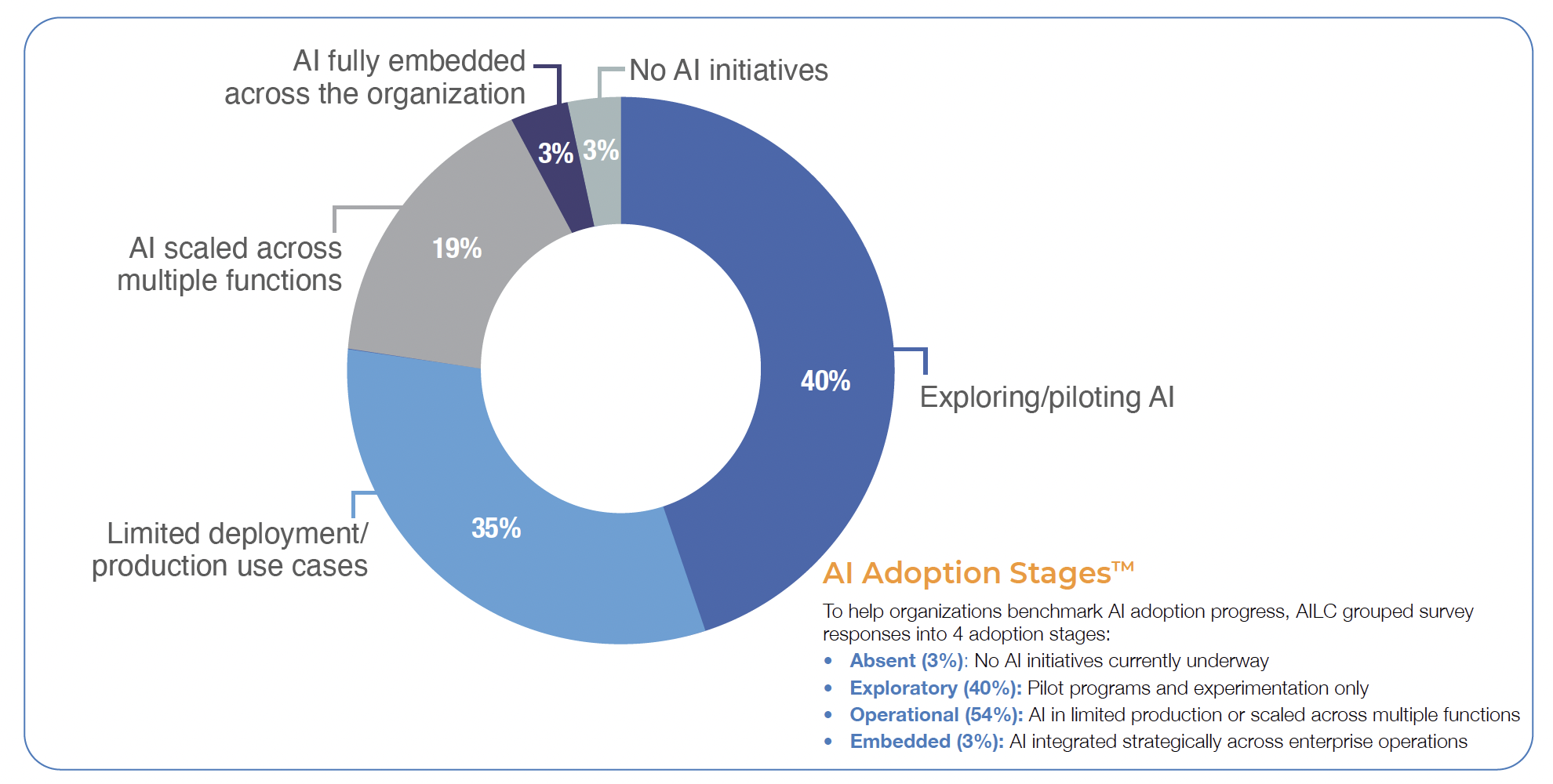
That distribution tells an important story. The primary adoption challenge is no longer convincing organizations to experiment with AI. Only 3% report having no AI initiatives at all.
Instead, the center of gravity has shifted toward operationalization. More organizations now need to determine how to take AI from a promising pilot or limited production deployment and turn it into a repeatable business capability.
The Hardest Transition May Be From Operational to Embedded
There is another number in the findings that deserves attention: 3%.
Despite the rapid movement into production, only 3% of respondents say AI is fully embedded across their organization. The gap between Operational adoption at 54% and Embedded adoption at 3% suggests that putting AI into production and integrating AI throughout an enterprise are very different accomplishments.
A successful AI application can be implemented within a department or workflow without fundamentally changing how the broader organization operates. Enterprise adoption requires considerably more.
Processes may need to be redesigned. Employees need to understand when and how to use AI. Managers need to know how responsibilities and performance expectations are changing. Governance must extend into everyday usage. Technical teams need sufficient business context, while business teams need enough AI fluency to identify and evaluate opportunities.
In other words, the constraint begins to move beyond the technology itself.
That is precisely where the talent findings in this study become important.
AI Adoption and Talent Readiness Are Moving at Different Speeds
When we look beyond Question #1, a gap begins to emerge.
While 54% of organizations have AI operating in production, 33% have no defined AI talent strategy. Only 37% provide any formal AI training, either company-wide or for selected roles.
These findings suggest that technology deployment is, in many cases, preceding the development of the workforce systems needed to support it.
That may be manageable during experimentation. A small group of technically proficient employees can test a tool, develop a proof of concept, or automate a contained process without requiring broad organizational change.
The equation changes when AI enters production.
Production AI affects real workflows, decisions, responsibilities, data, and customers. As deployment expands, organizations need employees who can do more than access an AI tool. They need people who understand how to apply it to their work, evaluate its outputs, identify appropriate use cases, recognize its limitations, and operate within organizational policies.
The study’s later findings reinforce this point. Business translation and use-case design is the most frequently cited AI talent gap at 31%, while critical thinking and validation (65%) and automation and workflow design (61%) are the two skills respondents consider most important for the AI era.
Those are not simply technical competencies. They are capabilities required to turn technology into better ways of working.
Adoption Is Not the Same as Workforce Adoption
There is also an important distinction between an organization using AI and its employees using AI effectively.
The study found that 54% of organizations estimate that no more than one-quarter of their employees actively use AI tools in their daily work. Only 6% say more than three-quarters of employees are active daily users.
This does not necessarily indicate an adoption problem. Not every employee or role needs the same level of AI usage, and organizations should be cautious about treating usage rates as a performance metric in isolation.
But it does illustrate why an enterprise can be relatively advanced in deploying AI while still having an early-stage AI workforce.
An automated process operating in the background may deliver substantial value without widespread employee interaction. A specialized team may have sophisticated AI capabilities while most employees rarely use AI. Conversely, employees may use general-purpose AI tools frequently without those activities being connected to formal enterprise AI initiatives.
AI leaders therefore need to distinguish among technology deployment, employee usage, and workforce capability. They are related, but they are not interchangeable measures of maturity.
The Workforce Challenge Grows as AI Scales
The implications become more significant as organizations move from Exploratory to Operational and eventually Embedded AI.
During the exploratory stage, organizations can often rely on a relatively small group of innovators. Once AI begins scaling across functions, that model becomes harder to sustain.
Managers need to understand how AI affects team structure and performance. Functional experts need to identify high-value use cases. Employees need training appropriate to their responsibilities. Technical teams need to collaborate more closely with process owners. HR and workforce leaders need visibility into changing skill requirements. Governance needs to become part of everyday operations rather than a policy document that sits apart from them.
This is one reason the study’s finding that 44% of organizations identify upskilling existing employees as their primary AI talent strategy is so consequential. Only 4% primarily rely on hiring external AI talent.
Organizations appear to recognize that they cannot hire their way to enterprise-wide AI maturity. The people who already understand the company’s customers, processes, systems, data, and operating environment will need to develop new capabilities as AI becomes part of their work.
AI Adoption Has Accelerated Since the Beginning of 2026
The direction of travel is also noteworthy.
The AI Leaders Council’s earlier 2026 Corporate AI Outlook Study found that 13% of organizations had no AI initiatives. In the new Talent Study, that figure has fallen to just 3%. The Talent Study also reports increases in pilots and scaled deployment across multiple functions. Because the two studies surveyed different respondent groups, these results should not be interpreted as a longitudinal measurement of the exact same organizations. Still, they provide directional evidence of continued movement toward production AI.
What has not moved is equally interesting: fully embedded AI remained at just 3% in both studies.
That may prove to be one of the more important benchmarks to watch.
Moving from no adoption to experimentation can happen relatively quickly. Moving from experimentation to a targeted production application is also increasingly accessible as AI platforms mature.
Moving from multiple production deployments to AI that is strategically embedded across an organization is a much larger organizational transformation.
Technology alone is unlikely to close that gap.
What This Means for AI Leaders
For organizations already deploying AI, the next maturity question should extend beyond “Where can we use AI next?”
Leaders should also be asking:
- Which employees and roles will be affected as current AI initiatives scale?
- What new skills will those employees require?
- Which workflows need to be redesigned rather than simply augmented with another tool?
- Where will human judgment and validation remain essential?
- Do managers understand how to lead teams whose work is increasingly AI-enabled?
- Are training and governance keeping pace with deployment?
- Does the organization’s talent strategy reflect its AI strategy?
These questions become more important as AI moves closer to core operations.
The 2026 Corporate AI Talent Study suggests that the next stage of enterprise AI maturity will depend on an organization’s ability to scale human capability alongside technical capability. AI adoption is advancing quickly. Workforce readiness now needs to catch up.
Explore the Full 2026 Corporate AI Talent Study
This is just one finding from the 2026 Corporate AI Talent Study. The full research examines how more than 300 executives are approaching AI talent strategy, hiring, skills gaps, employee confidence, training, workforce impact, and the changing role of employees as AI adoption expands.
Download the full study to benchmark your organization’s AI workforce readiness and explore all of the findings.