Organizations are moving quickly to put artificial intelligence into production. Their training programs are moving more slowly.
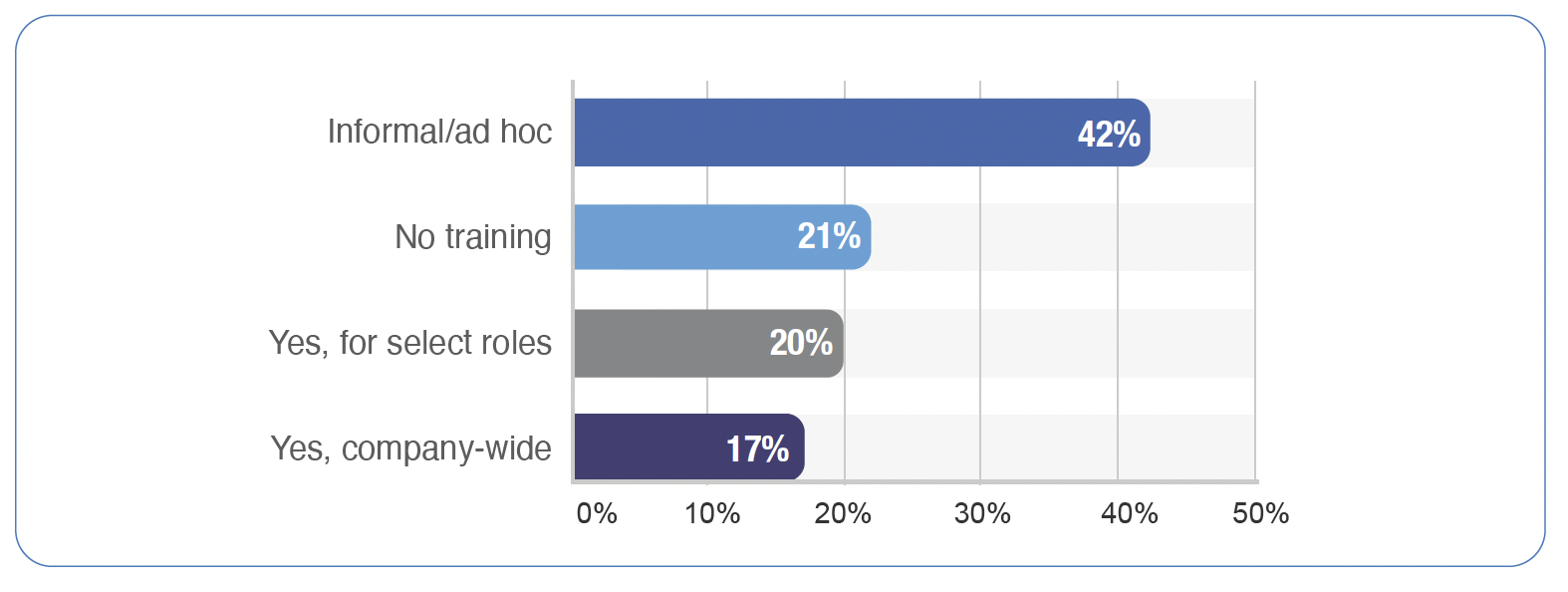
The 2026 Corporate AI Talent Study found that only 37% of organizations provide formal AI training, including 17% that offer company-wide programs and 20% that provide formal training to selected roles.
Meanwhile, 42% rely on informal or ad hoc AI training, and another 21% provide no AI training at all.
The contrast becomes more significant when viewed alongside the study’s adoption findings. More than half of organizations already have AI operating in production in some capacity, yet nearly two-thirds still lack a formal approach to developing AI capabilities across their workforce.
That creates an important question for AI leaders: Can organizations continue scaling AI if employee development remains largely informal?
Formal AI Training Remains the Exception
When respondents were asked whether their organizations provide formal AI training, the results were:
- 42% Informal or ad hoc training
- 21% No training
- 20% Formal training for selected roles
- 17% Formal company-wide training
Together, only 37% provide some form of structured AI training.
The fact that informal training leads the results is understandable.
AI has developed rapidly, and employees have often been the first to experiment with new tools. In many organizations, practical usage began before formal policies, learning programs, or workforce strategies were established.
That approach can be useful during early experimentation. Employees discover where AI is helpful, teams identify practical applications, and organizations learn which capabilities deserve further investment.
The challenge arises when informal learning remains the primary development model even as AI moves into production.
The Training Model Has Not Caught Up With the Adoption Model
The study found that approximately 54% of organizations now have AI operating in production, while only 3% report no AI initiatives.
That means AI is no longer an experimental technology for a substantial portion of respondents.
It is increasingly part of how work gets done.
Employees are using AI in IT and engineering, operations, executive decision-making, sales and marketing, finance and accounting, customer support, HR, and other functions.
As that happens, the consequences of inconsistent AI proficiency increase.
An employee experimenting with AI to brainstorm ideas presents one level of organizational risk. An employee relying on AI to analyze financial information, support a customer interaction, automate a workflow, or inform an executive decision presents another.
The more closely AI becomes connected to business-critical work, the harder it becomes to rely on employees independently determining how to use it.
Formal training becomes part of the infrastructure required to scale AI responsibly.
Informal Learning Has Been Valuable, but It Has Limits
The prevalence of informal training should not be viewed entirely as a weakness.
Self-directed experimentation has played an important role in enterprise AI adoption.
Employees have learned quickly because they have had direct access to increasingly intuitive tools. They have discovered use cases that centralized teams may never have identified. Peer learning has allowed practical techniques to spread organically across departments.
Organizations should preserve that experimentation.
But informal learning creates several limitations when it becomes the primary model.
Employees may develop inconsistent practices. Some become sophisticated users while others remain hesitant. Different departments may interpret policies differently. Employees may learn how to generate an output without learning how to validate it. Teams may create their own workflows without understanding broader governance, security, or data requirements.
The organization can end up with substantial AI activity without a consistent standard for AI proficiency.
That becomes difficult to manage as adoption expands.
Training Needs to Address More Than How to Use the Tool
One reason organizations may struggle to formalize AI training is that the technology changes so quickly.
Training employees on the exact features of a particular AI platform can become outdated rapidly. New models appear, interfaces change, and capabilities that once required advanced techniques become standard features.
That makes tool-specific instruction necessary but insufficient.
The Talent Study provides a useful indication of where training should go deeper.
When respondents identified the skills they consider most critical for the AI era, critical thinking and validation ranked first at 65%, followed by automation and workflow design at 61%. AI tool usage ranked third at 43%, while prompt engineering was selected by 33%.
Those findings suggest that effective AI training should address several layers of capability.
Employees need to know how to operate the technology, but they also need to know how to evaluate its outputs, identify appropriate applications, understand risks, redesign workflows, and determine when human judgment remains necessary.
Those capabilities are more durable than any individual AI interface.
Every Employee May Need a Baseline of AI Literacy
Formal training does not necessarily mean every employee needs the same curriculum.
However, as AI becomes more widely available, organizations may benefit from establishing a common baseline.
Employees should understand which AI tools are approved and how organizational policies apply to their use.
They should know what types of information can be shared with AI systems and what information should remain protected.
They should understand that AI-generated outputs can be inaccurate even when they appear convincing.
They should know when verification is expected, when human review is required, and where responsibility ultimately resides.
They should also understand the organization’s broader expectations around responsible AI usage.
These concepts form a foundation of AI literacy.
Without that baseline, organizations may have employees operating under very different assumptions about how AI should be used.
Beyond the Baseline, Training Should Follow the Role
A common foundation is only the beginning.
The AI capabilities required by an employee should depend on the work that employee performs.
A salesperson using AI for account research has different needs from a software engineer developing an AI-enabled application.
A finance professional working with sensitive financial information may require stronger training in validation, data handling, controls, and appropriate use.
An operations leader redesigning workflows may need deeper expertise in automation, process mapping, exception handling, and human oversight.
Managers may need training on an entirely different set of questions: How should work be reassigned when AI automates certain tasks? How should AI-assisted work be evaluated? What skills will employees need next? How should productivity expectations change?
Executives need enough AI literacy to evaluate investment decisions, risk, organizational readiness, and the implications of increasingly autonomous systems.
A mature training strategy therefore needs to be role-based.
The objective is not to give everyone the same AI education. It is to establish a common foundation and then develop the specific capabilities required for different types of work.
Formal Training Can Help Reduce the Confidence Gap
The study’s employee confidence findings reinforce the need for more structured development.
Only 3% of respondents describe employees as very confident using AI tools. The largest group, 45%, characterize employees as somewhat confident, while 28% say employees are not very confident.
That is consistent with a workforce still developing practical proficiency.
Employees may understand how to use ChatGPT, Copilot, or another AI application without feeling confident applying it to consequential work.
Structured training can help close that gap by giving employees something experimentation alone may not provide: a clear standard for what good AI usage looks like within their organization.
That includes approved use cases, practical examples, validation requirements, security expectations, escalation procedures, and role-specific guidance.
Confidence is easier to build when employees understand both what they can do and the boundaries within which they should operate.
Training Should Be Connected to Real Work
There is also a risk in formalizing AI training poorly.
A generic course explaining what artificial intelligence is may improve awareness without materially changing employee capability.
Organizations should increasingly connect training to actual workflows.
Instead of simply teaching an employee how to prompt an AI assistant, training might show how AI fits into a recurring process, what information should be supplied, what the employee should verify, which outputs can be used directly, and which require additional review.
Employees can practice on scenarios that resemble the work they actually perform. For professionals looking to build these practical capabilities, the IT Executives Council’s AI Certifications offer structured training in AI prompting and AI automation, with an emphasis on applying AI to real-world work and workflows.
This makes training more useful and gives the organization a way to reinforce its desired operating model.
It also connects directly with another major finding from the study: business translation and use-case design is the largest AI talent gap, identified by 31% of respondents.
Employees need to understand where AI fits into the business, not simply how the technology works.
Managers Need Their Own AI Training
One group deserves particular attention: managers.
Organizations often focus AI development on employees who directly use the tools or technical professionals who build and deploy them.
Managers sit between those groups and have a different responsibility.
They determine how work is assigned, how performance is evaluated, how employees develop, and how teams adapt when processes change.
As AI takes responsibility for more tasks, managers may need to answer questions they have never faced before.
What should an employee be expected to accomplish when AI eliminates several hours of manual work?
How should the quality of AI-assisted work be evaluated?
When should employees be encouraged to automate a process?
What happens when two employees performing the same role have dramatically different levels of AI proficiency?
Which responsibilities should remain human even when automation is technically possible?
Managers will play a major role in translating AI capability into changes in day-to-day work.
Training them only on how to operate AI tools leaves much of that responsibility unaddressed.
Training Also Creates a Mechanism for Governance
Formal AI training is often treated primarily as a talent-development issue.
It is also a governance mechanism.
Policies can define acceptable AI usage, but employees still need to understand how those policies apply in practice.
Training provides a way to turn governance principles into operating behavior.
An organization can explain why certain information cannot be entered into particular systems. It can show employees how to recognize higher-risk use cases. It can establish requirements for validation and human review. It can clarify who is accountable for AI-assisted work.
This becomes increasingly important as organizations move from conversational AI toward automation and agents capable of taking actions.
The more authority an AI system receives, the more important it becomes for the employees designing, supervising, and interacting with that system to understand the relevant controls.
Training and governance therefore should not develop independently.
Organizations Need to Know Whether Training Is Working
Formalizing AI training is only useful if it improves capability.
Completion rates are an easy metric, but they provide limited insight.
An employee completing a course does not necessarily mean that employee can apply AI effectively.
Organizations may need more practical measures.
Can employees identify appropriate AI use cases?
Can they recognize when an output requires validation?
Do they understand organizational policies?
Can they safely use approved tools?
Can they apply AI to role-specific tasks?
Can managers evaluate AI-assisted work?
Are trained employees producing measurable improvements in productivity, quality, accuracy, cycle time, or another relevant outcome?
As AI training matures, organizations may increasingly need competency-based approaches rather than relying solely on participation metrics.
The question should shift from “How many employees completed AI training?” to “What are employees now capable of doing differently?”
Formal Does Not Have to Mean Static
One concern organizations may have is that formal training cannot keep pace with AI.
That is true if training is designed as a one-time annual course.
AI development needs a more dynamic model.
A foundational curriculum can establish relatively durable concepts around responsible use, critical thinking, validation, data, security, and organizational policy.
Role-specific learning can evolve as new applications are deployed.
Short updates can address major changes in approved tools or capabilities.
Communities of practice can allow employees to share effective use cases and lessons learned.
Internal libraries can document successful prompts, workflows, policies, examples, and common mistakes.
Advanced users can help educate peers.
Formal training therefore does not need to eliminate informal learning.
A stronger model can combine the two.
The organization provides structure, standards, and role-specific development while employees continue experimenting, sharing ideas, and discovering new applications.
What This Means for AI Leaders
The 37% formal training figure is one of the clearest indicators that workforce readiness has room to catch up with AI adoption.
Organizations have moved quickly because the technology made rapid experimentation possible.
The next stage requires more structure.
For AI leaders, that means asking:
- Does every employee have a baseline level of AI literacy?
- Do employees understand approved tools, data requirements, and usage policies?
- Is training connected to actual roles and workflows?
- Are employees learning how to validate AI outputs rather than simply generate them?
- Do higher-risk roles receive more specialized training?
- Are managers prepared to lead AI-enabled teams?
- Are governance requirements incorporated into employee development?
- How frequently is training updated as technology changes?
- Are we measuring what employees can do after training rather than simply whether they completed it?
- Can informal experimentation continue within a more consistent organizational framework?
The objective should not be to replace employee experimentation with a rigid curriculum.
It should be to create enough structure that experimentation can scale safely and productively.
AI adoption can move quickly when employees are given access to powerful tools. Sustainable AI adoption requires employees who understand how to use those tools effectively within the context of their roles, responsibilities, and organizational standards.
The study suggests many organizations have completed the first step.
Formal workforce development now needs to catch up.
Explore the Full 2026 Corporate AI Talent Study
AI training is one part of a broader workforce readiness challenge. The 2026 Corporate AI Talent Study examines how more than 300 executives are approaching AI adoption, talent strategy, specialized hiring, skills gaps, employee confidence, training, job redesign, and future workforce planning.
Download the full 2026 Corporate AI Talent Study to explore the complete findings and benchmark how your organization is preparing employees for an increasingly AI-enabled workplace.