Predictions about artificial intelligence and employment often focus on one question: How many jobs will AI eliminate?
The early evidence from organizations using AI suggests the workforce impact may be more nuanced.
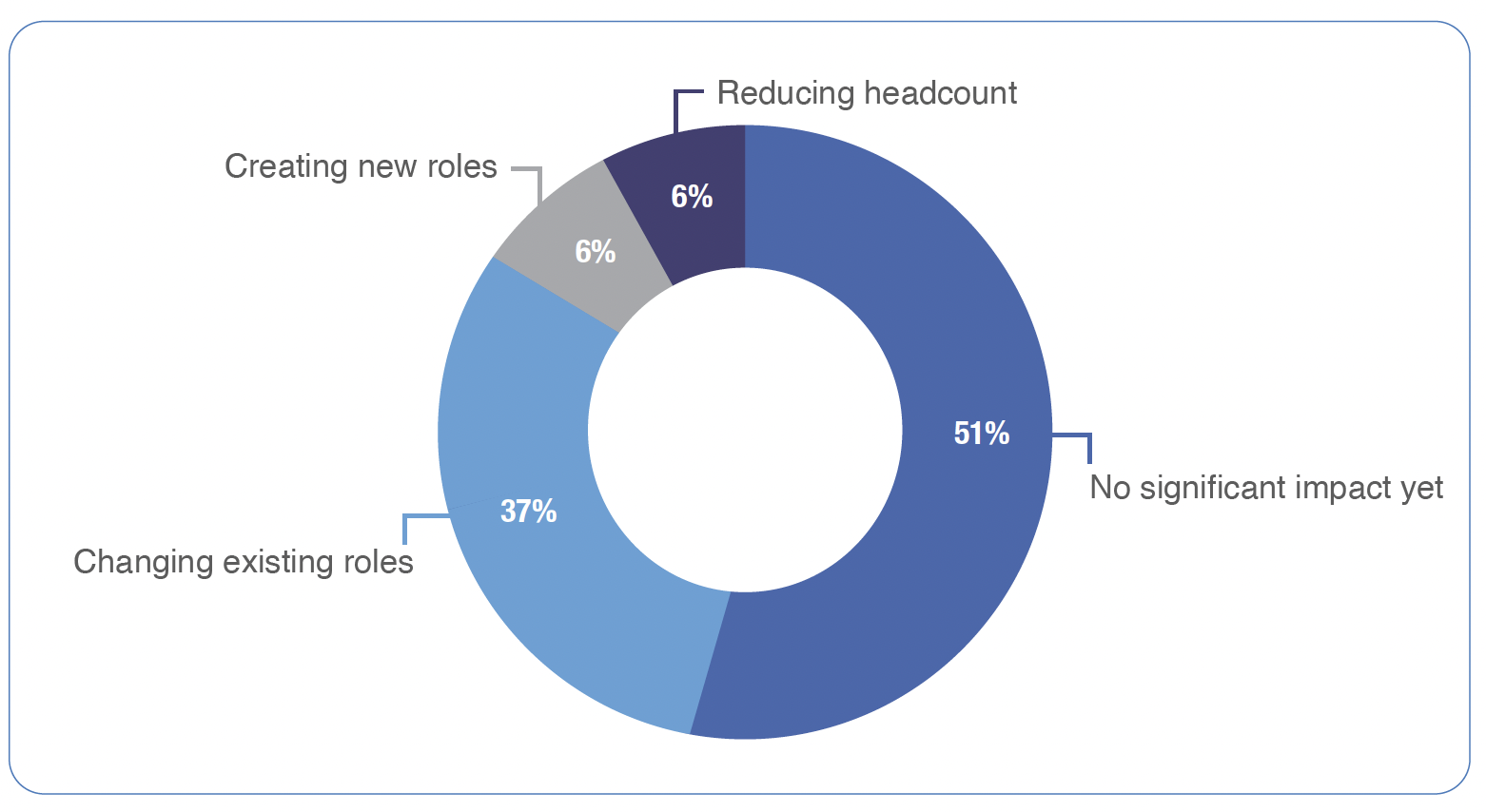
According to the 2026 Corporate AI Talent Study, 51% of respondents say AI has not yet had a significant impact on their workforce. Among organizations seeing an impact, however, changing existing roles is far more common than eliminating positions.
The study found that 37% say AI is changing existing roles, while only 6% report that AI is reducing headcount. Another 6% say AI is creating new roles.
For business leaders, that distinction matters. The near-term workforce challenge may be less about replacing large numbers of employees and more about determining how existing jobs should change when AI can perform an increasing share of the work within them.
Half of Organizations Have Yet to See Significant Workforce Impact
When respondents were asked how AI is currently affecting their workforce, the results were:
- 51% No significant impact yet
- 37% Changing existing roles
- 6% Creating new roles
- 6% Reducing headcount
These findings present a relatively measured picture of AI’s current workforce impact.
Despite rapid advances in AI capabilities, a majority of organizations have not yet experienced significant changes to their workforce.
That is important context.
Technical capability can develop much faster than organizational change. An AI system may be capable of automating a task long before an organization redesigns the process, changes employee responsibilities, adjusts staffing models, or incorporates the technology into everyday operations.
AI adoption and workforce transformation therefore should not be expected to move at the same speed.
The 51% reporting no significant impact yet may include organizations that are still experimenting with AI, as well as organizations using AI in production without having substantially redesigned jobs around it.
The word “yet” may be the most important part of the response.
Role Change Is Far More Common Than Headcount Reduction
Among organizations already seeing workforce effects, the dominant response is clear.
AI is changing existing roles.
At 37%, role change is more than six times as common as reported headcount reduction at 6%.
This suggests that many organizations are currently absorbing AI into their existing workforce rather than using it primarily as a mechanism for eliminating positions.
That aligns with several other findings in the Talent Study.
Only 4% of respondents identify external AI hiring as their primary talent strategy, while 44% are focused on upskilling existing employees. Meanwhile, 73% say they are not currently hiring specialized AI roles.
Together, the findings point toward a workforce model in which existing employees remain central to AI adoption.
The technology changes what those employees do.
AI Usually Automates Tasks Before It Eliminates Jobs
One reason role change may be more common than job elimination is that jobs consist of many different tasks.
A finance professional, for example, may gather information, reconcile data, investigate exceptions, prepare reports, communicate with business leaders, interpret results, and make recommendations.
AI may automate or accelerate several of those activities without performing the entire job.
The same is true across many functions.
AI can help a marketer research an audience and develop content without assuming responsibility for marketing strategy.
It can help a customer service employee find information and formulate responses without managing the entire customer relationship.
It can help an operations professional analyze process data without independently resolving every exception.
It can help an executive synthesize information without assuming accountability for the resulting decision.
This task-level impact is important because it changes how organizations should think about workforce planning.
The relevant question is not simply, “Can AI perform this job?”
A more useful question is, “Which parts of this job can AI perform, and what should the employee do with the capacity that creates?”
Job Redesign May Become the Central Workforce Challenge
Once AI removes or accelerates part of a role, organizations need to decide what happens next.
Suppose AI saves an employee five hours each week.
Does that employee perform more of the same work?
Take responsibility for additional customers?
Spend more time on analysis?
Focus on exceptions?
Move into higher-value activities?
Support a larger operation without additional headcount?
Or does the organization simply allow the time savings to be absorbed without deliberately changing the role?
These are management and organizational design questions, not technology questions.
Without intentional job redesign, organizations may deploy AI successfully without capturing its full value.
Employees can become more efficient at individual tasks while the broader job, process, and staffing structure remain unchanged.
Over time, the organizations that realize greater value from AI may be those that systematically reconsider what employees should be responsible for once technology performs more of the routine work.
Productivity Gains Could Change the Composition of Jobs
AI-enabled job redesign does not necessarily mean employees simply receive more work.
In many cases, it can change the composition of the role.
Routine information gathering may decline while analysis increases.
First-draft creation may decline while review and refinement increase.
Manual processing may decline while exception management increases.
Administrative work may decline while customer interaction increases.
Basic reporting may decline while interpretation and decision support increase.
This can create opportunities to move employees toward activities that require greater judgment, context, communication, or subject-matter expertise.
But that outcome is not automatic.
Organizations need to identify which activities should expand as other tasks become automated.
Otherwise, productivity improvements may remain isolated efficiencies rather than translating into broader changes in performance.
AI Can Make Human Judgment More Important
The Talent Study’s skills findings provide another clue about how jobs may evolve.
When respondents were asked which skills will be most critical in the AI era, critical thinking and validation ranked first at 65%. Automation and workflow design followed closely at 61%.
That is consistent with a workforce in which employees increasingly supervise, evaluate, and improve AI-assisted work.
As AI performs more research, drafting, analysis, and process execution, employees may spend less time creating every output manually.
Instead, they may need to review what AI produces, identify errors, apply business context, resolve exceptions, and determine when human intervention is necessary.
In some jobs, this could represent a significant shift.
Employees who were previously responsible for performing a process may increasingly become responsible for overseeing the quality of an AI-enabled process.
That can require different skills from those that made them successful in the original version of the job.
Role Change Creates an Upskilling Requirement
This helps explain why upskilling is such a prominent theme throughout the study.
If AI were primarily creating entirely new technical roles, organizations could focus much of their talent strategy on external recruiting.
If it were primarily eliminating positions, workforce strategy would center more heavily on restructuring and reductions.
But if AI is primarily changing existing roles, then organizations need to help existing employees adapt.
That requires understanding how each role is changing and which capabilities employees will need as a result.
Some may need stronger AI tool proficiency.
Others may need workflow design skills.
Some may need better data literacy.
Managers may need new capabilities for supervising AI-assisted work.
Employees whose routine responsibilities become automated may need deeper analytical, interpersonal, or decision-making skills.
Upskilling therefore should not be separated from job redesign.
Organizations first need to understand what the future version of the job looks like. They can then determine what development is required to move employees toward it.
The 6% Creating New Roles Is Also Worth Watching
Only 6% of respondents say AI is currently creating new roles.
That figure is relatively small, but it should not necessarily be interpreted as evidence that AI will create few new jobs over time.
The study captures the workforce impact organizations are experiencing today.
Many organizations remain early in their AI maturity, and only 3% report AI as fully embedded across the organization.
New roles may emerge as AI adoption becomes more sophisticated.
Some organizations may require greater expertise in AI governance, automation, data, product management, model oversight, or other areas.
But new AI responsibilities may also appear without producing entirely new job titles.
An existing business analyst may become responsible for designing AI-enabled workflows. A finance leader may take responsibility for validating AI-supported analysis. An operations employee may oversee automated processes.
This is another reason traditional job-title data may capture only part of AI’s workforce impact.
AI can create new work without creating a new position.
Headcount Reduction May Not Be the Best Measure of AI’s Labor Impact
The relatively low 6% reporting current headcount reductions is significant, but leaders should be cautious about using layoffs as the primary measure of AI’s workforce impact.
An organization can change its staffing model without eliminating existing positions.
If AI allows a team of 10 employees to support work that previously would have required 12, the immediate result may be no layoffs at all.
Instead, the organization may simply avoid hiring the next two employees.
AI’s labor impact could therefore appear first through slower headcount growth, changes in backfilling, different entry-level hiring patterns, or higher output per employee.
This becomes particularly important when the current workforce findings are considered alongside expectations for future hiring.
As the next question in the Talent Study shows, organizations are considerably more likely to expect AI to reduce future hiring than they are to report AI-driven headcount reductions today.
That distinction could become one of the most important workforce trends to watch.
Managers Will Be Central to Job Redesign
The shift toward changing existing roles places significant responsibility on managers.
Technology teams can deploy AI systems.
HR can develop workforce frameworks.
Learning teams can provide training.
But managers often determine how work actually changes.
They decide which responsibilities employees retain, which tasks can be delegated to AI, how work should be reviewed, what employees should do with newly available capacity, and how performance expectations should evolve.
Managers also see where the formal job description differs from the reality of day-to-day work.
That makes them essential to identifying how AI affects individual roles.
Organizations may need to involve managers much earlier in AI implementation, particularly when a use case has the potential to alter substantial portions of an employee’s workload.
Deploying the technology first and asking managers to figure out the workforce implications later may leave significant value unrealized.
Organizations Need Better Visibility Into Tasks, Not Just Jobs
AI may also require organizations to become more sophisticated in how they analyze their workforce.
Traditional workforce planning is often organized around jobs, titles, departments, and headcount.
AI operates at a different level.
It affects tasks.
Two employees with the same job title may perform substantially different activities. Some of those activities may be highly susceptible to AI assistance while others depend heavily on relationships, judgment, physical presence, institutional knowledge, or specialized expertise.
Organizations therefore may need to look inside the job.
Which activities consume the most time?
Which are repetitive?
Which require judgment?
Which involve structured information?
Where are employees waiting for information or approvals?
Which activities could be automated?
Which should remain human-led?
Where could AI improve the employee’s ability rather than replace the activity entirely?
That level of analysis provides a much stronger foundation for workforce planning than broad assumptions about which occupations AI will affect.
AI’s Workforce Impact Will Likely Be Uneven
The 51% reporting no significant workforce impact also serves as a reminder that AI will not affect every organization, function, or role at the same pace.
Some jobs contain large amounts of digital, repeatable, information-intensive work that AI can influence quickly.
Others depend more heavily on physical activity, interpersonal relationships, complex judgment, regulatory requirements, or work that cannot easily be standardized.
Even within the same organization, one department may experience significant workflow redesign while another sees relatively limited change.
Leaders should therefore be cautious about applying a single workforce assumption across the enterprise.
The better approach is to identify where AI is changing the economics or structure of specific work and plan accordingly.
What This Means for AI Leaders
The current workforce data provides a useful counterpoint to the most dramatic predictions about AI and employment.
Only 6% of respondents currently report headcount reductions because of AI.
At the same time, 37% already say existing roles are changing.
That suggests job transformation deserves at least as much attention as job displacement.
For AI leaders, the questions should include:
- Which tasks within existing roles are already being changed by AI?
- What responsibilities should expand as routine work declines?
- Are we redesigning jobs or simply adding AI tools to existing processes?
- What new skills will employees need as their responsibilities change?
- Are managers prepared to lead job redesign?
- How should performance expectations change when AI increases employee capacity?
- Are new AI responsibilities appearing inside existing positions?
- Do our workforce plans account for productivity gains that may reduce future hiring needs?
- Are we evaluating AI’s impact at the task level rather than relying solely on job titles?
- How will we know when a role has changed enough that its job description, career path, or compensation model should change too?
Organizations do not need to know exactly what every AI-enabled job will look like five years from now.
They do need to begin examining how work is changing today.
The first major workforce effect of AI may not be widespread job elimination. It may be the gradual redesign of millions of existing jobs as machines perform more tasks and employees take responsibility for what remains.
For organizations, managing that transition may prove to be one of the defining talent challenges of the AI era.
Explore the Full 2026 Corporate AI Talent Study
AI’s impact on existing roles is one part of a much broader workforce shift. The 2026 Corporate AI Talent Study examines how more than 300 executives are approaching AI adoption, talent strategy, specialized hiring, skills gaps, employee confidence, training, job redesign, and future workforce planning.
Download the full 2026 Corporate AI Talent Study to explore the complete findings and benchmark how your organization is preparing for AI’s impact on jobs, skills, and workforce strategy.