Artificial intelligence adoption is accelerating across corporate America. Most professionals have already experimented with tools like ChatGPT, but experimentation alone rarely leads to sustained business value.
The organizations seeing meaningful gains are moving beyond simple prompts and building structured approaches to how AI is used across teams, workflows, and decision-making.
In our previous article, AI Prompting: How to Get Better Results from AI and Turn It Into a Daily Work Tool, we covered the fundamentals of effective prompting, including clarity, context, structure, and iteration.
This article takes the discussion further by exploring advanced prompting concepts that are becoming increasingly important for executives, AI leaders, CIOs, CAIOs, and enterprise teams.
AI Prompting Is Becoming an Organizational Capability
One of the biggest misconceptions about AI prompting is that it is an individual skill only relevant to power users.
In reality, prompting is evolving into an operational capability.
Organizations are beginning to standardize prompts, create internal prompt libraries, establish governance policies, and define best practices for how AI tools are used across departments.
This shift matters because inconsistent prompting leads to inconsistent business outcomes.
For example:
- Two employees may ask AI the same question and receive entirely different recommendations
- Marketing teams may generate off-brand messaging
- Finance teams may receive incomplete analysis
- HR teams may unintentionally create compliance risks
- Executives may lose confidence in AI outputs due to inconsistency
The companies gaining the most value from AI are reducing this variability through repeatable prompting systems.
The Rise of AI Prompt Frameworks
Experienced AI users rarely write prompts from scratch every time.
Instead, they develop frameworks.
A prompt framework is a reusable structure designed to consistently generate higher-quality outputs.
Many enterprise teams are now building prompts with defined sections such as:
Role Definition: Tell the AI who it should act as.
Examples:
- “Act as a CFO evaluating operational efficiency”
- “Act as a cybersecurity advisor for a healthcare organization”
- “Act as an enterprise sales strategist”
This immediately changes how the AI approaches the task.
Objective Definition: Clearly define the outcome you want.
Instead of: “Write a summary”
Use: “Write a concise executive summary for a CIO audience focused on operational risk and business impact”
The specificity significantly improves relevance.
Constraints: Strong prompts establish boundaries.
Examples include:
- Desired tone
- Word count
- Audience sophistication
- Formatting requirements
- Regulatory considerations
- Industry context
- Without constraints, outputs often become generic.
Output Formatting: One of the most overlooked prompting techniques is specifying the exact output structure.
For example:
- Bullet points
- Tables
- Executive memo format
- SWOT analysis
- Slide outline
- Risk matrix
- Action plan
Formatting instructions dramatically improve usability.
Multi-Step Prompting Produces Better Results
Many professionals still use AI in a single interaction.
The most effective users approach prompting as a collaborative process.
Rather than asking AI to complete an entire task at once, advanced users break work into stages.
For example:
Stage 1: Research
Ask AI to identify trends, summarize data, or gather perspectives.
Stage 2: Analysis
Evaluate findings, compare options, or identify risks.
Stage 3: Recommendation
Generate strategic recommendations based on prior outputs.
Stage 4: Refinement
Adjust tone, shorten content, or tailor for specific stakeholders.
This staged approach produces far more accurate and strategic outputs than one large prompt.
AI Prompting for Executives and Leadership Teams
Executives are beginning to use AI differently than operational teams.
Rather than focusing solely on productivity, leadership teams are using prompting to support strategic thinking.
Examples include:
- Evaluating business risks
- Modeling scenarios
- Comparing market strategies
- Summarizing board materials
- Identifying operational bottlenecks
- Analyzing customer sentiment
- Stress-testing assumptions
- Preparing executive communications
The quality of these outputs depends heavily on prompt quality.
For example, a weak prompt may generate surface-level commentary. A well-structured prompt can simulate deeper strategic analysis by incorporating industry context, business objectives, and stakeholder priorities.
Prompt Chaining and Workflow Automation
Another emerging concept is prompt chaining.
Prompt chaining involves linking multiple prompts together to create semi-automated workflows.
For example, a marketing workflow may include:
- Generate article topics
- Expand into outlines
- Draft blog content
- Create LinkedIn posts
- Generate email promotion copy
- Summarize performance metrics
A finance workflow may include:
- Analyze financial data
- Identify anomalies
- Generate variance explanations
- Create executive summaries
- Draft board-ready commentary
This transforms AI from a standalone tool into part of an operational process.
Why Context Depth Matters More Than Prompt Length
One of the most common mistakes in prompting is assuming longer prompts automatically produce better outputs.
Length alone does not improve quality.
Relevant context does.
High-performing prompts often include:
- Business objectives
- Industry background
- Audience expectations
- Examples of preferred outputs
- Definitions of success
- Supporting data
- Prior decisions or assumptions
This allows AI to generate outputs that align more closely with organizational goals.
The best prompts reduce ambiguity.
Prompting and AI Governance
As AI adoption expands, prompting is becoming part of broader governance discussions.
Organizations are beginning to establish policies around:
- Sensitive data usage
- Confidential information
- Prompt approval processes
- Brand and messaging standards
- Compliance requirements
- Human review expectations
- AI usage documentation
This is particularly important in industries such as healthcare, financial services, manufacturing, and government contracting.
AI prompting is no longer simply a productivity topic. It is becoming part of enterprise risk management and operational governance.
The Importance of Human Judgment
Even advanced prompting does not eliminate the need for human oversight.
AI can accelerate thinking, summarize information, and improve efficiency, but it still requires human judgment.
Strong AI users understand:
- When to trust outputs
- When to challenge assumptions
- When additional validation is needed
- How to refine outputs strategically
- The future is not AI replacing professionals.
The future is professionals who know how to effectively direct AI.
Building AI Literacy Across the Organization
Many companies are now realizing that AI success depends less on technology access and more on workforce readiness.
Organizations that invest in AI literacy are often seeing:
- Faster adoption
- Higher productivity
- Better employee confidence
- More consistent outputs
- Reduced resistance to AI initiatives
Prompting skills are increasingly becoming foundational digital skills similar to spreadsheet proficiency or presentation development.
The challenge is that most professionals have never received formal training in how to use AI effectively.
Why Structured AI Training Accelerates Adoption
While self-learning can help, structured education significantly shortens the learning curve.
Formal training helps professionals:
- Understand advanced prompting strategies
- Apply AI to real business scenarios
- Build reusable prompt systems
- Improve consistency and output quality
- Reduce trial and error
- Use AI more strategically across departments
For enterprise teams, this can accelerate broader AI adoption initiatives.
AI Prompting Certification From Arizona State University
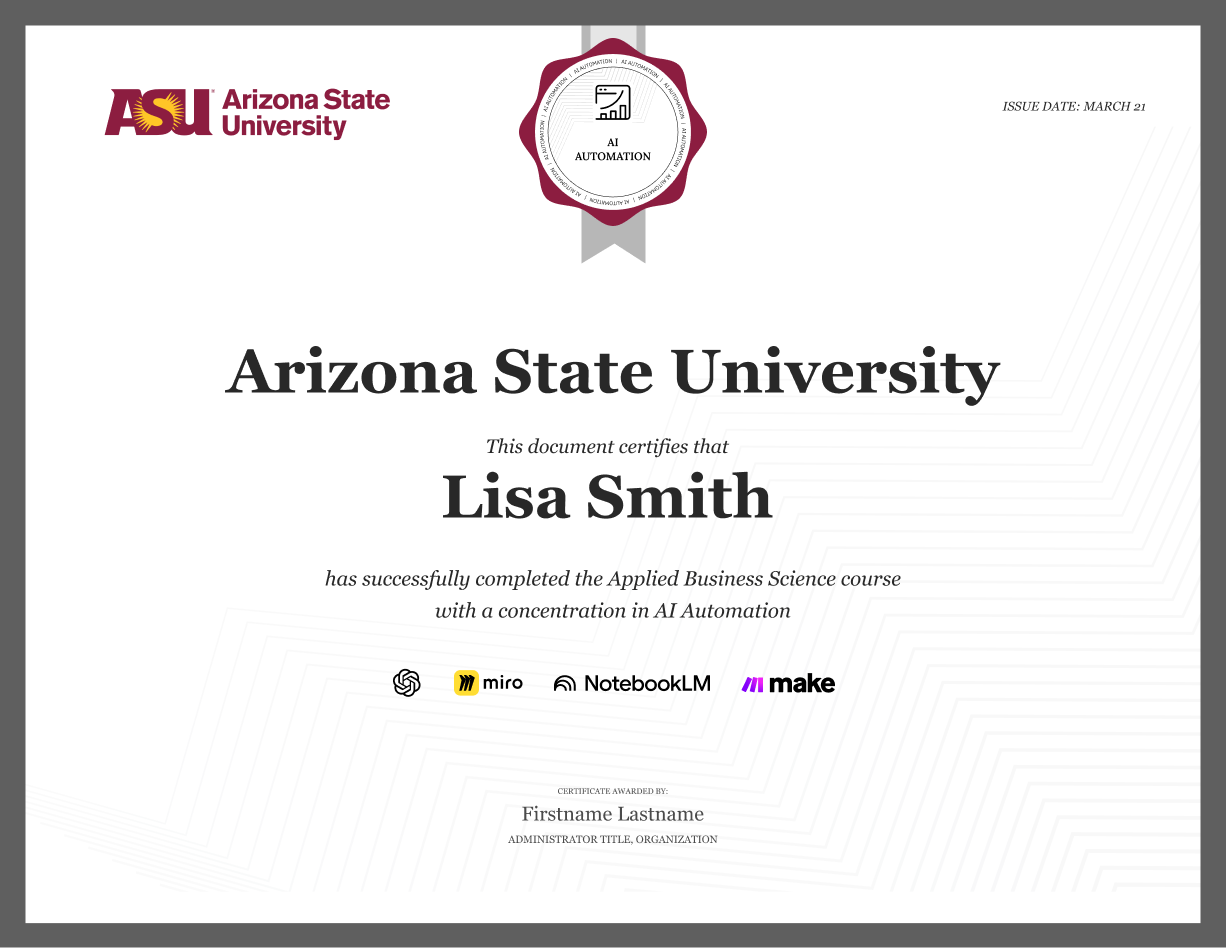
To help professionals and enterprise teams build practical AI skills, AI Leaders Council has partnered with Arizona State University and Ziplines Education to offer an AI Prompting Certification program designed for real-world business application.
The fully online 5-week program focuses on practical execution rather than theory.
Participants learn how to:
- Create structured prompts for business scenarios
- Improve AI output quality and consistency
- Build repeatable prompt frameworks
- Apply AI to communication, analysis, and workflow support
- Develop prompting strategies that align with enterprise use cases
The program also includes:
- Flexible pacing
- Hands-on exercises
- Reusable prompt templates
- Optional live sessions
- Professional certification for LinkedIn and resumes
For organizations looking to improve AI adoption across teams, structured prompting education can create a meaningful competitive advantage.
AI Prompting Is Quickly Becoming a Core Business Skill
The conversation around AI is shifting.
The question is no longer whether organizations will use AI.
The real question is whether teams know how to use it effectively, consistently, and strategically.
Prompting sits at the center of that conversation.
Professionals who learn how to guide AI effectively will be better positioned to improve productivity, support innovation, and drive stronger business outcomes in the years ahead.
To learn more about the AI Prompting Certification and other AI-focused professional development programs, visit our AI Certifications page.