AI tools are becoming increasingly accessible across the workforce. Employees can use generative AI to research information, analyze data, draft communications, summarize documents, automate tasks, and support decisions, often with little technical expertise required.
Access, however, does not necessarily translate into proficiency.
The 2026 Corporate AI Talent Study found that employee confidence in using AI remains relatively modest. While 45% of respondents describe employees as somewhat confident, only 3% say their employees are very confident.
Another 28% characterize employees as not very confident, 20% are neutral, and 4% say employees are not confident at all.
The results reveal an important distinction for organizations scaling AI: employees may be increasingly familiar with AI tools without yet having the knowledge, judgment, or experience required to use them consistently and effectively.
For AI leaders, the next phase of workforce adoption may therefore depend less on getting employees to try AI and more on helping them become proficient in applying it to real work.
Most Employees Have Some Confidence, but Few Have Reached the Highest Level
The study found:
- 45% say employees are somewhat confident
- 28% say employees are not very confident
- 20% are neutral
- 4% say employees are not confident at all
- 3% say employees are very confident
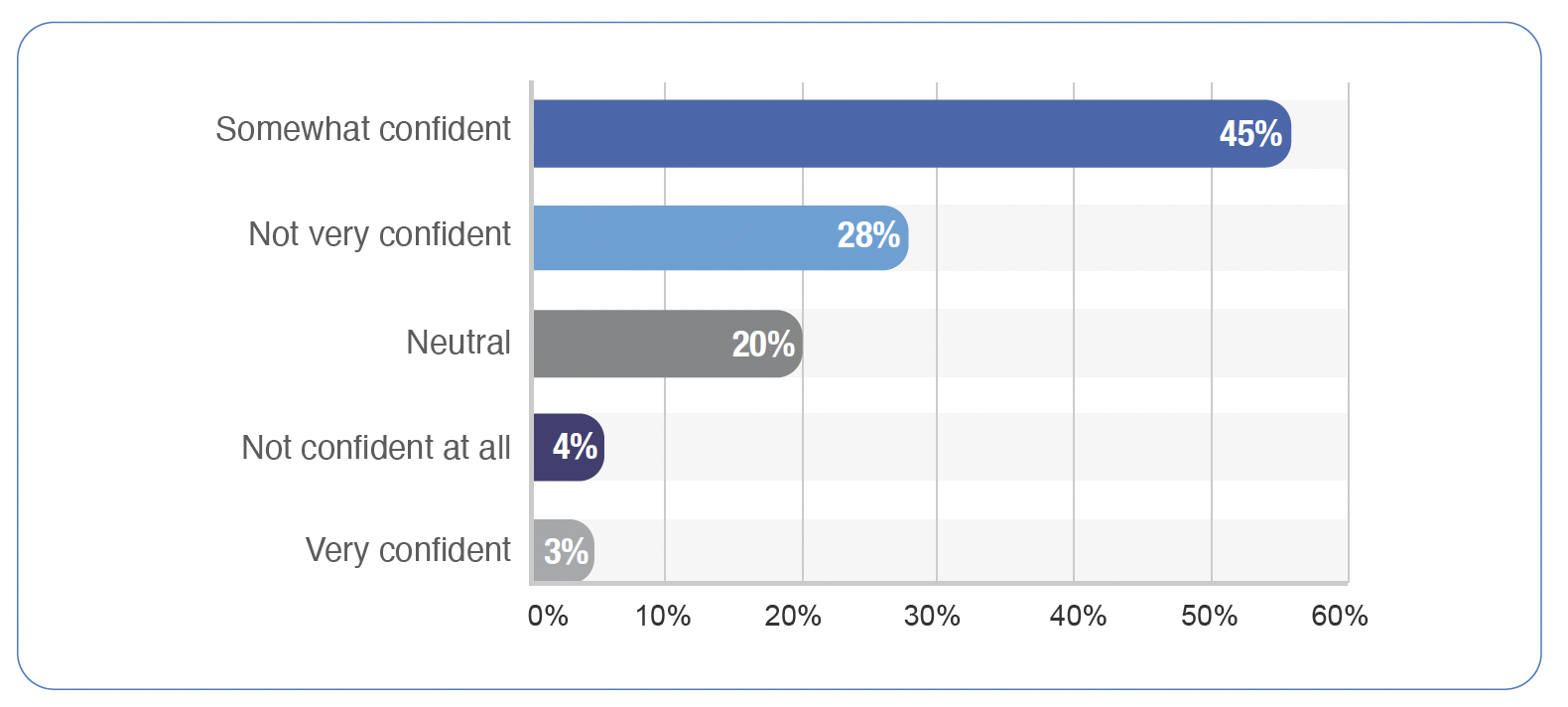
The largest group is encouraging. Nearly half of organizations report at least some confidence among employees.
But the small percentage at the top of the scale is notable.
Only 3% describe employees as very confident.
That suggests many organizations have moved beyond the earliest stage of AI awareness without yet developing a workforce that feels highly capable using the technology.
This middle ground is likely familiar to many organizations. Employees know what ChatGPT, Copilot, and other AI tools are. Some use them regularly. They may be comfortable asking questions, generating content, summarizing information, or experimenting with basic tasks.
The more difficult question is whether that comfort extends to using AI reliably within important business processes.
Familiarity and Proficiency Are Different
Confidence is inherently subjective.
An employee can feel comfortable using an AI tool without understanding its limitations. Another employee may be highly capable but remain cautious because they recognize where AI can fail.
For that reason, confidence should not be treated as a direct measure of AI proficiency.
It does, however, provide a useful signal about workforce readiness.
Organizations need employees who understand more than how to enter a prompt. They need employees who can determine when AI is appropriate, provide useful context, evaluate the response, recognize questionable outputs, protect sensitive information, and know when human judgment should override the technology.
Those capabilities become increasingly important as AI moves from low-risk experimentation into operational workflows.
Using AI to brainstorm ideas creates a different risk profile from using it to interpret financial information, support a customer interaction, evaluate a contract, recommend an operational action, or contribute to an executive decision.
As the consequence of the task increases, basic familiarity becomes less sufficient.
Self-Directed Learning May Explain the Confidence Gap
The study’s training findings provide important context for the confidence results.
Only 37% of organizations provide formal AI training, either company-wide or for selected roles. Another 42% rely primarily on informal or ad hoc training, while 21% provide no AI training.
Employees are also largely responsible for their own AI development.
When respondents were asked how employees are primarily learning AI today, 56% said they are self-taught. Internal training programs account for 23%, followed by peer learning at 10%, external certifications at 7%, and vendor training at 4%.
This creates a workforce environment in which employees can develop very different levels of AI capability even when they work within the same organization.
One employee may use AI every day and have developed sophisticated methods for prompting, validation, and workflow automation. Another may use the same platform occasionally for simple questions. A third may avoid it because they are uncertain about company policies or appropriate use.
All three may technically have access to the same technology.
Their ability to apply it effectively can be very different.
That inconsistency may help explain why “somewhat confident” is the dominant response.
More AI Usage Will Not Automatically Solve the Problem
It is tempting to assume confidence will naturally increase as employees use AI more frequently.
Experience certainly matters, but usage alone does not guarantee proficiency.
The study found that 54% of organizations estimate that no more than one-quarter of employees actively use AI tools in their daily work. Only 6% report daily AI usage among 76% to 100% of employees.
As usage expands, employees will gain more exposure to the technology. But organizations should be careful about treating increased usage as evidence of increased capability.
An employee can repeatedly use AI in ineffective ways.
They can accept generated information without sufficient validation. They can automate a poorly designed process. They can provide too little context and receive weak outputs. They can use an unapproved tool for sensitive information. They can become overly reliant on AI in situations that require professional judgment.
In those cases, more usage can amplify poor practices rather than eliminate them.
Organizations therefore need to develop quality of use alongside quantity of use.
The Most Important AI Skills Explain What Confidence Should Look Like
The study provides a useful indication of what stronger AI proficiency might involve.
When respondents were asked which skills are most critical for the workforce in the AI era, the highest-ranked capability was critical thinking and validation at 65%.
That was followed by:
- 61% Automation and workflow design
- 43% AI tool usage
- 33% Prompt engineering
- 29% Data literacy
- 25% Change management
These findings suggest that mature AI confidence should extend well beyond comfort with the interface.
An employee who is truly proficient should be able to evaluate what AI produces.
They should know when an answer needs additional verification. They should understand that fluent output is not necessarily accurate output. They should be able to recognize when the available data is incomplete or when an AI system lacks important business context.
They should also be able to think beyond individual prompts and consider how AI can change the underlying workflow.
This is a more demanding definition of AI proficiency than simply knowing how to use a tool.
Confidence Without Validation Can Become a Risk
There is another side to the confidence question that deserves attention.
Organizations should not necessarily aspire to maximum employee confidence if confidence means unquestioning trust in AI.
In some contexts, a degree of skepticism is valuable.
AI systems can generate inaccurate information, overlook context, reproduce errors from underlying data, and provide outputs that sound more certain than the evidence supports.
Employees who understand these limitations may actually approach AI more cautiously than inexperienced users.
This is why the study’s emphasis on critical thinking and validation is important.
The goal should be calibrated confidence.
Employees should feel comfortable enough to use AI where it can improve their work, while remaining sufficiently critical to recognize when outputs require verification, escalation, or human judgment.
Organizations therefore need to distinguish between confidence that comes from experience and confidence that comes from overestimating what AI can do.
Different Roles Require Different Levels of Confidence
Organizations also should not expect AI confidence to look the same across the workforce.
An employee who occasionally uses an approved AI assistant to summarize internal information may need a different level of expertise from someone designing an automated workflow that affects customers.
A manager using AI to support decisions needs different skills from an engineer building an AI-enabled application.
A finance professional working with sensitive financial information may need deeper knowledge of data handling, validation, and controls than an employee using AI for low-risk brainstorming.
This is one reason broad, generic AI training has limitations.
Foundational AI literacy can establish a common baseline across the organization. Employees can learn basic concepts, approved tools, policies, security requirements, limitations, and expectations for responsible use.
Beyond that baseline, training should increasingly follow the work.
Employees need to understand how AI applies to their actual roles, processes, decisions, and risks.
That is where confidence becomes meaningful.
Employees May Also Need Permission to Use AI
Low confidence does not always mean employees lack technical knowledge.
In some organizations, employees may simply be uncertain about what they are allowed to do.
Which AI tools are approved?
Can company information be entered into them?
Which tasks can be automated?
Does AI-generated work require human review?
Who is responsible if an AI-assisted decision is wrong?
When should employees disclose that AI was used?
Without clear answers, even capable employees may hesitate.
This makes governance part of the workforce adoption challenge.
Policies should create appropriate boundaries, but they should also make those boundaries understandable. Employees need enough clarity to know where experimentation is encouraged, where additional review is required, and where AI should not be used.
Ambiguous governance can suppress adoption just as easily as insufficient training.
Leaders Need Better Ways to Measure AI Proficiency
The confidence findings also raise a measurement question.
How does an organization know whether its workforce is actually becoming more capable with AI?
Self-reported confidence is one useful indicator, but it should not stand alone.
Organizations can also examine whether employees can successfully perform role-specific AI tasks, whether outputs are being validated appropriately, whether approved tools are being used, whether employees can identify suitable use cases, and whether AI-enabled workflows produce measurable improvements.
For certain roles, organizations may eventually develop competency frameworks that define what foundational, intermediate, and advanced AI proficiency look like.
For example, foundational proficiency might include understanding organizational policies and safely using approved tools. Intermediate proficiency could involve effective prompting, validation, and applying AI to established workflows. Advanced proficiency might include workflow redesign, automation, use-case development, or governance responsibilities.
The specific framework will vary by organization and role.
The broader principle is that AI readiness should eventually become something organizations can evaluate more systematically than simply asking whether employees are using AI.
Confidence Will Matter More as AI Moves Into the Workflow
The confidence question becomes increasingly important as AI adoption matures.
When AI is primarily an optional productivity tool, uneven employee proficiency may have limited organizational consequences.
When AI becomes embedded in business processes, the consequences are different.
Employees may need to review AI-generated recommendations, manage exceptions, supervise automated processes, interpret AI-supported analysis, or decide when an AI system should be overridden.
In those environments, employee capability becomes part of operational performance.
The organization cannot separate the effectiveness of the AI system from the effectiveness of the people interacting with it.
This is why workforce readiness needs to develop alongside technical adoption.
AI can be technically deployed before employees are prepared to use it well.
The study’s confidence findings suggest many organizations may currently be somewhere within that gap.
What This Means for AI Leaders
The fact that 45% of organizations describe employees as somewhat confident is a positive starting point. Employees are becoming familiar with AI, and many organizations have moved beyond the earliest stage of workforce awareness.
But the 3% reporting very high confidence shows how much room remains for capability development.
For AI leaders, the next questions should include:
- Do employees understand which AI tools and use cases are approved?
- Can they recognize when AI-generated information needs validation?
- Do they know what information can safely be shared with AI systems?
- Are employees learning AI primarily through structured development or individual experimentation?
- Does training address actual roles and workflows?
- Can employees identify where AI is useful and where human judgment remains essential?
- Are managers prepared to evaluate AI-assisted work?
- How are we measuring proficiency beyond adoption and usage?
- Are employees becoming appropriately confident rather than simply more trusting of AI?
The goal is not to create a workforce that believes AI can do everything.
It is to create one that understands how to use AI effectively, where to question it, and when human expertise matters most.
As AI becomes a more routine part of work, that combination of confidence and judgment will become increasingly important.
Explore the Full 2026 Corporate AI Talent Study
Employee confidence is one part of a broader AI workforce readiness challenge. The 2026 Corporate AI Talent Study examines how more than 300 executives are approaching AI adoption, talent strategy, specialized hiring, skills gaps, employee confidence, training, job redesign, and future workforce planning.
Download the full 2026 Corporate AI Talent Study to explore the complete findings and benchmark how your organization is preparing its workforce for AI.