AI’s impact on the workforce is often discussed in sweeping terms. Entire professions will be transformed. Millions of jobs will change. Nearly every employee will need to work differently.
The 2026 Corporate AI Talent Study provides a more measured view of what executives actually expect within their own organizations.
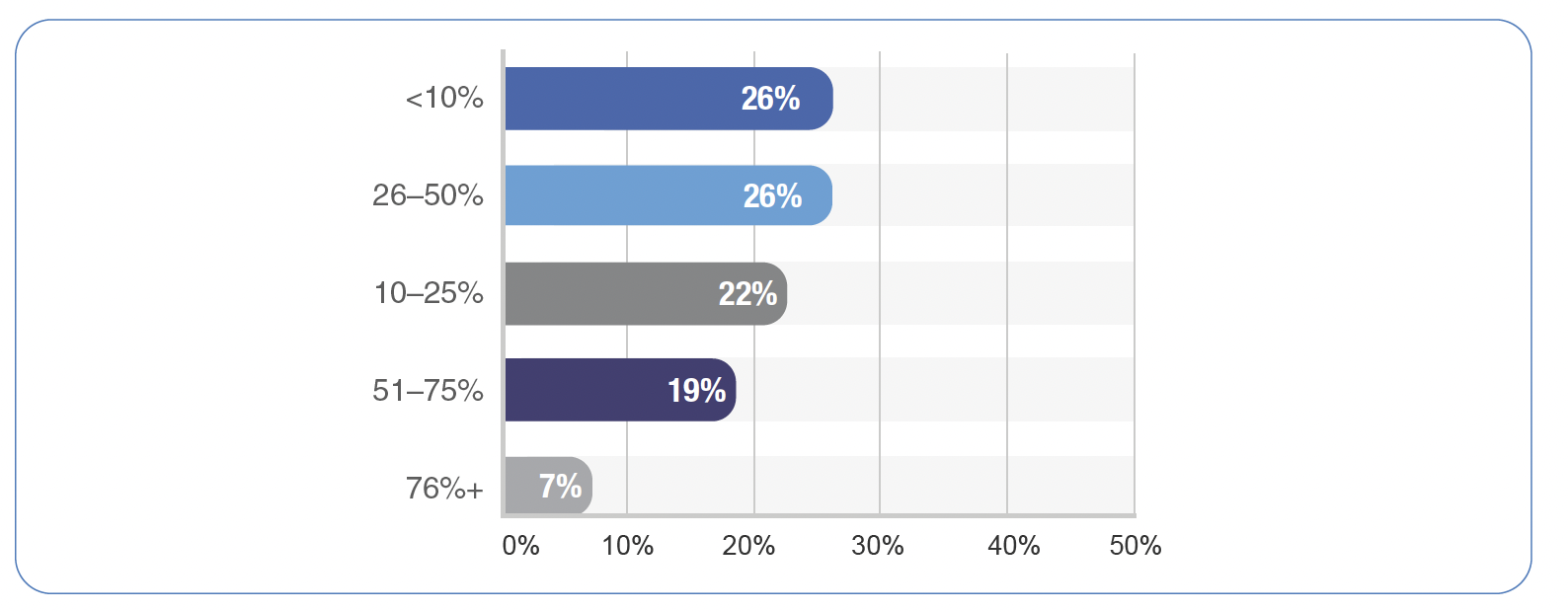
When asked what percentage of roles will be significantly impacted by AI within the next two years, responses varied considerably. While 26% expect fewer than 10% of roles to be significantly affected, another 26% expect AI to affect between 26% and 50% of roles. At the higher end, 19% anticipate significant impact across 51% to 75% of roles, while 7% expect more than three-quarters of their workforce to be affected.
Taken together, 48% of respondents expect significant changes to at least one-quarter of organizational roles within only two years.
That represents a substantial workforce transition, particularly because many organizations are still building the talent strategies, training programs, and workforce structures needed to support it.
Organizations Expect a Broad Range of Workforce Impact
Respondents estimate the percentage of roles that will be significantly impacted by AI within two years as follows:
- 26% expect fewer than 10% of roles to be impacted
- 22% expect 10% to 25% of roles to be impacted
- 26% expect 26% to 50% of roles to be impacted
- 19% expect 51% to 75% of roles to be impacted
- 7% expect more than 76% of roles to be impacted
The distribution is important because it shows there is no single expectation for AI’s workforce impact.
Some organizations anticipate relatively concentrated changes. Others expect AI to affect a substantial portion of their workforce.
Overall, 74% expect fewer than half of organizational roles to be significantly affected within two years, while approximately 26% expect AI to affect more than half.
This suggests that workforce transformation may be significant without necessarily becoming universal in the immediate future.
“Significantly Impacted” Does Not Necessarily Mean Replaced
The meaning of significant impact is critical.
It would be easy to interpret these percentages as estimates of how many jobs AI will eliminate. The broader findings from the Talent Study do not support that interpretation.
Only 6% of respondents currently report AI reducing headcount. By comparison, 37% say AI is changing existing roles.
As the study explains, significant impact can include changes to responsibilities, workflows, required skills, productivity expectations, decision-making, and the balance between human and automated work.
An employee can therefore remain in the same organization, department, and even the same job title while experiencing substantial changes to how the job is performed.
That may ultimately be the more common form of AI-driven workforce transformation.
A Job Can Change Significantly Without Disappearing
Consider what happens when AI begins performing parts of an existing role.
An employee may spend less time gathering information because AI can retrieve and summarize it.
A finance professional may spend less time preparing reports and more time interpreting results.
A marketer may produce first drafts faster but spend more time refining messaging and strategy.
A customer service employee may handle fewer routine inquiries while becoming more involved in complex cases.
An operations professional may move from manually executing a process to supervising an increasingly automated workflow.
The job still exists.
But its composition has changed.
Over time, enough changes to individual tasks can alter the skills required for the entire role.
That is why organizations should be careful about equating AI workforce planning with headcount planning.
The more immediate question may be how many jobs will need to be redesigned, not how many will disappear.
The Readiness Gap May Be More Important Than the Impact Estimate
The 48% expecting significant changes to at least one-quarter of organizational roles becomes more consequential when compared with the study’s talent findings.
The same study found:
- 33% of organizations have no defined AI talent strategy
- Only 37% provide formal AI training
- 56% say employees primarily learn AI on their own
This creates a potential workforce readiness gap.
Organizations expect AI to change a meaningful portion of work within a relatively short period, yet many have not established the development infrastructure required to prepare employees for those changes.
The issue is therefore not simply whether organizations are adopting AI.
It is whether workforce development is moving quickly enough to support what leaders already expect to happen.
Two Years Is a Short Workforce Planning Horizon
The timeframe makes the finding particularly important.
Two years is not a distant strategic horizon.
For many organizations, employees who will be performing AI-enabled jobs two years from now are already on the payroll today.
Managers who will oversee AI-enabled teams are already managing those teams.
Business processes that will eventually incorporate more AI are already operating.
This means organizations cannot rely entirely on future hiring to solve the skills requirements that emerge.
Developing an experienced employee takes time. Redesigning a job takes time. Creating effective training takes time. Changing processes and management expectations takes time.
If organizations wait until roles have already changed to begin preparing employees, workforce development will continually lag technology adoption.
The study recommends that leaders identify which roles are most likely to change, define the skills those positions will require, provide structured development opportunities, and redesign work before technology adoption outpaces employee readiness.
Workforce Planning Needs to Move From Jobs to Tasks
One of the challenges organizations face is determining which roles will actually be affected.
Looking only at job titles may not provide enough information.
AI usually changes work at the task level.
A single job might include research, data entry, analysis, communication, judgment, documentation, approvals, relationship management, and problem solving.
AI may be highly effective at some of those activities and far less useful for others.
Organizations therefore need to understand what employees actually do within each role.
A practical workforce assessment could examine:
Which tasks consume the most employee time?
Which activities are repetitive or information-intensive?
Where do employees spend time searching for or summarizing information?
Which processes involve predictable steps?
Which activities require substantial judgment or contextual knowledge?
Where could AI augment an employee rather than automate the activity?
Which tasks require human review regardless of AI capability?
This type of analysis provides a much stronger foundation for estimating workforce impact.
Instead of declaring an entire role “affected by AI,” leaders can identify precisely where the work is likely to change.
The Most Affected Roles May Need the Most Development, Not the Fewest Employees
There is another important implication.
A role with high AI exposure is not necessarily a role an organization should eliminate.
In some cases, those employees may become more valuable.
Consider a subject-matter expert whose routine analytical work can be accelerated by AI. That employee may now be able to apply years of institutional knowledge across a larger number of decisions, customers, projects, or transactions.
The value of the employee’s expertise has not disappeared.
The technology has increased the reach of that expertise.
This reinforces the importance of upskilling.
The Talent Study found that 44% of organizations identify upskilling existing employees as their primary AI talent strategy. That approach becomes particularly relevant when AI changes substantial portions of existing jobs.
Employees already understand the organization’s customers, processes, systems, data, and operating environment. Developing their ability to work effectively with AI may be more practical than attempting to replace that institutional knowledge through external hiring.
Role Redesign Should Start Before Automation Is Complete
Organizations often approach technology implementation sequentially.
First, select the technology.
Then implement it.
Then train employees.
Then determine how processes and responsibilities should change.
AI may require a more integrated approach.
If a new AI capability could remove several hours of routine work from a position, leaders should consider the future role before implementation is complete.
What should employees do with the additional capacity?
Which responsibilities should become more important?
What new skills will they require?
Should performance expectations change?
Will one employee eventually support more work?
Could responsibilities from another position move into the role?
Will managers need to supervise the work differently?
These questions influence whether AI creates isolated efficiency improvements or meaningful organizational change.
The earlier leaders begin answering them, the more intentionally they can manage the transition.
Managers Will Be Critical to Identifying Workforce Impact
Senior leaders can establish AI strategy, but managers are often better positioned to see how work is actually changing.
They know which tasks consume employees’ time.
They see where bottlenecks occur.
They understand which responsibilities require judgment and which are largely administrative.
They can observe when AI improves a process and when it creates additional review or rework.
Managers should therefore have a significant role in assessing AI’s workforce impact.
They can help identify tasks suitable for automation, determine how responsibilities should evolve, surface emerging skills gaps, and provide feedback on where employees need additional development.
This also means managers themselves need sufficient AI literacy to make those judgments.
A manager who does not understand AI’s capabilities or limitations will struggle to redesign work around it effectively.
Workforce Transformation Will Be Uneven Across the Enterprise
The spread of responses in the study also suggests organizations should avoid creating a single AI workforce plan for every employee.
The degree of change will vary substantially by function and role.
Some employees may need advanced training because AI becomes central to their daily workflow.
Others may need basic literacy because they occasionally interact with AI-generated information.
Some roles may require significant workflow redesign.
Others may remain relatively unchanged.
A smaller group may be responsible for building, governing, or managing AI systems and therefore require deeper specialization.
This creates a need for segmented workforce planning.
Rather than asking whether the entire workforce is AI-ready, organizations can identify different populations based on expected exposure and required capability.
That can make training investments more targeted and workforce planning more realistic.
Organizations Need to Define What “AI-Ready” Means
If a meaningful share of jobs will change within two years, organizations also need a clearer definition of workforce readiness.
Having access to an AI tool is not sufficient.
Neither is completing a single training course.
An AI-ready employee may need to understand how AI applies to their work, recognize appropriate use cases, evaluate outputs, protect sensitive information, identify errors, redesign workflows, and know when human judgment is required.
The exact capabilities will vary by role.
The study’s broader findings provide some direction. Critical thinking and validation, automation and workflow design, practical AI tool usage, data literacy, and change management all appear among the skills organizations consider important.
Workforce readiness therefore involves a combination of technology proficiency, business understanding, judgment, and process capability.
That is a more substantial development challenge than simply teaching employees how to use a chatbot.
The Next Two Years Should Be Treated as a Workforce Design Window
There is still considerable uncertainty about how quickly AI capabilities will develop and how organizations will ultimately use them.
But leaders do not need perfect predictions to begin preparing.
The Talent Study shows that many organizations already expect meaningful workforce change within two years.
That creates a window for preparation.
Organizations can map likely workforce exposure.
They can identify roles where significant task changes are already occurring.
They can strengthen foundational AI literacy.
They can create more advanced development paths for employees in high-impact positions.
They can involve managers in job redesign.
They can reconsider workforce plans that assume historical relationships between growth and headcount will continue unchanged.
Most importantly, they can begin doing this while the transition is still developing rather than after new ways of working have already taken hold.
What This Means for AI Leaders
The final question in the 2026 Corporate AI Talent Study brings many of the study’s findings together.
AI is already in production across a majority of participating organizations. Employees are learning to use it. Existing roles are beginning to change. Organizations expect hiring requirements to shift.
Now nearly half of respondents expect at least one-quarter of organizational roles to experience significant AI-related changes within just two years.
For AI leaders, the questions should include:
- Which roles are most likely to change significantly within the next two years?
- Which tasks within those roles will AI affect first?
- What will employees be expected to do differently?
- Which skills will become more important as routine work is automated?
- Are our training investments aligned with the roles facing the greatest change?
- Are managers prepared to redesign work and lead AI-enabled teams?
- How will productivity expectations evolve?
- Where can existing employees be upskilled rather than replaced?
- Are workforce plans accounting for changes in hiring and staffing requirements?
- Do employees understand what AI adoption means for the future of their own roles?
The organizations best prepared for AI’s workforce impact may not be those that predict every technological development correctly.
They may be the ones that become better at continuously evaluating how work is changing and developing their people accordingly.
AI workforce readiness is ultimately a question of whether organizations can redesign work and build employee capability at the same pace that the technology changes what is possible.
The next two years will provide an important test.
Explore the Full 2026 Corporate AI Talent Study
The percentage of roles expected to change is the final piece of a broader picture of AI workforce readiness. The 2026 Corporate AI Talent Study examines AI adoption, employee usage, talent strategy, specialized hiring, skills gaps, confidence, training, job redesign, hiring expectations, and anticipated workforce impact.
Download the full 2026 Corporate AI Talent Study to explore the complete findings and benchmark how your organization is preparing its workforce for the next stage of AI adoption.