AI talent is often described as scarce, expensive, and fiercely competitive. As organizations expand their AI investments, the assumption is that finding qualified employees will become one of the biggest obstacles to scaling.
The 2026 Corporate AI Talent Study suggests the reality is more complicated.
When executives were asked how difficult it is to hire AI talent, 60% selected neutral, by far the most common response. Another 26% described AI hiring as difficult and 10% as very difficult. Only 4% said it was somewhat easy, and no respondents characterized it as very easy.
On the surface, that might suggest most organizations are not experiencing a serious AI recruiting problem.
But the previous question in the study provides important context: 73% of organizations are not currently hiring specialized AI roles.
That changes how the results should be interpreted.
The 60% neutral response may say as much about the limited role external recruiting currently plays in many organizations’ AI strategies as it does about the availability of AI talent.
Most Organizations Are Neutral on AI Hiring Difficulty
The responses to Question #6 were:
- 60% Neutral
- 26% Difficult
- 10% Very difficult
- 4% Somewhat easy
- 0% Very easy
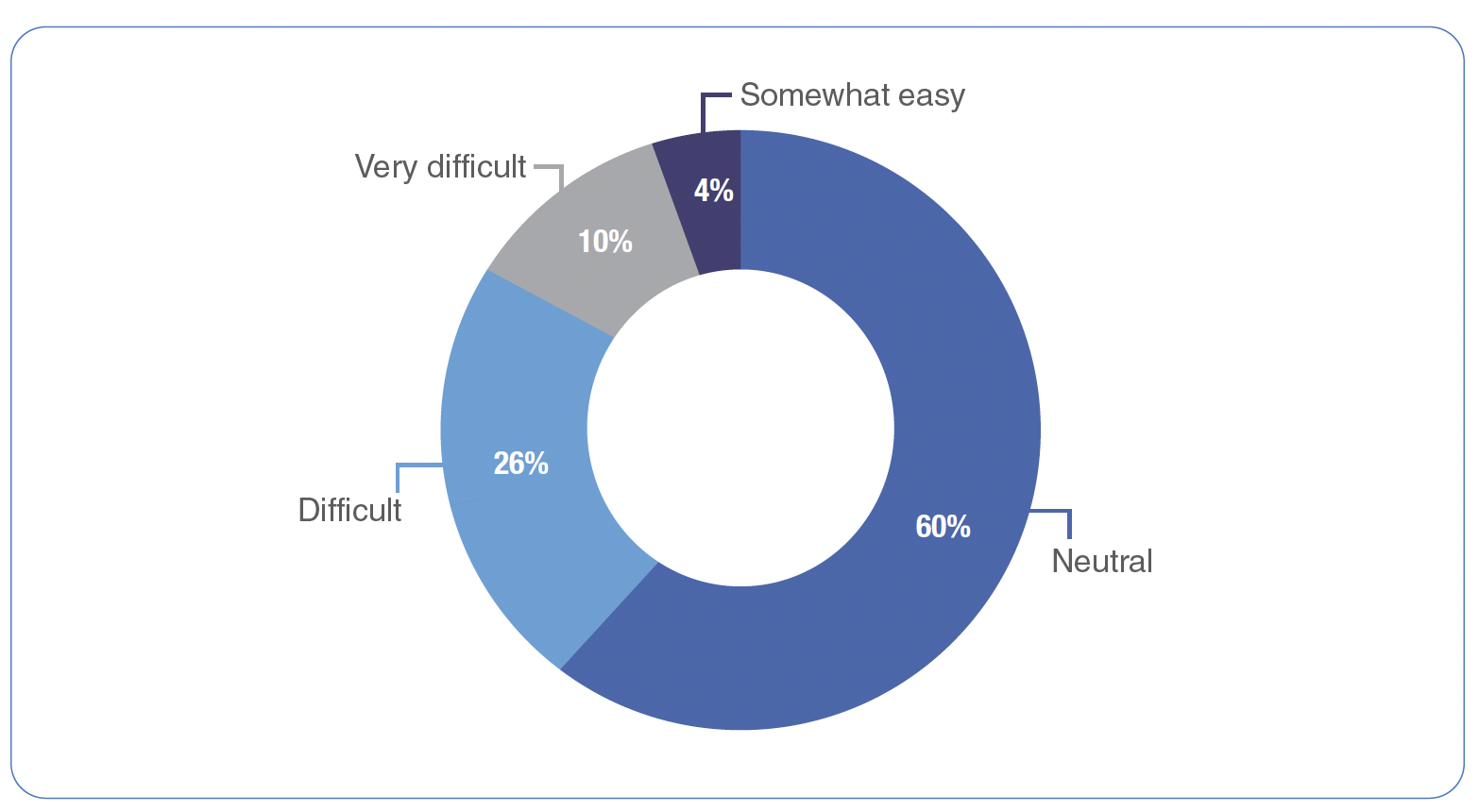
Among organizations expressing a clear opinion, the results lean decisively toward difficulty. A combined 36% describe hiring AI talent as difficult or very difficult, compared with only 4% that consider it somewhat easy.
No respondents selected very easy.
Still, the dominant result is neutral, and that deserves closer examination.
Neutral can mean many things. Some organizations may have encountered a balanced talent market in which qualified candidates are available but competition remains significant. Others may have filled the positions they needed without unusual difficulty.
But there is another plausible explanation supported by the study itself: many organizations simply may not be recruiting enough specialized AI talent to have developed a strong view of the market.
The 73% Finding Changes the Interpretation
Question #5 asked which AI-related roles organizations are actively hiring.
Seventy-three percent said they were not currently hiring the specialized AI positions included in the study. Among those recruiting, AI Engineers and Machine Learning Engineers were the most common roles at 12%, followed by AI Governance and Risk roles at 7% and Data Scientists at 6%.
That context matters considerably when evaluating hiring difficulty.
An organization that has recently attempted to recruit several machine learning engineers is likely to have a much more informed opinion about talent availability, compensation, and competition than an organization that has not entered the market.
The study therefore does not provide evidence that AI talent is generally easy to hire. In fact, the responses pointing in either direction suggest the opposite: difficulty outweighs ease by nine to one.
Instead, the data suggests that AI hiring difficulty is not yet a universal organizational experience because specialized AI hiring itself is not yet universal.
That distinction is important for AI leaders evaluating their own workforce strategy.
Organizations Are Building AI Capability Without Large-Scale External Hiring
The limited hiring activity does not reflect limited AI adoption.
The study found that 54% of organizations already have AI operating in production, either through limited production use cases or deployments scaled across multiple functions. AI is also being used across IT and engineering, operations, executive decision-making, sales and marketing, finance and accounting, customer support, and HR.
Organizations clearly need AI capabilities.
They simply are not relying primarily on specialized external hiring to obtain them.
The talent strategy findings make that even clearer. Forty-four percent identify upskilling existing employees as their primary AI talent strategy, while another 17% combine hiring with upskilling. Only 4% primarily rely on external AI hiring.
This suggests that the AI talent market cannot be understood solely by tracking demand for new AI job titles.
A substantial amount of workforce development is occurring internally.
Employees are learning to use AI within established roles. Existing technical professionals are expanding their AI capabilities. Functional experts are incorporating AI into workflows. Organizations are determining which capabilities require dedicated specialists and which can become part of the broader workforce.
The result is an AI labor market that may be more distributed than traditional hiring data suggests.
The More Important Question Is Which Talent Is Actually Hard to Find
“AI talent” is also an increasingly broad category.
An organization looking for an experienced machine learning engineer capable of developing production AI systems faces a very different labor market from one seeking a finance professional who understands how to use AI effectively in forecasting, reporting, or analysis.
Similarly, an AI governance leader, data engineer, AI Product Manager, and operations professional capable of redesigning an AI-enabled workflow represent very different combinations of skills and experience.
Treating all of these requirements as a single talent category can obscure where the real shortages exist.
The study offers an important clue.
When executives were asked to identify their biggest AI talent gap, technical expertise in machine learning and engineering ranked fourth at 15%.
The leading gap was business translation and use-case design at 31%, followed by employee adoption and training at 24% and data readiness and data engineering at 16%.
This suggests that some of the hardest AI capabilities to develop may not correspond neatly with traditional AI job titles.
Organizations need people who can understand what AI is capable of doing, understand how the business operates, identify valuable applications, redesign processes, and determine where human judgment remains necessary.
Finding that combination may be more difficult than simply recruiting someone with an AI credential.
AI Talent Scarcity May Increasingly Be About Combinations of Skills
The challenge becomes clearer when considering how AI is entering the enterprise.
An AI engineer may understand models, architecture, and technical implementation but have limited knowledge of a company’s financial close process.
A controller may understand every control, exception, and dependency within that process but lack experience designing AI-enabled workflows.
A governance professional may understand risk requirements but need functional experts to identify where those requirements intersect with actual work.
Successful enterprise AI often requires these capabilities to come together.
That means organizations may increasingly encounter compound skill gaps rather than shortages of a single technical skill.
The most valuable employees may be those who can operate across boundaries: technology and business, AI and process design, automation and judgment, innovation and governance.
Those combinations can be difficult to recruit because they require experience that traditionally developed in separate career paths.
This is also why internal development can be so important. Existing employees already possess one side of the equation: knowledge of the business, customers, processes, systems, and organizational environment.
Upskilling can add the AI capabilities needed to connect that knowledge with new technology.
Hiring Difficulty May Increase as Organizations Move From Pilots to Scale
There is another reason leaders should be cautious about interpreting today’s neutral result as evidence that AI recruiting will remain manageable.
Most organizations have not yet reached the most advanced stage of AI adoption.
Only 3% of respondents describe AI as fully embedded across their organizations. Another 19% have scaled AI across multiple functions, while 35% report limited deployment or production use cases and 40% remain in exploration or pilots.
Talent requirements can change significantly as organizations move through these stages.
A pilot may be supported by a small technical team, a vendor, or a few highly motivated employees. Scaling AI across multiple business functions creates different demands.
Organizations may need stronger architecture, integration, security, governance, data engineering, change management, workflow design, and functional expertise. They may also need leaders capable of coordinating these disciplines.
Some of those capabilities can be developed internally. Others may require external recruiting.
As more organizations reach that point simultaneously, competition for particular combinations of AI experience could intensify.
The organizations that currently report neutral hiring difficulty may therefore face a different market as their own AI strategies mature.
Waiting Until the Hiring Need Appears Creates Its Own Risk
Organizations should also avoid assuming that limited current hiring means there is little need for workforce planning.
AI talent requirements can emerge quickly once an initiative moves from experimentation to production.
A successful pilot may reveal the need for data engineering. Expanding an AI application may introduce governance requirements. Moving an agent into a business-critical workflow may require stronger security and oversight. Scaling a solution across multiple functions may expose a shortage of employees capable of translating functional needs into technical requirements.
If leaders wait until these needs become urgent before determining how the capabilities will be sourced, recruiting difficulty becomes more consequential.
The better approach is to anticipate capability requirements before they become open positions.
Organizations can map the skills required for their expected AI roadmap and determine which already exist internally, which can be developed, which can be obtained through partners or vendors, and which will require external hiring.
This makes talent planning proactive rather than reactive.
Build, Buy, Borrow, or Automate?
The AI talent discussion may ultimately need a broader framework than hiring versus upskilling.
For every capability an organization needs, leaders can consider several options.
They can build the capability by developing existing employees.
They can buy it through external hiring.
They can borrow it through consultants, technology partners, vendors, contractors, or other outside expertise.
And increasingly, they may be able to automate portions of the work itself using AI.
Different capabilities will call for different approaches.
Core institutional knowledge may be best developed internally. Highly specialized expertise that is needed continuously may justify external hiring. Skills required temporarily during implementation may be better sourced through partners. Routine technical or analytical tasks may increasingly be augmented through AI tools.
This portfolio approach is particularly relevant because AI capabilities themselves are changing quickly.
Hiring aggressively for a narrowly defined skill that may look very different in two years carries its own risk. Developing durable internal capabilities such as critical thinking, validation, workflow design, data literacy, and AI fluency may provide more flexibility as specific technologies evolve.
Hiring Difficulty Is Only One Measure of AI Talent Readiness
There is also a broader lesson in the data.
Organizations can have little difficulty hiring AI talent and still have a significant AI workforce problem.
Recruiting is only one component of readiness.
The study found that 33% of organizations have no defined AI talent strategy. Only 37% provide formal AI training, and 56% say employees are primarily learning AI on their own.
At the same time, business translation and use-case design is the largest reported AI talent gap.
These findings suggest that the central workforce challenge extends beyond whether qualified candidates are available in the external market.
Organizations also need to know what capabilities they require, where those capabilities should reside, how existing employees will develop them, and how roles will change as AI becomes more embedded in the business.
A company could successfully hire several AI engineers and still struggle to identify useful business applications, drive employee adoption, redesign workflows, or establish effective governance.
Conversely, an organization with limited specialized hiring may build substantial AI capability by developing the right employees and selectively adding expertise where it is genuinely needed.
What This Means for AI Leaders
The study’s hiring data should encourage leaders to ask more precise questions than simply, “Is AI talent hard to find?”
The more useful questions include:
- Which AI capabilities will our strategy require over the next two years?
- Which of those capabilities already exist inside the organization?
- Which can realistically be developed through upskilling?
- Which require specialized external hires?
- Where could partners or vendors fill temporary or highly specialized gaps?
- Are we looking for technical expertise when the actual gap is business translation or process knowledge?
- Which combinations of technical and functional expertise will become most valuable?
- How will our talent requirements change as AI moves from pilots into production and scale?
- Are we identifying future capability gaps before they become urgent hiring needs?
The 60% neutral response should not be mistaken for evidence that AI talent is readily available.
Instead, it reflects a market in which many organizations are still determining what AI talent they need and how much of it must come from outside the organization.
For those already competing for specialists, the balance is considerably clearer: far more respondents describe AI recruiting as difficult than easy.
As enterprise adoption matures, the AI talent challenge may become less about finding people with “AI” in their titles and more about finding or developing the specific combinations of technical expertise, business knowledge, judgment, and process understanding required to turn AI into operational value.
Explore the Full 2026 Corporate AI Talent Study
Hiring difficulty is one part of a broader AI workforce challenge. The 2026 Corporate AI Talent Study examines how more than 300 executives are approaching AI adoption, talent strategy, specialized hiring, skills gaps, employee confidence, training, job redesign, and future workforce planning.
Download the full 2026 Corporate AI Talent Study to explore the complete findings and benchmark how your organization is preparing for the AI talent requirements ahead.