When organizations discuss AI talent shortages, the conversation often turns quickly to technical expertise.
Do we have enough AI engineers? Data scientists? Machine learning specialists? People who understand models, infrastructure, and emerging AI platforms?
Those skills matter. But according to the 2026 Corporate AI Talent Study, they are not where executives see the largest gap.
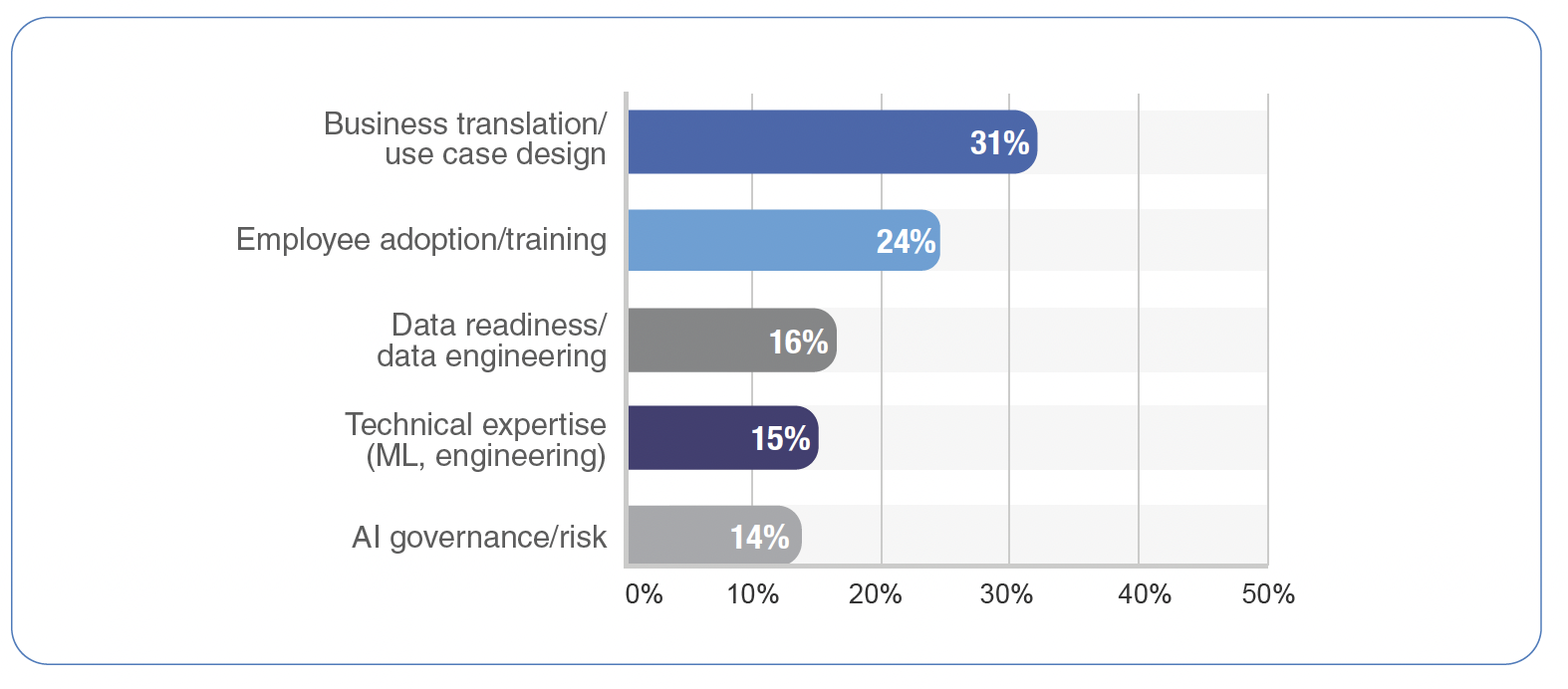
When respondents were asked to identify their biggest AI talent gap, business translation and use-case design ranked first at 31%. Employee adoption and training followed at 24%, while data readiness and data engineering came in at 16%.
Technical expertise in machine learning and engineering ranked fourth at 15%.
The findings point to a broader challenge emerging as AI moves deeper into the enterprise. Organizations increasingly have access to powerful technology. What they often lack are people who can determine where that technology should be applied, connect it to real business problems, redesign the surrounding work, and translate between technical possibilities and operational realities.
Business Translation Is the Largest AI Talent Gap
The results show how organizations rank their most significant AI talent gaps:
- 31% Business translation and use-case design
- 24% Employee adoption and training
- 16% Data readiness and data engineering
- 15% Technical expertise in machine learning and engineering
- 14% AI governance and risk
The distribution is notable because every category represents a legitimate requirement for enterprise AI.
Organizations need technical expertise. They need reliable data. They need governance. They need employees who understand how to use new tools.
But the largest share of executives pointed to the capability that connects those pieces to the business.
That suggests the AI talent challenge is evolving.
As access to AI platforms expands, simply having the technology becomes less differentiating. Organizations must be able to identify where AI can create meaningful value and then translate that opportunity into a workable process.
That requires a different kind of expertise.
What Does “Business Translation” Actually Mean?
Business translation can sound abstract, but in practice it is highly operational.
It is the ability to understand a business problem well enough to determine whether AI can help solve it and then translate that problem into requirements that technical teams, vendors, or AI systems can act on.
Consider an organization that wants to use AI to improve its financial close.
A technically oriented team might immediately identify opportunities for automation, anomaly detection, document processing, or intelligent reconciliation.
But before any of those capabilities are deployed, someone needs to understand how the close actually works.
Which tasks create the most delays? Which steps require judgment? Where do exceptions occur? Which data sources can be trusted? Which controls cannot be compromised? Where does information move manually between systems? Which problems are truly responsible for slowing the process?
Only then can the organization determine where AI is likely to create meaningful value.
The same applies in customer service, operations, sales, HR, IT, supply chain, and nearly every other function.
The challenge is not simply finding something AI can do.
It is determining what AI should do within the context of a specific business process.
AI Use-Case Design Requires More Than Technical Knowledge
This distinction helps explain why technical expertise does not rank first.
A machine learning engineer may know how to build a sophisticated AI system without knowing which business process deserves attention first.
A finance leader may understand the process intimately but have limited knowledge of what current AI technology can realistically accomplish.
A business translator operates between those domains.
That person does not necessarily need to be the organization’s strongest technical expert. They do need enough AI literacy to understand the technology’s capabilities and limitations, combined with enough business knowledge to recognize valuable applications.
They also need to ask the right questions.
What problem are we solving? How is it handled today? What would improve if AI were introduced? What data is required? What happens when the AI is wrong? Where does human review remain necessary? How will the workflow change? How will success be measured?
Those questions often determine whether an AI initiative creates business value or remains an interesting technical experiment.
The Finding Reflects AI’s Shift From Experimentation to Operations
The prominence of business translation may also reflect where organizations currently stand in their AI journeys.
The study found that 54% of respondents now have AI operating in production, while another 40% remain in exploration or pilots. Only 3% report no AI initiatives.
Early AI experimentation can often begin without extensive business translation.
An employee can test a generative AI tool. A technical team can build a proof of concept. A department can experiment with an assistant or automation platform.
Production changes the requirements.
Once AI becomes part of an actual business process, organizations need to answer more difficult questions about workflow, ownership, controls, integration, adoption, measurement, and accountability.
The central question moves from “Can we use AI?” to “How should AI change the way this work gets done?”
That transition increases the value of employees who understand both the technology and the business environment in which it will operate.
As more organizations move from isolated experimentation toward operational deployment, business translation is likely to become increasingly important.
The Second-Largest Gap Reinforces the Same Story
The second-largest talent gap is also revealing.
Twenty-four percent of respondents identified employee adoption and training as their biggest AI talent gap.
Combined with business translation and use-case design, more than half of respondents selected challenges associated with turning AI technology into organizational capability rather than purely technical development.
That is consistent with several other findings throughout the study.
Only 37% of organizations provide formal AI training. Another 42% rely on informal or ad hoc training, and 21% provide none.
Meanwhile, 56% say employees are primarily learning AI on their own.
The issue, therefore, is not simply whether organizations can acquire or deploy AI tools. It is whether employees can incorporate those tools effectively into the way work is performed.
Business translation determines where AI belongs in the workflow. Adoption and training help employees operate successfully within the redesigned workflow.
The two challenges are closely connected.
Organizations May Need More “Bilingual” AI Talent
The findings suggest that some of the most valuable AI talent may be people who are effectively bilingual.
They understand the language of the business and the language of AI.
In finance, that might be an FP&A leader who understands forecasting, planning, data structures, and how AI can support analysis.
In operations, it could be a process owner who understands bottlenecks, automation, system dependencies, and AI-enabled workflow design.
In marketing, it may be someone who understands customer strategy, content operations, analytics, and how generative AI can fit into those processes.
In IT, it could be a technical leader who understands architecture while also being able to frame AI investments in terms of business outcomes.
These employees may never hold an “AI” job title.
Yet they can play a critical role in moving AI from a technical capability to an operational one.
This also helps explain another finding from the study: 73% of organizations are not currently hiring specialized AI roles.
Organizations may not need a newly created AI position for every use case. They may instead need to develop AI fluency among people who already understand the business.
Domain Experts Could Become Some of the Most Important AI Talent
This creates an opportunity for organizations to look differently at their existing workforce.
Many of the employees best positioned to identify high-value AI opportunities may already be inside the company.
They understand where work breaks down.
They know which reports take hours to prepare, which customer requests require repeated manual effort, which processes depend on spreadsheets, which decisions require information from several systems, and which tasks consume disproportionate amounts of employee time.
Historically, that knowledge may have been viewed primarily as functional expertise.
In an AI-enabled organization, it can become part of the organization’s AI capability.
The challenge is giving those domain experts enough understanding of AI to recognize what is possible.
That does not mean turning every finance manager, operations leader, or HR professional into a machine learning specialist.
It means developing sufficient AI literacy that employees can connect their process knowledge to new ways of working.
For many organizations, this may be one of the highest-value forms of upskilling.
Use-Case Design Needs More Discipline as AI Becomes Easier to Access
There is another reason business translation matters.
AI tools are becoming easier to deploy.
That reduces the technical barrier to experimentation, but it can also create an abundance of potential use cases.
Organizations may quickly accumulate ideas for assistants, agents, automations, copilots, analytics applications, and other AI-enabled processes.
The challenge then becomes prioritization.
A technically feasible use case is not automatically a valuable use case.
Leaders need to consider factors such as expected business impact, implementation effort, data readiness, risk, employee adoption, integration requirements, scalability, and the amount of human oversight required.
This makes use-case design a portfolio management capability as much as an innovation capability.
Without that discipline, organizations risk investing time in projects that demonstrate what AI can do without materially improving how the business operates.
The strongest business translators can help distinguish between an impressive demonstration and an operationally valuable application.
The Skills Findings Point in the Same Direction
The study’s broader skills data reinforces this interpretation.
When respondents were asked which skills will matter most in the AI era, critical thinking and validation ranked first at 65%, followed by automation and workflow design at 61%.
Both ranked ahead of AI tool usage at 43% and prompt engineering at 33%.
Those priorities align closely with business translation.
Critical thinking helps employees evaluate AI outputs, challenge assumptions, recognize errors, and determine when human judgment is required.
Workflow design helps them rethink how work should be performed once AI becomes part of the process.
Together, these capabilities allow employees to do more than operate an AI tool. They allow them to determine how AI should fit into the organization.
That distinction may become increasingly important as AI interfaces become simpler and basic tool proficiency becomes more common.
Knowing how to use AI will matter.
Knowing how to redesign work around AI may matter more.
Business Translation Should Not Become a Single Job
There is a temptation to respond to every emerging capability gap by creating a new job title.
The study suggests organizations should be cautious about doing that here.
Some companies may benefit from dedicated AI Product Managers, AI transformation leaders, or similar roles that formally bridge technology and business functions.
But business translation is unlikely to scale if it belongs exclusively to a small centralized team.
AI is already being used across IT, operations, executive decision-making, sales and marketing, finance and accounting, customer support, and HR.
A centralized AI team cannot reasonably possess deep expertise in every process across all of those functions.
Organizations therefore need translation capability distributed throughout the business.
Functional leaders need greater AI literacy. Technical teams need stronger business understanding. Cross-functional teams need ways to collaborate on use-case design. Employees closest to the work need channels for identifying opportunities and participating in redesign.
The organization may need designated translators, but it also needs translation as an organizational capability.
Closing the Gap Requires a Different Talent Strategy
If business translation is the largest AI talent gap, traditional recruiting alone is unlikely to solve it.
Organizations may struggle to find external candidates who simultaneously possess deep knowledge of their unique processes, systems, customers, culture, data, and technology environment.
Much of that knowledge already exists internally.
That makes internal development particularly important.
Organizations can identify employees with strong functional expertise, curiosity about AI, process orientation, and the ability to work across teams. Those employees can then receive more advanced development in AI capabilities, use-case identification, workflow design, data requirements, governance, and implementation.
Technical employees can be developed in the opposite direction, building stronger understanding of business processes, stakeholder needs, and operational outcomes.
Cross-functional project teams can bring both groups together.
Over time, the goal is to create more employees capable of operating at the intersection of business and technology.
What This Means for AI Leaders
The biggest AI talent gap identified in the study should cause leaders to reconsider how they define AI expertise.
Technical talent remains essential. Data readiness and governance remain important. But those capabilities alone do not determine whether an organization will extract value from AI.
Someone still needs to connect the technology to the work.
For AI leaders, that means asking:
- Who inside the organization understands both AI capabilities and business processes?
- Which functional experts could become stronger AI translators with additional training?
- Are business teams involved early enough in AI use-case design?
- Do technical teams understand the operational problems they are being asked to solve?
- Is there a consistent framework for identifying and prioritizing AI use cases?
- Are AI projects measured against business outcomes rather than technical completion?
- Do employees understand how to redesign workflows rather than simply add AI to existing processes?
- How will successful use cases and lessons learned spread across functions?
The organizations that develop this capability may gain an advantage that is difficult to replicate through technology purchases alone.
AI platforms will continue to improve. Access to powerful models will continue to expand. Technical capabilities that once required specialized expertise may become increasingly accessible.
The ability to understand a business problem, determine where AI can create value, and redesign the work accordingly may prove much harder to commoditize.
That is why the biggest AI talent gap may also be one of the most important capabilities organizations can build.
Explore the Full 2026 Corporate AI Talent Study
Business translation and use-case design are only part of the evolving AI workforce challenge. The 2026 Corporate AI Talent Study examines how more than 300 executives are approaching AI adoption, talent strategy, specialized hiring, skills gaps, employee confidence, training, job redesign, and future workforce planning.
Download the full 2026 Corporate AI Talent Study to explore the complete findings and benchmark how your organization is preparing its workforce for AI.