As artificial intelligence becomes more capable, one of the biggest workforce questions is also one of the most practical: What skills should organizations actually be developing?
The answer may be different from what many expected during the early rise of generative AI.
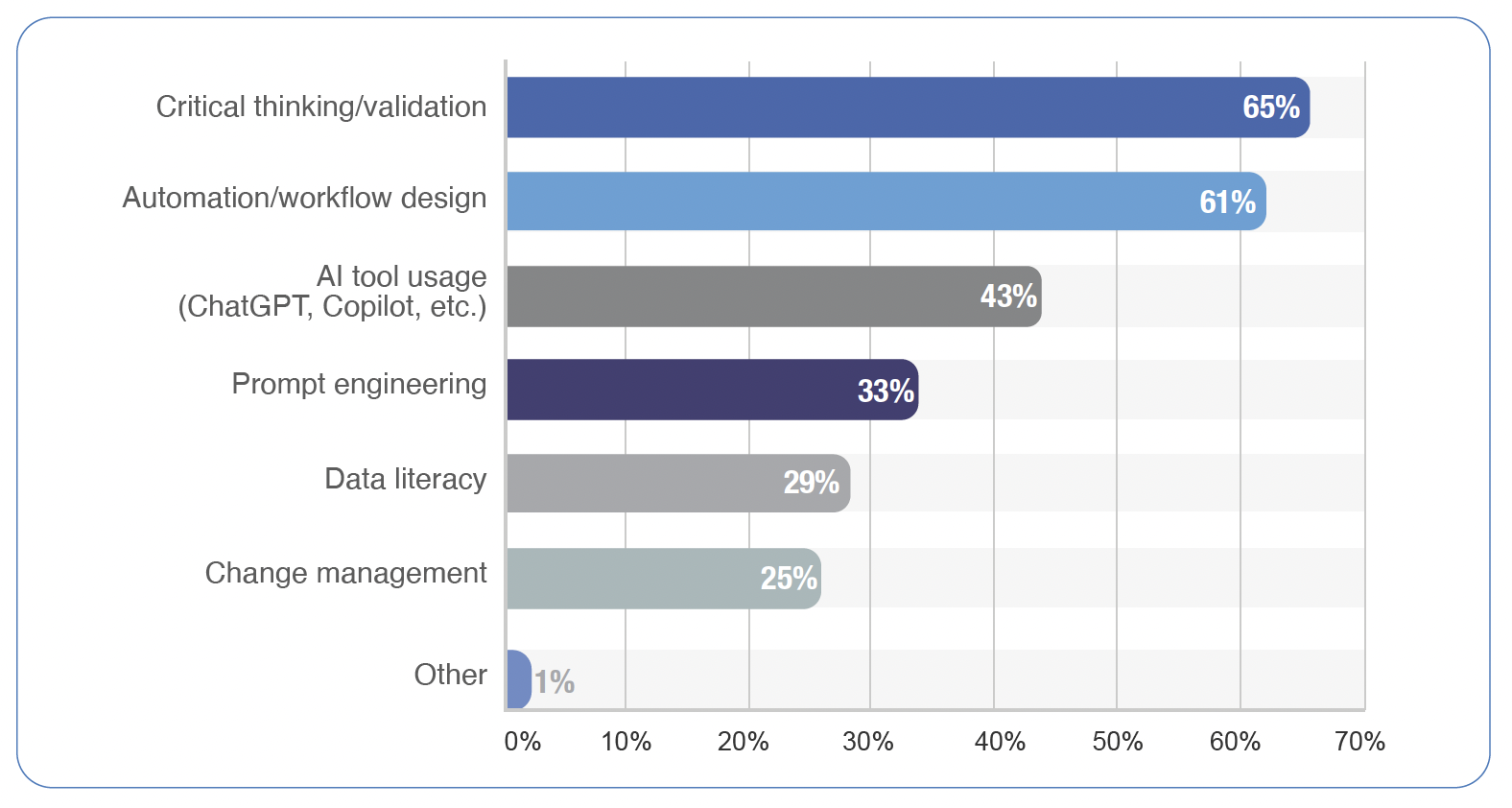
According to the 2026 Corporate AI Talent Study, executives place the greatest value on skills that help employees evaluate AI and redesign work around it. Critical thinking and validation ranks first at 65%, followed closely by automation and workflow design at 61%.
Both rank well ahead of prompt engineering at 33%.
The results suggest that the AI-ready workforce will require more than proficiency with a particular model or platform. As AI tools become easier to access and use, the capabilities that distinguish employees may increasingly involve judgment, process knowledge, and the ability to determine how AI should fit into the work itself.
Critical Thinking and Workflow Design Lead the Skills Agenda
Respondents were asked to select up to three skills they consider most critical for their workforce in the AI era. The results were:
- 65% Critical thinking and validation
- 61% Automation and workflow design
- 43% AI tool usage, including ChatGPT, Copilot, and similar applications
- 33% Prompt engineering
- 29% Data literacy
- 25% Change management
- 1% Other
The ranking provides an important picture of what organizations believe AI readiness will require.
The top two skills are not tied to a specific technology. They involve evaluating information and redesigning how work gets done.
That distinction matters.
AI platforms will change. Interfaces will evolve. Techniques that seem specialized today may become standard features tomorrow.
The ability to exercise judgment and understand processes is more durable.
AI Makes Critical Thinking More Important
It would be easy to assume that as AI becomes better at research, analysis, writing, summarization, and decision support, employees will need to perform less analytical work themselves.
The study points toward a different conclusion.
As AI performs more of the initial work, employees increasingly need to evaluate the work AI performs.
That helps explain why critical thinking and validation ranks first at 65%.
Employees need to recognize errors, question outputs, apply business context, and determine when human review remains necessary.
Consider an employee using AI to analyze a large set of information.
The technology may dramatically reduce the time required to summarize the data and identify patterns. But the employee still needs to ask whether the analysis makes sense. Are important variables missing? Does the conclusion conflict with known business conditions? Is the underlying information reliable? Has the AI confused correlation with causation? Is additional verification required before the result is used?
The same principle applies to content generation, customer interactions, financial analysis, operational recommendations, research, and other AI-supported activities.
As AI increases the speed at which work can be produced, organizations may need employees who are even better at determining whether that work deserves to be trusted.
Validation Is Becoming Part of the Job
This creates a subtle change in how many jobs may be performed.
Historically, an employee might have been responsible for researching information, developing an analysis, and presenting a recommendation.
AI can increasingly assist with the first two steps.
The employee’s role may shift toward providing context, reviewing the analysis, challenging assumptions, identifying exceptions, and making the final judgment.
In other words, part of the work moves from creation to supervision and validation.
That does not necessarily make the work easier.
Evaluating a plausible but incorrect AI-generated answer can require considerable expertise. Employees need enough subject-matter knowledge to recognize when something is wrong, even when the output appears polished and convincing.
This means organizations should be cautious about assuming AI proficiency is primarily a technology skill.
In many roles, the most important AI skill may be knowing enough about the underlying work to challenge the technology effectively.
Workflow Design Ranking at 61% Signals the Next Stage of Adoption
The second-highest result may be equally significant.
Sixty-one percent of respondents identify automation and workflow design as a critical workforce skill.
That suggests organizations are beginning to look beyond individual AI productivity.
The first wave of generative AI adoption often centered on discrete tasks: drafting an email, summarizing a document, generating ideas, researching a topic, or answering a question.
Those applications can save time, but they generally leave the broader process unchanged.
Workflow design asks a more consequential question:
If AI can perform parts of this work differently, should the entire process still operate the same way?
That can lead to much larger changes.
A process that once involved gathering information manually, transferring it between systems, preparing an analysis, routing it for review, and creating a final report may be redesigned around automation and AI.
Some steps may disappear. Others may be combined. Human review may move to a different point in the process. Exceptions may be routed automatically. Information that was previously analyzed periodically may become available continuously.
The value comes from redesigning the workflow rather than simply making one existing task faster.
The report itself notes that workflow design’s high ranking suggests organizations are moving beyond AI as a standalone productivity tool and toward embedding it in end-to-end processes.
AI Tool Usage Matters, but It Is Only Part of Proficiency
AI tool usage ranks third at 43%.
Employees clearly need practical experience with the applications relevant to their jobs. They need to know how to interact with AI, provide appropriate context, refine requests, use available features, and incorporate outputs into their work.
But the fact that tool usage ranks below critical thinking and workflow design is instructive.
Knowing how to operate an AI platform does not necessarily mean an employee knows how to use it effectively.
The distinction is similar to other workplace technologies. Knowing how to use spreadsheet software does not automatically make someone skilled in financial analysis. Knowing how to operate a business intelligence platform does not make someone an effective data analyst.
The tool provides capability. The employee still needs the expertise to apply it.
As AI interfaces become more intuitive, basic tool proficiency may also become easier to acquire.
That could make the surrounding skills increasingly valuable.
The competitive advantage may not come from employees knowing where to click. It may come from knowing what to ask, what to question, what to redesign, and what decision to make afterward.
Prompt Engineering May Be Evolving From a Specialty Into a Baseline Skill
Prompt engineering attracted enormous attention during the early expansion of generative AI.
In the Talent Study, however, only 33% of respondents identify prompt engineering as one of the most critical workforce skills, placing it fourth.
That does not mean prompting is unimportant.
Employees still need to know how to give AI systems useful instructions, provide context, structure requests, refine outputs, and communicate what they are trying to accomplish.
But the ranking suggests organizations may increasingly see prompting as one component of broader AI proficiency rather than the defining skill of an AI-ready employee. That is also the interpretation presented in the study’s findings.
The hiring results reinforce that idea. Only 3% of organizations report actively hiring Prompt Engineers or AI Specialists.
As AI systems become better at understanding natural language and interpreting user intent, highly specialized prompting techniques may also become less central to everyday usage.
The durable skill is likely to be the ability to communicate a business objective clearly, supply the right context, evaluate the response, and incorporate it into a broader workflow.
Data Literacy Remains an Important Foundation
Data literacy ranks fifth at 29%.
While it sits below the leading skills, its importance should not be underestimated.
AI systems depend heavily on information. Employees need to understand what data they are working with, where it came from, what it represents, and whether it is appropriate for the task.
An AI-generated analysis can be technically correct while still being misleading if the underlying data is incomplete, outdated, biased, or poorly structured.
Employees do not all need to become data scientists. They do need enough literacy to ask basic but consequential questions.
What information is driving this result? Is the source reliable? Is anything missing? Does the data represent the population or business condition we are trying to understand? Can this information appropriately be shared with the AI system being used?
As AI gives more employees the ability to perform sophisticated analysis without traditional technical skills, those questions may become relevant to a much broader portion of the workforce.
Change Management Is a Workforce Skill Too
Change management was selected by 25% of respondents.
It may initially seem different from the other skills on the list, but its inclusion is significant.
AI changes more than individual tasks. It can change workflows, responsibilities, decision rights, performance expectations, and relationships between teams.
Employees may need to learn new ways of working while abandoning processes they have used for years. Managers may need to redesign responsibilities. Leaders may need to explain why changes are occurring and how employees will be affected.
The ability to implement change therefore becomes part of AI readiness.
This is especially important given another finding in the study: employee adoption and training is the second-largest AI talent gap, identified by 24% of respondents.
An organization can have strong technical capabilities and well-designed AI use cases and still struggle if employees do not adopt the new processes.
AI transformation therefore requires people who can help the organization move from technical implementation to sustained behavioral change.
The Skills Work Together
Perhaps the most useful way to interpret Question #9 is not as a ranking of isolated skills.
The capabilities reinforce one another.
Imagine an operations professional redesigning a process with AI.
They need AI tool proficiency to understand what the technology can do.
They need workflow design to determine how the process should change.
They need data literacy to understand what information the system relies on.
They need prompting skills to interact effectively with generative AI.
They need critical thinking and validation to evaluate the output and determine where human oversight remains necessary.
And they may need change management to help colleagues adopt the redesigned process.
The value comes from the combination.
This is also why AI workforce development cannot be reduced to teaching employees how to use a single platform.
The objective is to develop employees who can apply AI effectively within the context of their work.
Organizations Should Build Skills Around Roles, Not Tools
The findings have important implications for training strategy.
Many organizations naturally begin AI training with the technology itself: how to use a particular assistant, model, or platform.
That is useful, particularly during initial adoption.
But the skills data suggests training programs should become broader as organizations mature.
A finance employee may need AI training built around analysis, reporting, forecasting, controls, and validation.
An operations professional may need greater emphasis on process mapping, automation, exception handling, and workflow redesign.
A manager may need to understand how to evaluate AI-assisted work, redesign responsibilities, and manage employee adoption.
A technical employee may need deeper knowledge of data, integration, governance, and business translation.
There should still be a common foundation. But beyond that foundation, AI development should increasingly reflect the work employees actually perform.
This approach also helps organizations avoid training employees in capabilities they are unlikely to use while overlooking the skills that will materially change their jobs.
AI Skills Should Be Treated as a Moving Portfolio
There is another implication for workforce planning: organizations should expect the skills mix to change.
Specific AI platforms and techniques are evolving rapidly. A capability that requires significant expertise today may become automated or built directly into enterprise software tomorrow.
That makes it risky to construct an entire workforce strategy around today’s tools.
Organizations need a portfolio of skills that combines current technical proficiency with more durable capabilities.
The study’s two leading skills provide a useful example.
Critical thinking and validation are valuable regardless of which AI model generates the output.
Workflow design remains valuable regardless of which platform automates the process.
These capabilities travel with the employee as technology changes.
That does not eliminate the need for platform-specific training. It changes how organizations should balance their investment.
Employees need enough knowledge of today’s tools to be productive and enough durable capability to adapt when those tools inevitably change.
What This Means for AI Leaders
Question #9 provides one of the clearest signals in the study about what an AI-ready workforce may actually look like.
It is not defined primarily by deep technical expertise or mastery of a particular AI interface.
Organizations place the greatest value on employees who can think critically about AI outputs and redesign work around AI capabilities.
For AI leaders, that raises several practical questions:
- Does our AI training emphasize judgment as much as tool usage?
- Are employees taught how to validate AI-generated information?
- Do teams understand how to redesign workflows rather than simply add AI to existing tasks?
- Which roles require stronger data literacy?
- Are we treating prompt engineering as one skill within broader AI proficiency?
- Do managers have the change-management capabilities required to lead AI-enabled teams?
- Are training investments tied to how individual jobs are actually changing?
- Are we developing skills that will remain valuable as AI platforms evolve?
The organizations that answer those questions well may be better prepared for a technology environment that will continue to change rapidly.
The specific AI tools employees use in 2028 may look very different from those they use today.
The ability to question an output, understand a process, redesign work, apply business context, and exercise sound judgment will remain valuable regardless.
That may ultimately be the most important message in the skills data: the AI-ready workforce will be defined as much by how people think and redesign work as by how well they operate AI technology.
Explore the Full 2026 Corporate AI Talent Study
Workforce skills are one part of the broader AI talent challenge. The 2026 Corporate AI Talent Study examines how more than 300 executives are approaching AI adoption, talent strategy, specialized hiring, skills gaps, employee confidence, training, job redesign, and future workforce planning.
Download the full 2026 Corporate AI Talent Study to explore the complete findings and benchmark the skills your organization will need to build an AI-ready workforce.