
As part of our continued deep dive into the 2026 Corporate AI Outlook Study, we are examining what organizations are actually trying to achieve with AI in the coming year. While adoption patterns and investment priorities provide important context, business objectives offer the clearest signal of how leaders define success.
In this post, we focus on the top outcomes organizations expect AI to deliver in 2026 and what those expectations reveal about how AI strategies are evolving.
Productivity and efficiency lead AI objectives
Survey results show that workforce augmentation and productivity are the most frequently cited objectives for AI in 2026, followed closely by cost reduction and efficiency gains. Customer experience and engagement also rank highly, while faster innovation and revenue growth appear as secondary goals.
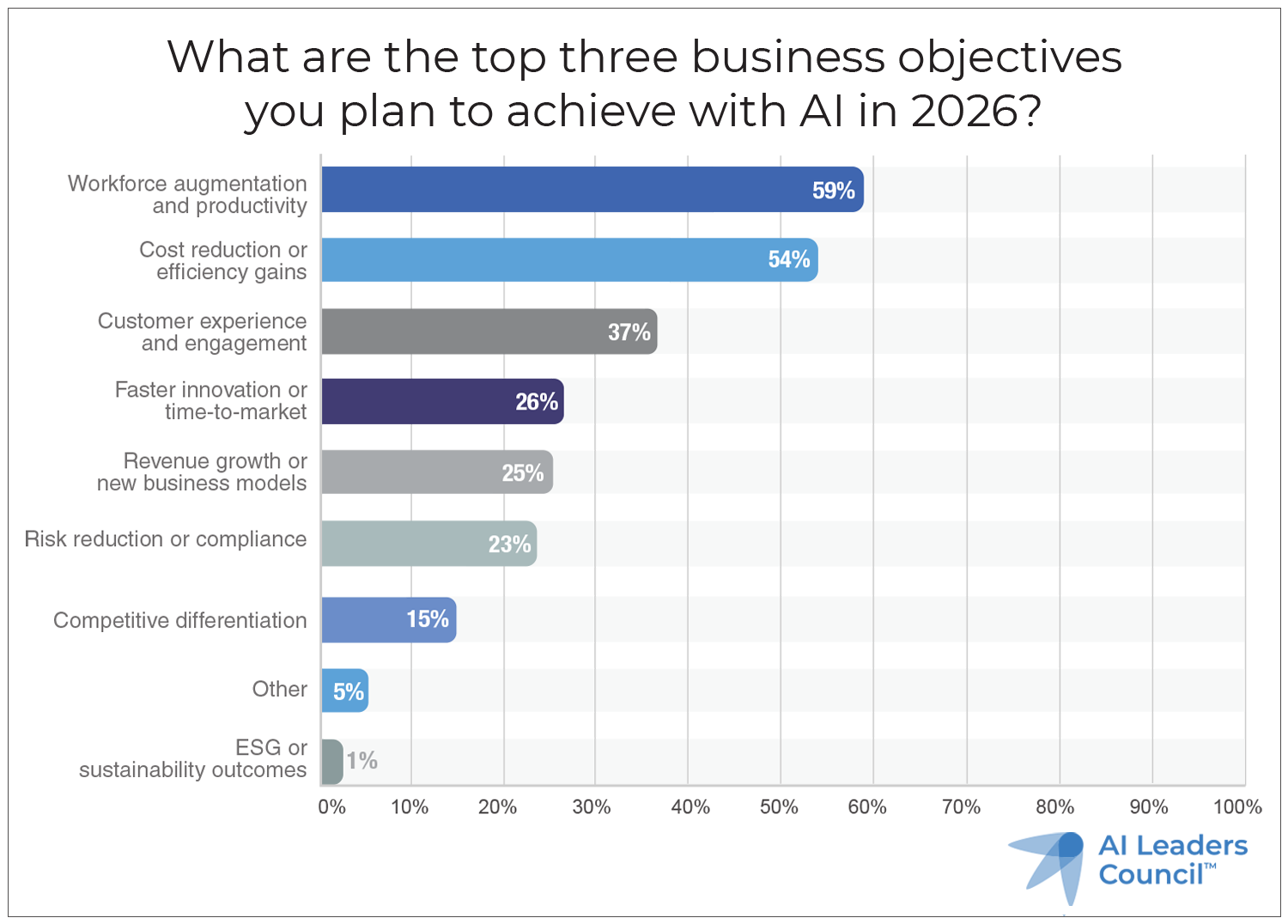
This ordering is telling. Organizations are prioritizing improvements to how work gets done before pursuing broader transformation. AI is being positioned as a practical tool to support employees, reduce friction, and improve execution across existing processes.
- Workforce augmentation and productivity: 59%
- Cost reduction or efficiency gains: 54%
- Customer experience and engagement: 37%
- Faster innovation or time-to-market: 26%
- Revenue growth or new business models: 25%
- Risk reduction or compliance: 23%
- Competitive differentiation: 15%
- Other: 5%
- ESG or sustainability outcomes: 1%
Growth ambitions are present, but sequenced
Revenue growth, new business models, and competitive differentiation appear lower on the list of near-term objectives. This does not suggest that leaders lack ambition. Instead, it reflects a deliberate sequencing of goals.
Many organizations appear focused on stabilizing operations, building confidence, and proving value internally before using AI as a driver of external growth. Establishing reliable performance improvements creates a foundation for more ambitious initiatives over time.
AI ROI expectations are becoming more disciplined
As AI investment increases, leaders are placing greater emphasis on outcomes that can be observed, measured, and sustained. Productivity improvements, cost savings, and service enhancements are easier to validate than speculative growth projections.
“If there is no ROI, it’s science fiction. You end up with an expensive toy.”
This perspective reinforces why organizations are anchoring AI objectives in operational value. Leaders are increasingly accountable for demonstrating that AI contributes meaningfully to business performance.
What this means for AI strategy
The objectives highlighted in the study suggest a shift in how AI is governed and evaluated. Rather than treating AI as a standalone innovation initiative, organizations are integrating it into performance conversations, budgeting decisions, and operational planning.
AI leaders who align initiatives with clearly defined business outcomes are better positioned to maintain executive support and scale successful use cases across the organization.
See how objectives align with AI investment and risk
The 2026 Corporate AI Outlook Study from the AI Leaders Council connects business objectives to adoption patterns, investment priorities, and risk considerations across organizations. Download the full report to understand how AI leaders are defining success for 2026 and beyond.