
As part of our continued deep dive into the 2026 Corporate AI Outlook Study, we are examining how AI leaders expect adoption to evolve by business function. Looking at where organizations plan to expand next provides useful insight into priorities, readiness, and how leaders are sequencing AI investment.
In this post, we focus on which functions are expected to see the largest increase in AI adoption in 2026 and what those expectations reveal about how organizations are thinking about scale.
Operations and IT remain at the center of AI expansion
Survey results show that operations and IT are expected to see the largest increases in AI adoption in 2026, followed closely by customer service and sales and marketing. These functions tend to offer clearer opportunities for efficiency gains, automation, and measurable improvement.
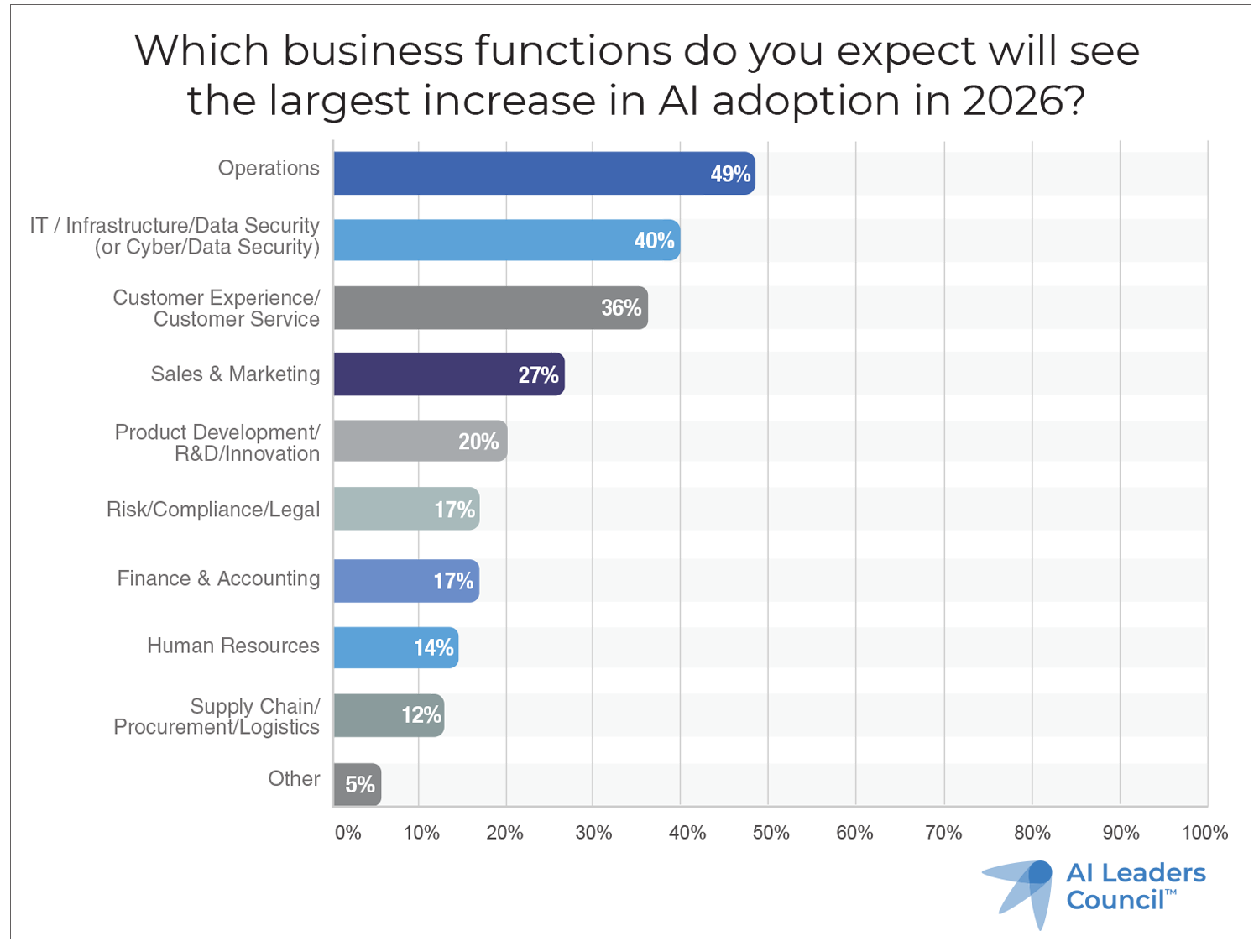
This pattern reflects a continuation of current adoption dynamics. Organizations are expanding AI where data is already accessible, workflows are repeatable, and outcomes can be evaluated without introducing excessive risk.
- Operations: 49%
- IT / Infrastructure / Data Security (or Cyber/Data Security): 40%
- Customer Experience / Customer Service: 36%
- Sales & Marketing: 27%
- Product Development / R&D / Innovation: 20%
- Risk / Compliance / Legal: 17%
- Finance & Accounting: 17%
- Human Resources: 14%
- Supply Chain / Procurement / Logistics: 12%
- Other: 5%
Customer-facing functions are gaining AI momentum
Customer service and sales and marketing rank high among functions expected to increase AI use. Leaders are increasingly comfortable applying AI to areas that affect responsiveness, personalization, and speed, particularly when AI supports employees rather than replacing human interaction.
This momentum reflects growing interest in practical, use-case-driven approaches to customer-facing AI. Rather than focusing on abstract capability, organizations are prioritizing how AI can be embedded into real workflows that improve service quality and decision-making.
For a deeper look at how organizations are moving from experimentation to execution in customer-facing AI, we recently hosted a webinar titled From Hype to Action: How to Build with Agentic AI the Right Way. The discussion explores real-world implementation considerations, governance, and common pitfalls when deploying AI agents in customer-facing environments.
Regulated and people-centric functions remain more cautious
Finance, risk, compliance, and human resources appear lower on the list of expected acceleration. This does not indicate lack of interest. Instead, it reflects the additional scrutiny required when AI influences financial decisions, regulatory obligations, or people management.
Trust, explainability, and accountability remain gating factors in these areas. Many organizations are taking a deliberate approach, focusing on governance and policy development before expanding AI use more broadly.
Uneven AI adoption creates coordination challenges
As AI adoption accelerates in some functions faster than others, organizations face a coordination challenge. Disparate adoption can lead to inconsistent governance, fragmented data usage, and uneven employee experience if not managed intentionally.
Leaders who anticipate this dynamic can take steps to align adoption across functions. Shared standards, cross-functional communication, and clear ownership help ensure that AI scales in a way that supports the organization as a whole rather than creating silos.
Planning for function-specific AI expansion
Understanding which functions are likely to accelerate next helps leaders prioritize investment, education, and governance efforts. The 2026 Corporate AI Outlook Study examines these adoption patterns in detail and connects them to broader investment and risk considerations. Download the full report from the AI Leaders Council to see where AI adoption is expected to grow and how leaders are preparing for function-specific scale in 2026.