
As part of our ongoing deep dive into the 2026 Corporate AI Outlook Study, we are examining how organizations are prioritizing AI investment heading into 2026. Understanding where leaders plan to allocate resources provides important context for how AI strategies are maturing beyond experimentation.
In this post, we focus on the types of AI applications leaders identify as top investment priorities and what those choices reveal about how organizations are defining value.
AI investment favors applied, operational use cases
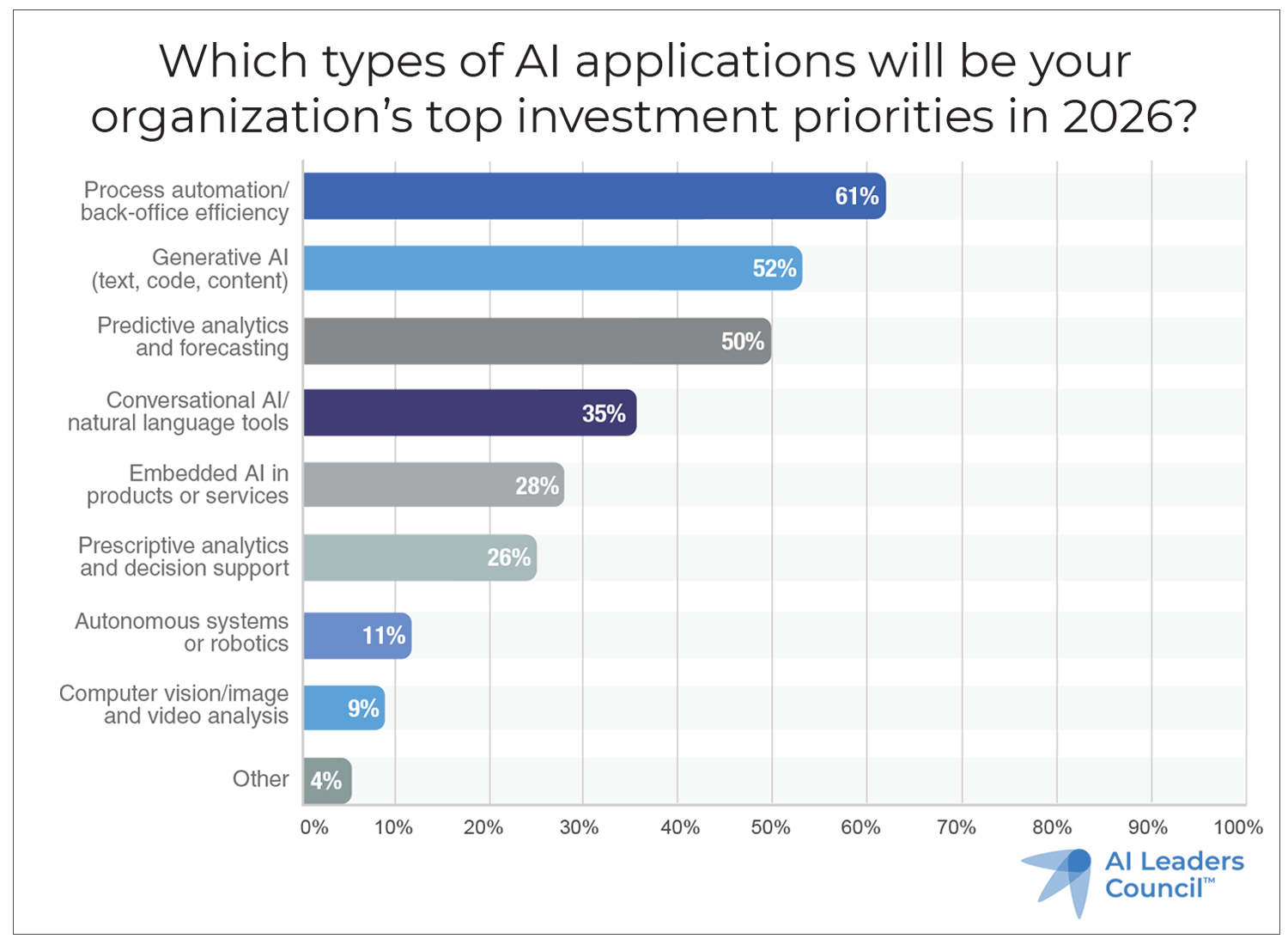
Survey results show that AI investment is concentrated in practical applications that support day-to-day operations. Process automation, generative AI, and predictive analytics rank highest among planned investment areas. These categories reflect use cases that can be embedded directly into existing workflows and deliver measurable efficiency or decision support.
Rather than pursuing highly specialized or experimental technologies, organizations appear focused on applications that improve productivity, reduce manual effort, and support better outcomes across teams.
- Process automation / back-office efficiency: 61%
- Generative AI (text, code, content): 52%
- Predictive analytics and forecasting: 50%
- Conversational AI / natural language tools: 35%
- Embedded AI in products or services: 28%
- Prescriptive analytics and decision support: 26%
- Autonomous systems or robotics: 11%
- Computer vision / image and video analysis: 9%
- Other: 4%
Generative AI is being positioned as an enablement tool
Strong interest in generative AI reflects its growing role in supporting knowledge work. Leaders are investing in tools that assist with drafting, summarization, analysis, and information retrieval, particularly where these capabilities can augment employees rather than replace them.
This positioning matters. Organizations that frame generative AI as a support mechanism tend to focus earlier on governance, training, and appropriate usage. This helps avoid unrealistic expectations while still capturing meaningful value.
Decision support remains a priority alongside automation
Predictive and decision-support applications continue to attract investment as leaders look to improve forecasting, planning, and operational decision-making. These use cases often rely on existing data assets and can deliver value without introducing significant process disruption.
The combination of automation and decision support suggests that organizations are pursuing balance. AI is being used both to remove friction from routine tasks and to improve judgment where complexity remains.
What is not driving AI investment yet
More specialized applications, including robotics and advanced computer vision, appear lower on the priority list for many organizations. This does not indicate a lack of interest, but rather a focus on readiness. These technologies often require greater integration effort, higher capital investment, and more mature operating environments.
Leaders appear to be sequencing investment deliberately, prioritizing foundational capabilities before expanding into more complex domains.
Aligning investment with AI readiness
The investment patterns highlighted in the study suggest that AI leaders are becoming more selective. Capital is flowing toward use cases that can scale across the organization and be governed consistently.
The 2026 Corporate AI Outlook Study from the AI Leaders Council examines how these investment priorities connect to adoption maturity, business objectives, and risk considerations. Download the full report to see how AI leaders are aligning investment decisions with practical outcomes in 2026.