
Following the release of our 2026 Corporate AI Outlook Study, we are continuing a deeper review of the findings by exploring individual questions and their implications for AI leaders. This approach allows us to move beyond headline statistics and focus on what the data suggests about real-world adoption patterns.
In this post, we look at which business functions are using AI today and which areas are moving more cautiously. Understanding where AI is already embedded, and where it is not, provides important insight into organizational readiness, governance considerations, and where leadership attention is most needed as adoption expands
AI adoption starts where data and automation already exist
AI is not being adopted evenly across organizations. According to the 2026 Corporate AI Outlook Study, usage is most concentrated in IT, infrastructure, data, and security functions, followed by operations, sales, and customer-facing teams.
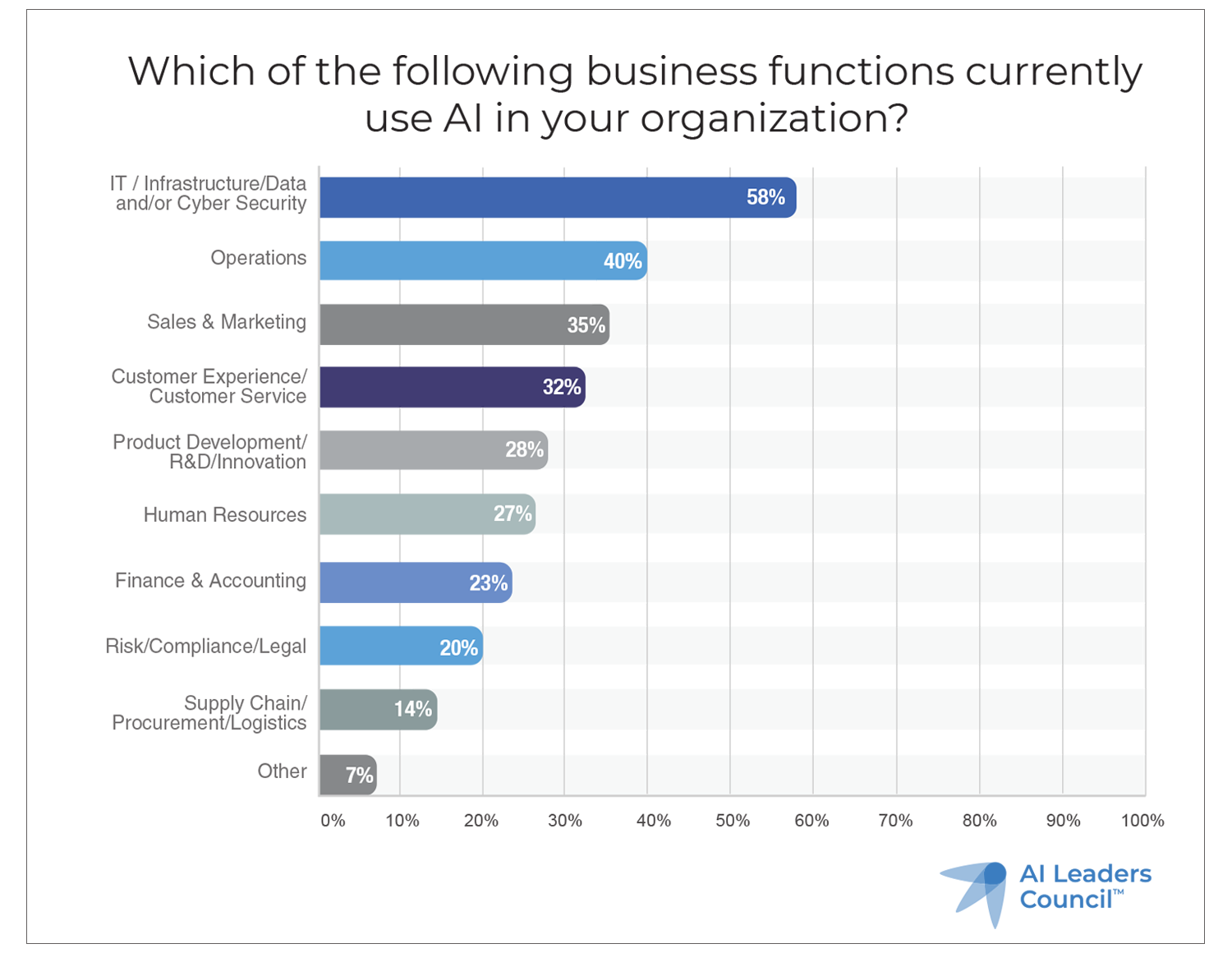
These functions tend to have stronger data foundations, clearer automation opportunities, and existing familiarity with advanced technologies. As a result, they often become early adopters and internal proof points for AI value.
- IT / Infrastructure / Data and/or Cyber Security: 58%
- Operations: 40%
- Sales & Marketing: 35%
- Customer Experience / Customer Service: 32%
- Product Development / R&D / Innovation: 28%
- Human Resources: 27%
- Finance & Accounting: 23%
- Risk / Compliance / Legal: 20%
- Supply Chain / Procurement / Logistics: 14%
- Other: 7%
Why some functions move slower
Finance, human resources, and compliance functions show lower levels of AI adoption. This does not necessarily indicate resistance. Instead, it reflects higher requirements for accuracy, explainability, and governance. Decisions in these areas often carry regulatory, financial, or people-related implications that demand greater confidence in AI outputs.
Without clear policies, auditability, and accountability, leaders are understandably cautious about expanding AI into these domains. As a result, adoption tends to follow readiness rather than enthusiasm.
The risk of uneven AI adoption
When AI adoption accelerates in some functions but not others, organizations can experience fragmentation. Teams may develop AI-enabled workflows independently, creating inconsistencies in governance, data usage, and risk management.
Leaders who anticipate this dynamic can take steps to align adoption across functions. Establishing shared governance standards, investing in education, and encouraging cross-functional collaboration can help ensure AI scales in a coordinated way.
Planning for broader AI adoption
Understanding where AI is used today provides insight into where it is likely to expand next. The 2026 Corporate AI Outlook Study examines which functions leaders expect to see the largest increase in AI adoption in 2026 and why. Download the full report to see how AI usage is evolving across the organization and where leadership attention is most needed.