
As part of our continued deep dive into the 2026 Corporate AI Outlook Study, we are examining individual survey questions to better understand how AI is translating into business results. While many organizations have active AI initiatives underway, leaders continue to ask a familiar question: is AI actually delivering meaningful impact?
In this post, we focus on how executives assess the business impact of their current AI initiatives and why value is often real but difficult to see.
Most organizations report moderate or unclear AI impact
The study shows that most organizations describe the impact of their AI initiatives as moderate or limited to specific areas. Only a small percentage report AI delivering transformative results across the enterprise.
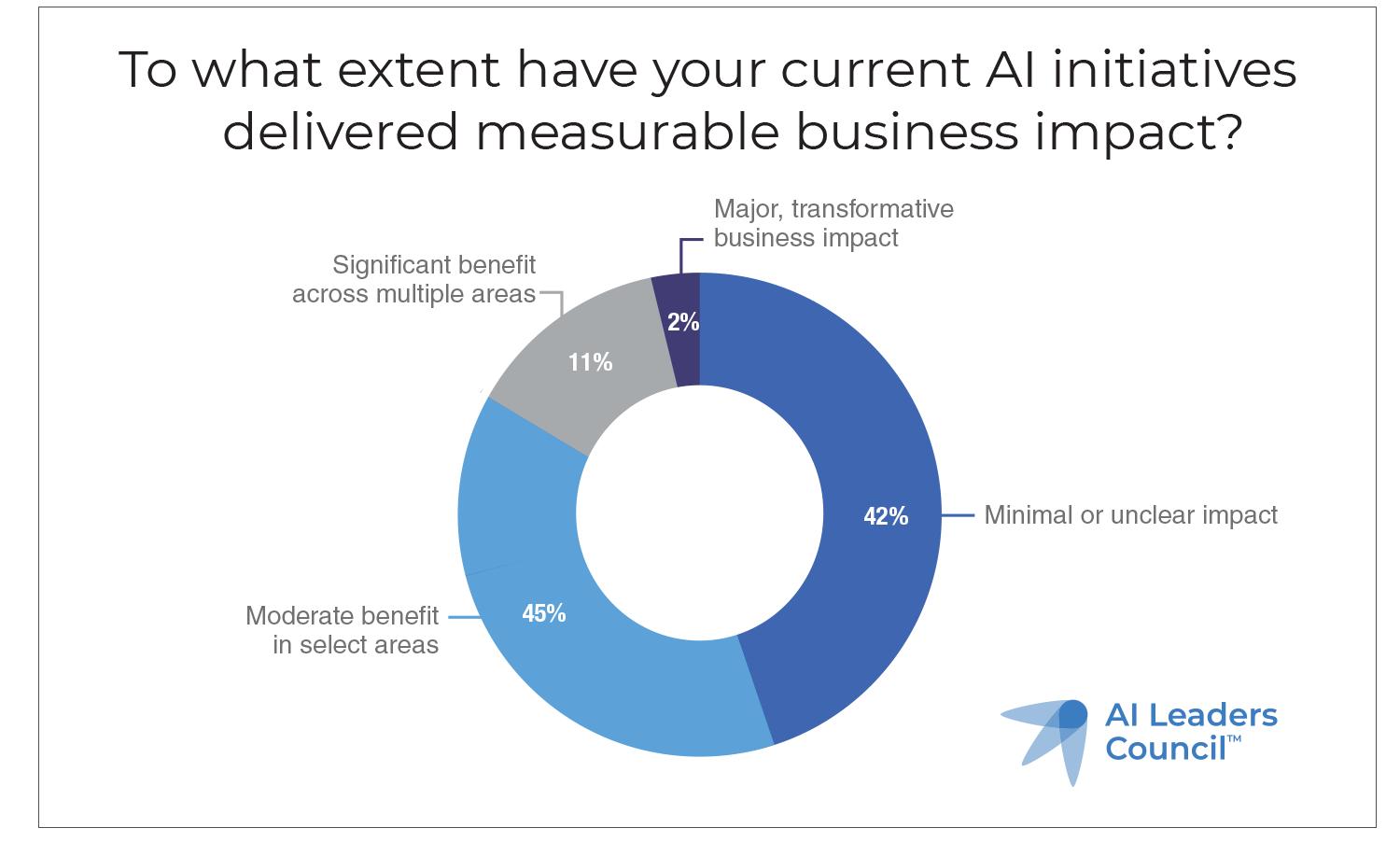
This does not indicate failure. Instead, it reflects how AI value typically emerges. Early impact is often concentrated within individual workflows, teams, or processes rather than across entire business units. These gains can be meaningful, but they do not always register as headline transformation.
- Minimal or unclear impact: 42%
- Moderate benefit in select areas: 45%
- Significant benefit across multiple areas: 11%
- Major, transformative business impact: 2%
Why AI value is hard to measure
AI frequently improves speed, accuracy, or effort in ways that reduce friction rather than create visible output. When work takes less time, requires fewer manual steps, or happens automatically, the benefit can disappear into daily operations.
In many organizations, measurement frameworks have not yet caught up to these changes. Without clear baselines, ownership, and outcome definitions, leaders struggle to translate efficiency gains into metrics that resonate across the organization.
Operational improvements often happen behind the scenes
Some of the most effective AI use cases focus on process-heavy work that was previously time-consuming and repetitive. These improvements may not change how work looks externally, but they can materially affect capacity, responsiveness, and risk.
“When we talk about impact, I think the most obvious early benefits tend to come from behind-the-scenes, process-oriented solutions. Things like scanning thousands of engagement letters, validating signatures, pulling key terms, and moving that information into our systems automatically. That work used to take an enormous amount of time, and now it happens in the background. The impact is huge, but it’s not always visible.”
AI Innovators: A Conversation with OJ Laos, Director of AI, Armanino
This perspective reinforces why many leaders report progress without describing it as transformational. Value is present, but it is embedded within operations rather than showcased as a single initiative.
Moving from activity to sustained AI impact
As AI adoption expands, organizations will need stronger discipline around defining success and scaling what works. This includes identifying which use cases should be measured at the task level versus the business level, assigning ownership, and revisiting metrics as processes change.
Leaders who treat early AI initiatives as learning opportunities, rather than final outcomes, are better positioned to compound value over time. Incremental gains can become material when they are repeated, standardized, and extended across functions.
See how leaders are measuring AI impact
The 2026 Corporate AI Outlook Study explores how organizations assess AI impact and how expectations are evolving as adoption matures. Download the full report to see how AI leaders are connecting investment to measurable outcomes heading into 2026.