As organizations expand their use of artificial intelligence, they face a fundamental workforce question: Where will the necessary AI talent come from?
For years, much of the conversation around AI talent focused on recruiting specialists. AI engineers, machine learning experts, data scientists, and other technical professionals were viewed as essential resources for organizations seeking to build AI capabilities.
The 2026 Corporate AI Talent Study suggests that organizations are taking a broader approach.
When asked to describe their AI talent strategy, 44% of respondents identified upskilling existing employees as their primary approach, making it the most common strategy by a considerable margin. Another 17% are combining external hiring with internal development.
Only 4% say their primary strategy is hiring external AI talent. At the same time, a significant 33% still have no defined AI talent strategy at all.
The findings point toward an important shift in how organizations are thinking about AI talent. For many, building an AI-ready workforce will be less about assembling a separate team of AI specialists and more about developing new capabilities within the workforce they already have.
Organizations Are Looking Inward for AI Talent
The full results show a clear preference for internal workforce development:
- 44% are upskilling existing employees
- 33% have no defined AI talent strategy
- 17% are using a combination of hiring and upskilling
- 4% primarily hire external AI talent
- 2% report AI skills are embedded across all roles
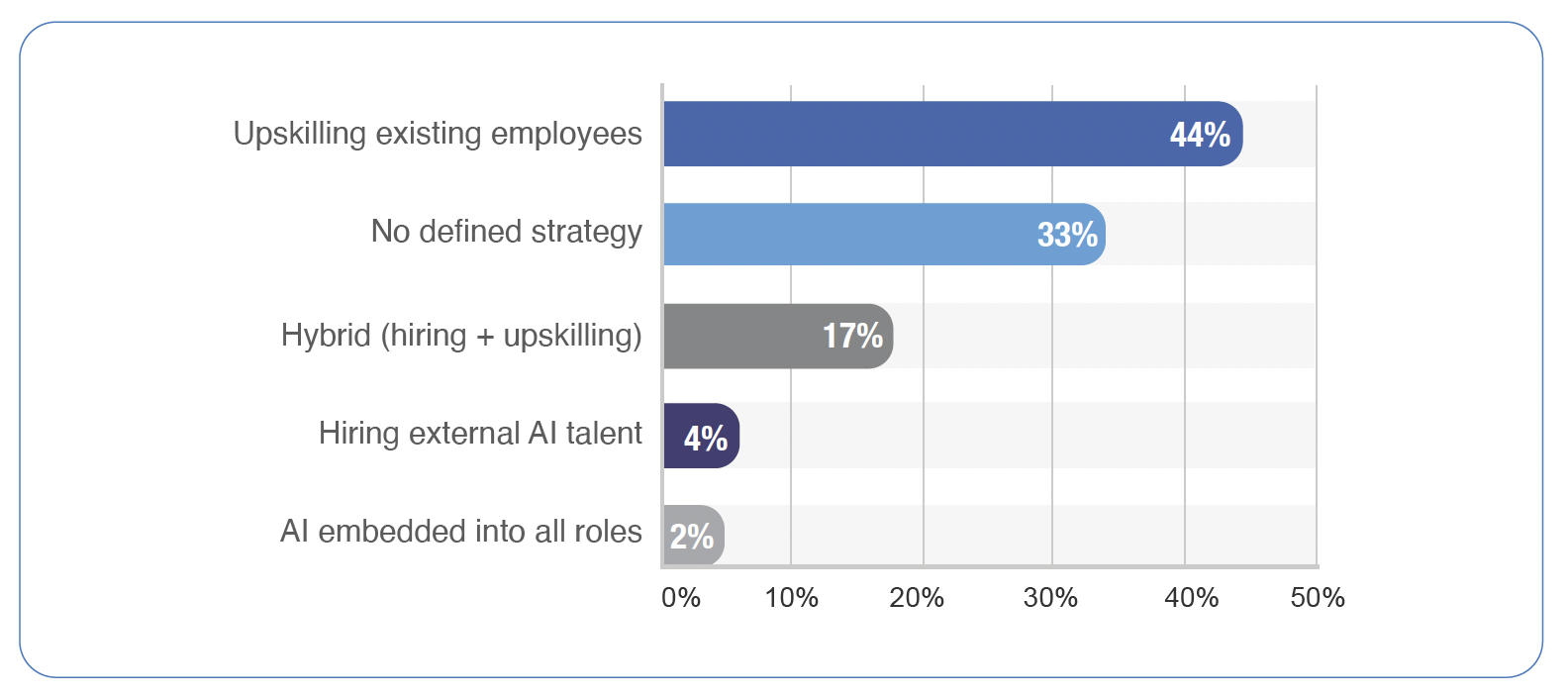
The contrast between upskilling and external hiring is particularly notable.
For every organization primarily looking outside for AI talent, many more are looking at the employees already inside the business.
This does not mean specialized AI hiring is becoming unnecessary. Organizations developing complex AI systems will continue to need engineers, data scientists, governance professionals, and other specialists.
But the scale of the workforce transformation created by AI makes recruiting alone an impractical solution.
AI is already being used across IT and engineering, operations, executive decision-making, sales and marketing, finance and accounting, customer support, and HR. As its use expands, organizations will need AI capability across many different job functions rather than within a small collection of technical positions.
That fundamentally changes the talent equation.
The Existing Workforce Has Something AI Specialists Often Do Not
One reason upskilling makes sense is that effective AI adoption requires more than knowledge of AI.
It also requires knowledge of the organization.
Existing employees understand customers, products, internal systems, workflows, regulations, historical decisions, exceptions, and the informal processes that keep the business operating. Much of this knowledge can take years to develop.
That institutional knowledge becomes particularly valuable when organizations try to determine where AI should actually be applied.
A finance employee may recognize that a seemingly repetitive process contains important controls and exceptions. An operations manager may know why a workflow that appears inefficient was designed a certain way. A customer service employee may understand which situations can be automated and which require human intervention.
Technical AI expertise alone does not necessarily provide that context.
Upskilling allows organizations to add AI capabilities to existing business expertise rather than attempting to recreate business expertise inside a newly hired AI team.
This interpretation is supported by another important finding from the study. When respondents were asked to identify their largest AI talent gap, business translation and use-case design ranked first at 31%, ahead of technical expertise in machine learning and engineering at 15%.
The shortage organizations are experiencing is therefore not exclusively a shortage of people who understand AI. It is also a shortage of people who can connect AI to meaningful business problems.
Upskilling Does Not Mean Turning Everyone Into an AI Expert
There is a potential trap in the upskilling discussion.
If organizations conclude that AI will affect nearly every function, they may assume every employee needs extensive AI training.
That is unlikely to be an effective strategy.
The capabilities required will vary substantially by role.
Some employees may need foundational AI literacy: understanding what approved tools are available, how organizational policies apply, what information can safely be shared, and how to evaluate AI-generated outputs.
Others may need much deeper capabilities in workflow design, automation, data, governance, model evaluation, or AI implementation.
Managers may need to understand how AI changes responsibilities, productivity expectations, and team structure. Executives may need sufficient AI literacy to evaluate investments, risks, and AI-supported decisions.
Technical specialists will require another level of expertise entirely.
An effective upskilling strategy therefore should not be defined simply by the number of employees who complete an AI course. It should begin with roles and work.
Which jobs are changing? Which tasks can be augmented or automated? Which employees will regularly interact with AI? Which employees will design AI-enabled processes? Who will validate outputs? Who is accountable when AI contributes to a decision?
The answers should determine what skills are developed and where.
The Skills Data Supports a Broader Definition of AI Talent
The study provides additional evidence that AI workforce development should extend beyond technical instruction.
When respondents were asked which skills will be most critical for their workforce in the AI era, critical thinking and validation ranked first at 65%, followed closely by automation and workflow design at 61%.
AI tool usage ranked third at 43%, while prompt engineering was selected by 33%.
This ordering is significant.
The two highest-ranked capabilities involve judgment and the redesign of work rather than proficiency with a particular AI model or platform.
As AI tools become easier to use, the differentiating skill may increasingly be knowing what to do with them.
Can an employee recognize an appropriate use case? Can they rethink a process rather than simply perform the same process slightly faster? Can they determine whether an AI-generated answer is credible? Can they apply business context that the model does not have? Can they identify when human intervention is necessary?
These capabilities often build naturally on expertise employees already possess.
That makes upskilling more than a response to an external AI talent shortage. It can be a deliberate strategy for combining AI capabilities with existing institutional knowledge.
But There Is a Major Gap Between Strategy and Execution
The 44% prioritizing upskilling is encouraging. Other findings in the study, however, raise an important question:
Are organizations investing enough in workforce development to make that strategy work?
Only 37% of respondents provide formal AI training. Of those, 17% provide formal training company-wide and 20% limit formal programs to selected roles. Another 42% rely on informal or ad hoc training, while 21% provide no AI training.
The disconnect becomes even clearer when employees are asked how they are developing AI capabilities in practice.
A majority 56% are primarily self-taught. Internal training programs account for only 23% of primary AI learning, followed by peer learning at 10%, external certifications at 7%, and vendor training at 4%.
Taken together, the findings expose a potential weakness in the upskilling strategy.
Organizations say they intend to build AI capability internally, but much of that development is still occurring informally and independently.
That may be sufficient during experimentation. It becomes harder to sustain as AI moves into production and employees begin relying on it for consequential business processes.
Upskilling Needs to Become an Operating Capability
Organizations may need to rethink what “upskilling” means.
Providing access to an AI platform and encouraging employees to experiment is not the same as developing an AI-ready workforce.
Neither is offering a single introductory course.
A mature internal development strategy is likely to require several layers.
Employees need foundational knowledge of AI, organizational policies, data security, appropriate use, and validation. Individual functions need more specific instruction tied to their workflows and business requirements. Advanced users may require deeper development in automation, use-case design, governance, data, or implementation.
Organizations also need mechanisms for turning individual learning into institutional learning.
If one employee discovers an effective way to automate a recurring process, how does that knowledge reach others? If a department identifies a failed use case, how does another team avoid repeating it? If employees develop better methods for validating AI outputs, how are those practices standardized?
This is where communities of practice, internal use-case libraries, role-based learning paths, peer education, and centers of excellence can become important.
The objective is not simply to make employees more knowledgeable about AI. It is to build a system that continuously develops and distributes AI capability as the technology and the work evolve.
The 33% Without a Talent Strategy May Face the Greatest Risk
While upskilling leads the results, the second-largest response deserves just as much attention.
One-third of organizations have no defined AI talent strategy.
That figure becomes more consequential when considered alongside the study’s adoption results.
More than half of respondents already have AI operating in production in some capacity. AI implementation is therefore moving ahead at many organizations even though the corresponding workforce strategy has not yet been established.
This creates the possibility of a widening readiness gap.
Organizations may deploy more tools and automate more processes while employees remain uncertain about how their roles will change. Managers may be expected to lead AI-enabled teams without clear guidance. Skills requirements may evolve faster than learning programs. Individual departments may develop their own approaches without an enterprise workforce plan.
Eventually, those gaps can become constraints on adoption itself.
The technology may be ready to scale while the organization is not.
Hiring and Upskilling Should Not Be Viewed as Opposing Strategies
The findings should not be interpreted as an argument against external AI hiring.
In many cases, organizations will need both.
Highly specialized AI engineering, data, architecture, security, governance, and model-development requirements may be difficult or inefficient to develop entirely from within. External hires can introduce expertise that does not currently exist inside the organization.
At the same time, those specialists cannot independently create AI capability across every business function.
The more useful question is therefore not “Should we hire or upskill?”
It is “Which capabilities should we build internally, and which should we acquire?”
That decision should be based on the organization’s AI strategy, existing workforce capabilities, technology environment, and the roles AI is expected to play.
The 17% already pursuing a combined hiring-and-upskilling strategy may provide an early indication of how more mature AI talent models develop.
Specialists can provide depth where depth is required. Upskilling can provide breadth across the organization.
What This Means for AI Leaders
The dominance of upskilling signals an important evolution in enterprise AI strategy.
Organizations increasingly recognize that becoming AI-ready is not primarily a recruiting exercise. It is a workforce transformation challenge.
For AI leaders, that means talent planning should become part of AI planning from the beginning.
Before deploying or scaling a new AI capability, leaders should be asking:
- Which employees and roles will be affected?
- What capabilities already exist within those teams?
- What new skills will employees need?
- Which skills can realistically be developed internally?
- Where is specialized external talent required?
- Is training tied to actual roles and workflows?
- How will successful practices spread across the organization?
- How will job expectations and career paths evolve as employees develop AI capabilities?
The study suggests that organizations are already moving toward an internal development model. The next challenge is making that model deliberate.
Upskilling cannot simply mean asking employees to learn AI. It needs to become a structured workforce strategy connected directly to where and how the organization intends to use AI.
Organizations that make that connection will be better positioned to preserve valuable institutional knowledge while building the new capabilities required for an AI-enabled business.
Explore the Full 2026 Corporate AI Talent Study
Upskilling is only one part of the evolving AI talent landscape. The 2026 Corporate AI Talent Study examines how more than 300 executives are approaching AI adoption, talent strategy, specialized hiring, skills gaps, employee confidence, training, job redesign, and future workforce planning.
Download the full 2026 Corporate AI Talent Study to explore the complete findings and benchmark your organization’s approach to building an AI-ready workforce.