Much of the discussion about artificial intelligence and employment has focused on layoffs. Yet organizations may be anticipating a different, and potentially more gradual, change in workforce demand.
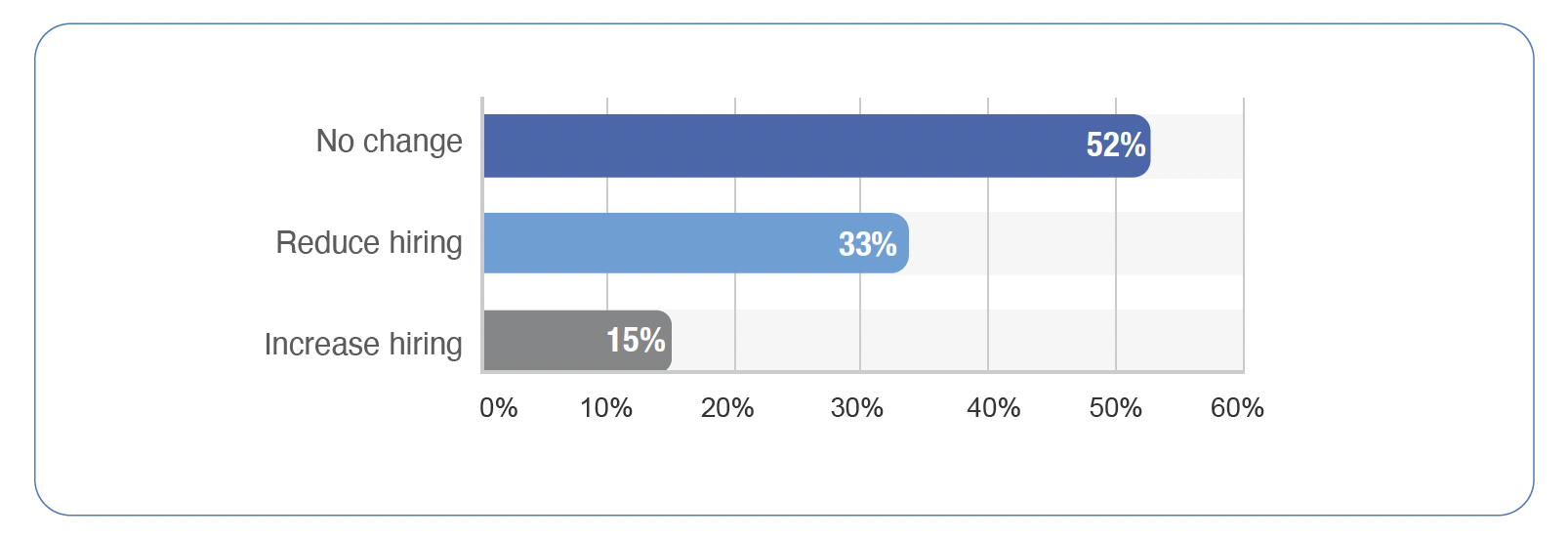
According to the 2026 Corporate AI Talent Study, 33% of respondents expect AI to reduce hiring over the next two years, compared with only 15% who expect AI to increase hiring. A majority, 52%, anticipate no overall change.
That means organizations expecting a hiring impact are more than twice as likely to anticipate needing fewer new employees as they are to expect AI to create additional hiring demand.
This finding becomes particularly interesting when compared with AI’s impact on today’s workforce. Only 6% of organizations currently report headcount reductions due to AI.
The emerging workforce story may therefore be less about organizations eliminating large numbers of existing positions and more about needing fewer additional employees as AI increases the capacity of the workforce already in place.
Most Organizations Still Expect No Change in Hiring
When respondents were asked how they expect AI to affect hiring over the next two years, the results were:
- 52% No change
- 33% Reduce hiring
- 15% Increase hiring
The majority response deserves attention.
Despite rapid advances in AI and widespread predictions about its impact on employment, more than half of respondents do not expect AI to change their organization’s overall hiring requirements during the next two years.
That suggests organizations are approaching AI’s workforce implications with more restraint than some public narratives might imply.
AI will also affect organizations differently. Some functions contain substantial amounts of repeatable, information-intensive work that can be automated or accelerated. Others depend more heavily on specialized expertise, relationships, physical activity, complex judgment, or regulatory oversight.
Even within the same company, AI could reduce hiring requirements in one department while creating demand for new skills or positions elsewhere.
The overall workforce impact is unlikely to be uniform.
The 33% Expecting Reduced Hiring May Be the More Important Signal
While 52% expect no change, the imbalance among organizations expecting an impact is notable.
Thirty-three percent expect AI to reduce hiring, compared with 15% expecting it to increase hiring.
That does not necessarily mean organizations are planning workforce reductions.
It could mean something more subtle.
Consider an organization that historically needed to add five employees whenever a particular business unit reached a certain level of growth.
If AI enables the existing team to process more transactions, analyze more information, support more customers, or complete administrative work more efficiently, the organization may be able to reach the same growth milestone while adding only two or three employees.
Nobody has been replaced.
But several future hires may no longer be necessary.
At scale, that distinction could have significant implications for workforce planning.
AI May Affect Hiring Before It Affects Headcount
The Talent Study provides an important comparison between current workforce impact and expected future hiring.
Only 6% of respondents currently report that AI is reducing headcount. Yet 33% expect AI to reduce hiring over the next two years. The report notes that organizations may be anticipating productivity improvements that allow existing teams to absorb additional work, replace fewer departing employees, or support growth without increasing staffing at historical rates.
This may be one of the most consequential ways AI affects employment in the near term.
Organizations do not necessarily need to eliminate existing jobs to change their workforce trajectory.
They can reduce hiring through attrition.
They can decide not to backfill every departing employee.
They can increase the number of customers or transactions supported by an existing team.
They can delay hiring that previously would have occurred at a particular growth threshold.
They can consolidate responsibilities as AI reduces the administrative burden within multiple roles.
Each decision may appear relatively small on its own. Collectively, they can materially change future workforce demand.
Historical Staffing Ratios May Become Less Reliable
Most organizations have some understanding of how headcount traditionally scales with the business.
A certain amount of revenue requires a certain finance organization. A particular number of customers requires a particular customer support team. Transaction volumes drive operations staffing. Sales growth leads to additional administrative resources.
Those relationships often become embedded in budgets and workforce plans.
AI could weaken some of those historical relationships.
The Talent Study specifically notes that workforce planning based primarily on historical staffing ratios may become less reliable as organizations account for productivity improvements, changing skill requirements, process automation, and the redistribution of work between employees and AI systems.
That does not mean every staffing ratio suddenly becomes obsolete.
It does mean leaders may need to ask whether assumptions based on previous operating models remain appropriate.
If a process that once required 100 employee hours can eventually be completed in 70, headcount requirements should not automatically increase at the same rate as workload.
This changes workforce planning from a relatively linear exercise into a more dynamic one.
Productivity Gains Need to Be Connected to Workforce Planning
Many organizations evaluate AI initiatives by estimating time savings.
An AI assistant might save employees several hours per week. An automated workflow may reduce manual processing. Generative AI may accelerate research, drafting, documentation, or analysis.
Those benefits are useful, but the more important question is what happens to the capacity that AI creates.
If 20 employees each save three hours per week, the organization has created 60 hours of additional weekly capacity.
Where does it go?
Employees may perform more work. They may spend additional time on higher-value activities. Service levels may improve. The organization may take on more volume. Or the additional capacity may eventually reduce the need to add another position.
Without connecting productivity improvements to workforce planning, leaders may struggle to determine whether AI is materially changing the economics of their organization.
This requires AI leaders, business leaders, finance, and HR to evaluate productivity together rather than treating AI efficiency and headcount planning as separate conversations.
Reduced Hiring Could Be Difficult to See in Traditional AI Metrics
There is another challenge.
A job that was eliminated is relatively easy to count.
A job that was never created is much harder to measure.
Suppose a department employs 50 people today and still employs 50 people two years from now.
At first glance, AI may appear to have had little workforce impact.
But if the department’s workload increased 30% during that period and historically would have required 10 additional employees, the workforce impact looks very different.
The organization has effectively increased its capacity without increasing headcount.
This means traditional measures such as layoffs or total employment may provide an incomplete picture of AI’s impact.
Organizations may also need to track revenue per employee, transactions per employee, customers supported per employee, workload per team, backfill rates, planned versus actual hiring, and other productivity measures relevant to the business.
The important question is not simply whether headcount declined.
It is whether the relationship between output and labor changed.
Entry-Level Hiring Could Require Particular Attention
One workforce question leaders should begin examining is where reduced hiring would occur.
AI often performs tasks associated with research, documentation, summarization, first drafts, routine analysis, data processing, and other repeatable knowledge work.
In many organizations, some of those responsibilities have traditionally been assigned to more junior employees.
If AI absorbs a meaningful portion of that work, organizations may eventually reconsider how many entry-level employees they need.
But that creates a second-order talent challenge.
Junior roles are not only a source of labor. They are also how organizations develop future experienced employees, managers, and leaders.
An analyst learns through analytical work before becoming a senior analyst. A junior accountant develops experience before becoming a manager. An entry-level marketer gains exposure to customers, campaigns, and strategy before assuming broader responsibilities.
If AI changes the economics of entry-level work, organizations may need to redesign early-career roles rather than simply reduce them.
Otherwise, they could solve an immediate productivity problem while creating a future talent pipeline problem.
The Talent Study does not identify which levels or specific roles respondents expect to be affected by reduced hiring, so this is an area organizations will need to evaluate within their own workforce.
Some Hiring Will Increase Even as Overall Demand Declines Elsewhere
The 15% expecting AI to increase hiring should not be overlooked.
AI can reduce demand for certain types of work while increasing demand for others.
Organizations may need employees who can design AI-enabled processes, prepare and manage data, oversee governance, implement systems, evaluate outputs, manage change, or translate business requirements into viable AI use cases.
The Talent Study identifies many of these capabilities elsewhere in its findings. Business translation and use-case design rank as the largest AI talent gap, while critical thinking, validation, automation, and workflow design rank among the most important workforce skills.
The report also recognizes that some areas may require new capabilities in AI implementation, data, governance, process design, and oversight even as routine work requires fewer resources.
The hiring impact of AI may therefore involve changing the composition of the workforce as much as changing its size.
An organization could hire fewer employees overall while competing more aggressively for particular capabilities.
Reduced Hiring Makes Internal Talent Mobility More Important
If organizations add fewer employees from outside, internal talent development becomes increasingly important.
Employees whose work changes because of AI may need opportunities to move toward activities that remain valuable or become more important.
That could include analysis, customer interaction, process design, oversight, decision support, relationship management, AI governance, or other responsibilities that require deeper business context and human judgment.
This connects directly with another major finding from the Talent Study: 44% of respondents identify upskilling existing employees as their primary AI talent strategy.
If hiring slows while skill requirements continue changing, organizations will have fewer opportunities to solve capability gaps simply by adding people.
They will need to become better at moving skills through the existing workforce.
That means identifying adjacent skills, creating development paths, redesigning roles, and giving employees opportunities to take on responsibilities that AI makes more important.
Workforce Planning and AI Strategy Need to Converge
AI strategy has often been led by technology, data, innovation, or individual business functions.
Workforce planning has traditionally been led by HR and business leadership.
The 33% hiring finding suggests those conversations increasingly need to intersect.
When an organization evaluates an AI initiative, leaders should consider more than implementation cost and expected productivity.
They should also ask:
How will this change the amount of work employees can perform?
Will additional capacity reduce future hiring requirements?
Which roles are most affected?
Which skills become more important?
Will positions need to be redesigned?
Could the initiative affect planned backfills?
Does the organization need fewer employees in one area but more specialized capabilities elsewhere?
These questions allow organizations to incorporate AI into workforce planning before staffing decisions become reactive.
The Talent Study similarly recommends connecting AI strategy with workforce strategy by identifying the roles, functions, and processes most likely to be affected and incorporating the required skills into workforce planning.
Leaders Should Be Careful About Treating Reduced Hiring as the Objective
The finding that AI could reduce hiring should not automatically turn headcount reduction into the measure of AI success.
Some organizations will use productivity improvements to operate with fewer employees.
Others will use the same improvements to grow faster without proportionally increasing costs.
A team that can serve twice as many customers does not necessarily need to become smaller. The organization might instead use that capacity to expand.
Likewise, employees who spend less time on administrative work can potentially devote more time to customers, analysis, innovation, quality, or other activities that create value.
The strategic question is what the organization wants to do with the capacity AI creates.
Reducing labor requirements is one possible outcome.
It is not the only one.
What This Means for AI Leaders
The Talent Study does not point toward an immediate, widespread contraction in hiring. A majority of respondents still expect no overall change during the next two years.
But the 33% expecting reduced hiring compared with 15% expecting increased hiring is an important early signal.
AI’s workforce impact may become visible in hiring plans before it becomes visible in layoffs.
For AI and business leaders, that raises several questions:
- Which functions are most likely to experience productivity gains from AI?
- How should those gains affect future headcount plans?
- Are historical staffing ratios still appropriate?
- Will AI allow existing teams to absorb additional growth?
- Should every departing employee automatically be replaced?
- Which roles may require fewer hires, and which skills may become more difficult to find?
- How will reduced entry-level hiring affect future talent pipelines?
- Can existing employees move into roles where demand is increasing?
- Are productivity improvements being incorporated into financial and workforce planning?
- How should the organization measure AI’s workforce impact if headcount does not actually decline?
The answers will vary considerably by organization, function, and role.
What is becoming clearer is that leaders should not wait for layoffs to determine whether AI is affecting employment.
The more immediate shift may be in the jobs organizations decide they no longer need to add.
For workforce planners, that could make AI’s impact quieter than widespread job displacement, but no less consequential.
Explore the Full 2026 Corporate AI Talent Study
The potential impact of AI on future hiring is one part of a broader transformation in how organizations build and manage their workforce. The 2026 Corporate AI Talent Study examines AI adoption, talent strategy, hiring, skills gaps, employee confidence, training, job redesign, and future workforce expectations.
Download the full 2026 Corporate AI Talent Study to explore the complete findings and benchmark how your organization is preparing for the changing relationship between AI, productivity, and workforce growth.