In our first deep dive into the 2026 Corporate AI Talent Study, we looked at how quickly organizations are moving AI from experimentation into production. Now we turn to an equally important question: Where is AI actually being used across the organization?
The answer matters for talent strategy.
AI may have entered many organizations through technology teams, but the study shows that its use now extends well beyond IT and engineering. Operations, executive leadership, sales and marketing, finance and accounting, and customer support are all putting AI to work.
As adoption spreads across functions, organizations face a different workforce challenge. They no longer need AI expertise concentrated in one technical team. They need employees throughout the business who can understand where AI applies, use it responsibly, evaluate its output, and redesign work around new capabilities.
IT Leads AI Usage, but the Story Is Broader Than Technology
Question #2 asked respondents which business functions currently use AI within their organizations.
IT and engineering lead at 65%, which is not surprising. These teams are often responsible for AI infrastructure, application development, security, integration, data environments, and the evaluation of emerging technologies.
But the results quickly broaden:
- IT / Engineering: 65%
- Operations: 49%
- Executive decision-making: 45%
- Sales & Marketing: 42%
- Finance & Accounting: 35%
- Customer Support: 31%
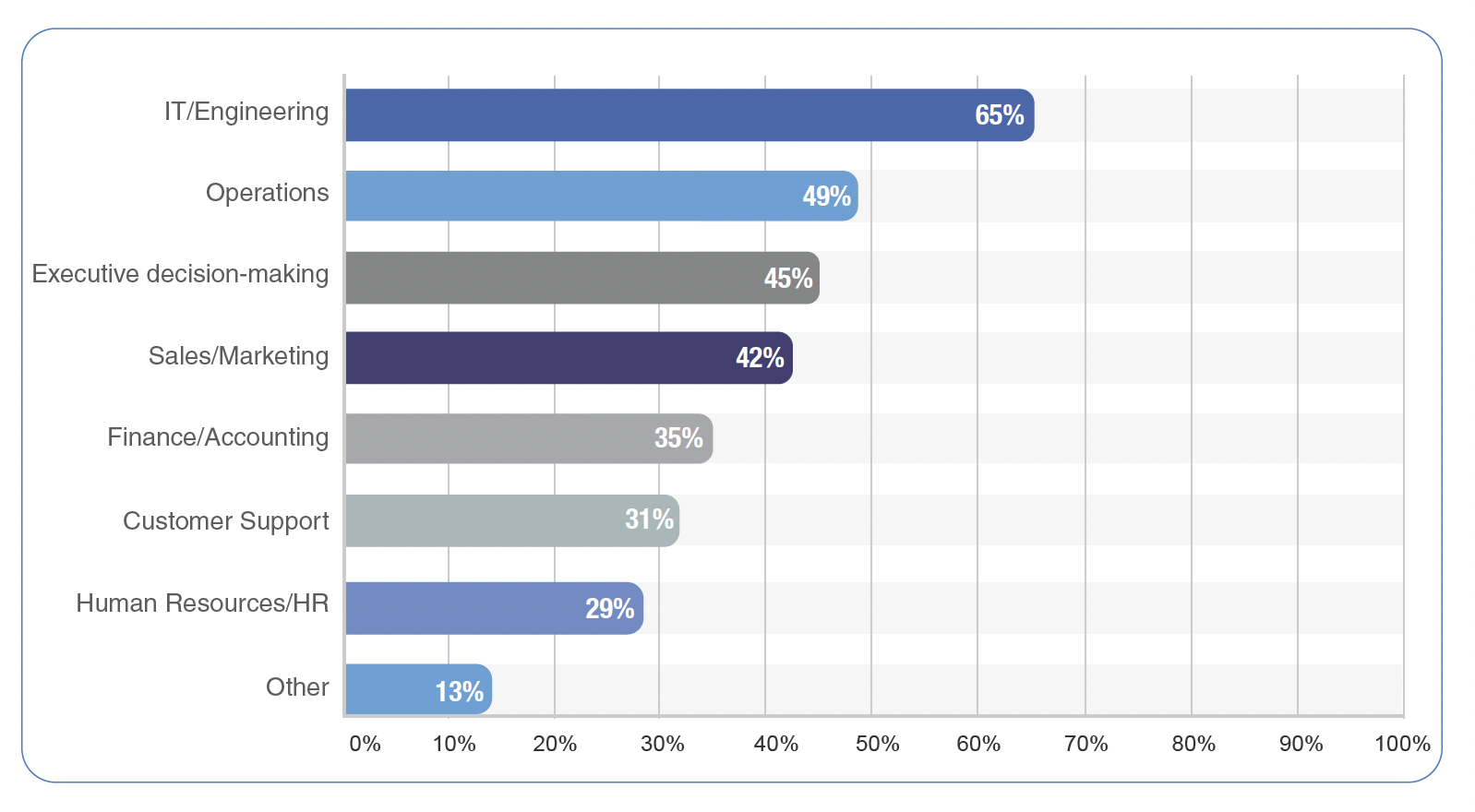
The important finding is not simply that IT ranks first. It is that no other function approaches IT’s usage level, while several business functions have nevertheless reached meaningful adoption.
That creates an increasingly distributed AI environment.
An organization may have developers using AI to accelerate coding, operations teams automating workflows, executives using AI to synthesize information, marketers generating and analyzing content, finance teams exploring reporting applications, and customer service teams augmenting support.
These are all examples of AI adoption, but they require very different knowledge, controls, training, and measures of success.
Enterprise AI Talent Is Becoming a Distributed Capability
Early discussions about AI talent often centered on technical specialists: machine learning engineers, data scientists, AI researchers, and more recently, prompt engineers.
Those roles remain important. But the functional distribution in this study points toward a broader talent requirement.
As AI becomes part of operations, finance, marketing, customer support, and executive decision-making, organizations need AI capability inside those functions, not simply AI expertise available somewhere within the technology organization.
An engineer may understand what an AI model can technically accomplish, but an operations leader understands where a workflow routinely breaks down. A finance professional understands which outputs require reconciliation and control. A customer service leader understands which interactions can be automated and which require judgment or empathy. A salesperson understands where administrative work consumes time that could otherwise be spent with customers.
The value of AI increasingly depends on bringing those two forms of expertise together: knowledge of AI capabilities and knowledge of the business process.
This is reinforced elsewhere in the Talent Study. When respondents were asked about their largest AI talent gap, business translation and use-case design ranked first at 31%, ahead of technical expertise in machine learning and engineering.
That is a significant signal for leaders designing their AI workforce strategy.
The Business Translator May Be More Important Than Another Tool Expert
If AI adoption is spreading function by function, one of the most valuable capabilities may be the ability to identify where the technology actually belongs.
Organizations do not necessarily need every employee to become an AI specialist. They do need people who can look at a business problem, understand the process behind it, determine whether AI is appropriate, and help translate that opportunity into a workable solution.
This capability becomes particularly important because functional teams often have knowledge that is difficult to capture elsewhere.
A process may look straightforward on paper while containing dozens of exceptions understood only by experienced employees. A finance workflow may involve controls that are not obvious to a development team. A customer interaction may require context that cannot be inferred from the underlying data alone.
The AI Leaders Council’s recent Talent Study webinar highlighted this problem as well. Panelists noted that substantial organizational knowledge often remains undocumented, residing with employees rather than in systems AI can readily access.
That makes domain expertise more valuable, not less.
The organizations that scale AI effectively may therefore be those that can connect technical teams with employees who deeply understand the work being transformed.
Different Functions Require Different Adoption Strategies
The results also caution against a single enterprise AI adoption playbook.
Consider IT and finance.
At 65%, IT and engineering are the most common users of AI. Finance and accounting stand at 35%.
It would be easy to interpret that 30-point difference simply as finance being “behind.” The reality is more complicated.
Different functions operate under different risk tolerances, regulatory requirements, data constraints, and standards for accuracy. An AI-generated coding suggestion that is reviewed by a developer presents a different risk profile from an AI-generated financial output that could influence reporting or an executive decision.
Finance teams, for example, have established controls precisely because errors can have significant consequences. The Talent Study webinar discussion noted that those existing controls can ultimately become a foundation for broader AI adoption rather than merely a barrier to it.
The implication for AI leaders is important: lower adoption does not automatically indicate resistance.
Sometimes it indicates that the path to responsible adoption is more demanding.
Rather than establishing an enterprise-wide target for AI usage and expecting every function to move at the same pace, leaders should consider what responsible maturity looks like within each part of the organization.
Executive AI Usage Deserves Particular Attention
One of the more interesting results is the 45% reporting AI use for executive decision-making.
This suggests AI is not confined to task automation. It is increasingly entering environments where information is interpreted, options are evaluated, and decisions are made.
That raises a different set of talent questions.
Executives do not necessarily need to understand how to build AI systems. They do need sufficient AI literacy to understand what an output represents, where uncertainty exists, how source data affects the result, and when human judgment should override an AI recommendation.
This becomes particularly important as AI tools evolve from producing information to recommending or taking actions.
Leadership AI literacy therefore should not be treated as a lighter version of technical training. It is its own capability, centered on judgment, governance, risk, business application, and accountability.
AI Training Should Follow the Work
The functional spread of AI also has implications for training.
If IT, operations, finance, marketing, customer support, and executives are using AI differently, a generic “AI 101” course can only go so far.
Broad AI literacy provides a useful foundation. Employees should understand what AI can and cannot do, appropriate data practices, organizational policies, and the importance of validating outputs.
Beyond that foundation, however, training should increasingly become role-specific.
An operations employee may need to learn how to identify automation opportunities and redesign workflows. A finance professional may need stronger training around validation, controls, and appropriate use of sensitive information. A marketing professional may need to understand intellectual property, brand standards, and output verification. Executives may need to focus on decision quality, governance, and strategic implications.
This is particularly relevant given another finding from the study: only 37% of organizations currently provide formal AI training, either company-wide or for selected roles.
As AI becomes more functionally distributed, informal learning alone becomes increasingly difficult to reconcile with consistent enterprise standards.
Centralize the Guardrails, Distribute the Capability
For AI leaders, the data points toward a model in which some responsibilities remain centralized while AI capability becomes increasingly distributed.
Security standards, governance policies, approved platforms, architecture, data access rules, and risk frameworks often benefit from enterprise consistency.
Use-case identification, workflow redesign, adoption, and day-to-day application need much deeper involvement from individual functions.
That balance can prevent two common problems.
If AI remains too centralized within IT, business functions may struggle to translate technical capabilities into meaningful operational improvements. If adoption becomes entirely decentralized, organizations risk fragmented technology decisions, duplicated work, inconsistent controls, and uneven governance.
The goal is not to move AI ownership away from IT. It is to recognize that enterprise AI cannot be owned by IT alone.
What This Means for AI Leaders
Question #2 shows an organization-wide AI footprint taking shape. IT and engineering remain at the center, but operations, executive leadership, sales and marketing, finance, and customer support are already significant users.
For AI leaders, that changes the talent mandate.
The question is no longer simply, “Do we have enough AI expertise?”
Leaders should increasingly ask:
- Do individual functions have enough AI literacy to identify valuable applications?
- Who connects business problems with technical capabilities?
- Are domain experts involved in designing AI-enabled workflows?
- Does training reflect the different needs and risks of each function?
- Are governance and security standards consistent as adoption decentralizes?
- Do executives have the skills to evaluate AI-supported decisions critically?
- Are successful use cases and lessons being shared across functions?
- These questions become more important as AI moves from isolated applications toward an enterprise capability.
The organizations best positioned for the next phase of adoption may not be those with the largest centralized AI teams. They may be those that can combine centralized technical and governance expertise with distributed business knowledge throughout the workforce.
Explore the Full 2026 Corporate AI Talent Study
Where AI is being used today is only one part of the workforce story. The 2026 Corporate AI Talent Study examines how more than 300 executives are approaching AI adoption, employee usage, talent strategy, specialized hiring, skills gaps, training, job redesign, and future workforce planning.
Download the full 2026 Corporate AI Talent Study to explore the complete findings and benchmark your organization’s approach to building an AI-ready workforce.