Organizations are moving quickly to adopt artificial intelligence, but that does not necessarily mean AI has become part of everyday work for most employees.
That distinction is one of the more important findings from the 2026 Corporate AI Talent Study.
In our first two articles in this series, we examined the broader state of AI adoption and where AI is being used across the enterprise. The research shows that AI is increasingly moving into production and spreading beyond IT into operations, executive decision-making, sales and marketing, finance, customer support, and other functions.
But Question #3 looks at adoption from a different perspective: How many employees are actually using AI tools in their daily work?
The results suggest that organizational AI adoption and workforce AI adoption are progressing at very different rates.
More Than Half Report AI Usage Among 25% or Less of Employees
When executives were asked what percentage of employees actively use AI tools in their daily work, the largest group, 29%, said between 10% and 25% of employees.
Another 25% said fewer than 10% of employees are active daily AI users.
Combined, 54% of organizations report that no more than one-quarter of their workforce actively uses AI in daily work.
Usage becomes progressively less common at higher levels:
- 29% report daily AI usage among 10% to 25% of employees.
- 25% report usage among fewer than 10%.
- 21% report usage among 26% to 50%.
- 19% report usage among 51% to 75%.
- Only 6% report that 76% to 100% of employees actively use AI.
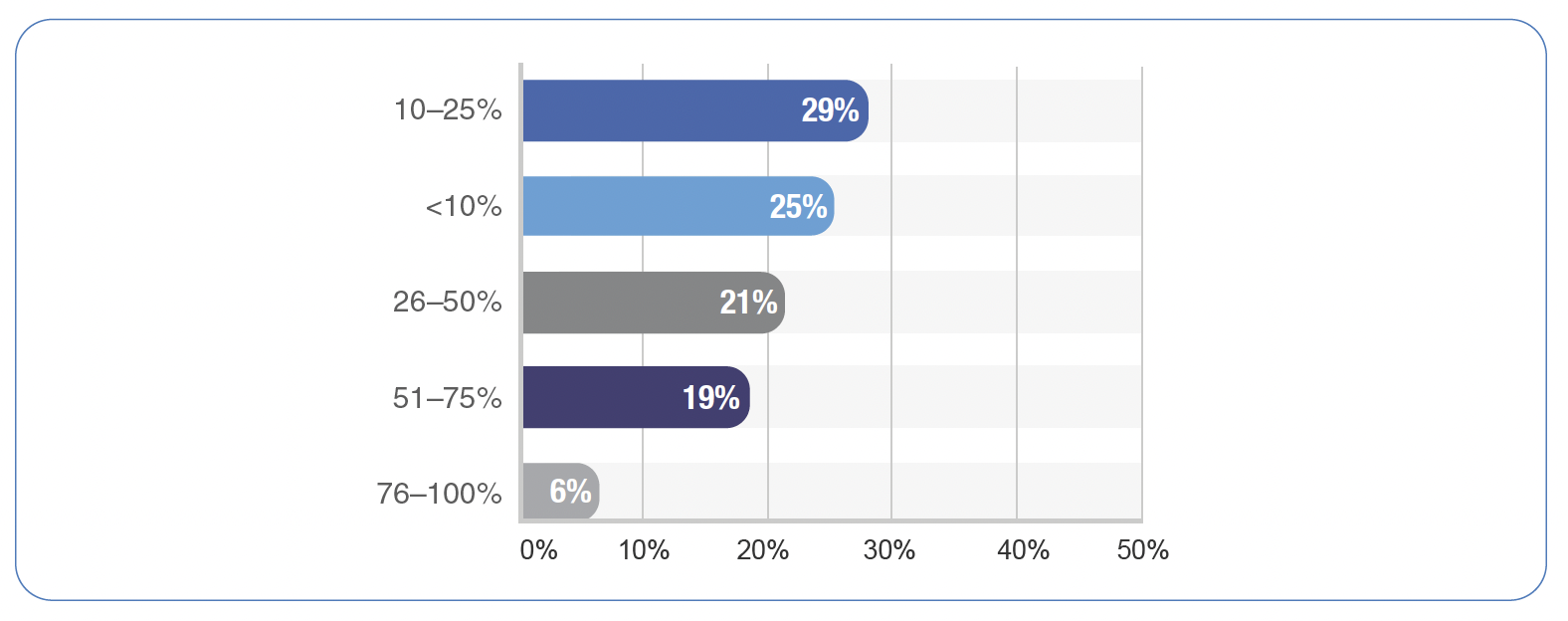
The results reveal a workforce adoption curve that is considerably less mature than the broader enterprise adoption story.
That is not necessarily a contradiction. It highlights the importance of defining what we mean when we say an organization has “adopted AI.”
Enterprise Adoption Does Not Mean Enterprise-Wide Usage
In Question #1 of the study, 54% of organizations reported having AI operating in production in some capacity. Yet in Question #3, the same percentage, 54%, said no more than one-quarter of employees actively use AI tools in their daily work.
Those two findings provide an important perspective on the current state of enterprise AI.
An organization can have sophisticated AI applications in production without having widespread employee usage.
AI might be embedded within a customer service workflow, used by a specialized analytics team, incorporated into software development, or operating behind the scenes within an automated business process. These applications may produce significant value even though most employees never interact directly with the underlying AI.
Similarly, one department may be using AI extensively while adoption remains minimal elsewhere.
For leaders, this means enterprise AI maturity cannot be measured solely by the number of AI applications that have entered production.
Technology deployment and workforce adoption are related, but they are different dimensions of maturity.
Broad Employee Usage Should Not Be the Goal by Itself
It would be easy to look at the data and conclude that organizations simply need more employees using AI.
That would be the wrong objective.
Not every role has the same opportunity to benefit from AI, and there is little value in encouraging employees to use AI simply to increase an adoption metric.
A warehouse employee, financial analyst, software developer, salesperson, attorney, customer service representative, and senior executive may each have very different opportunities for AI-enabled work. Some roles may eventually interact with AI throughout the day. Others may benefit indirectly from AI embedded within the systems and processes they already use.
The more useful question is therefore not “What percentage of our employees use AI?”
It is “Are the employees who could benefit from AI using it effectively?”
That shifts the discussion from adoption volume to business value.
Organizations should be identifying the employee populations and workflows where AI can meaningfully improve productivity, decision-making, quality, customer experience, or speed. Adoption efforts can then be concentrated around those opportunities rather than pursuing an arbitrary enterprise-wide usage target.
The Next Adoption Gap Is Between Experimentation and Consistent Use
There is another distinction hidden within the phrase “actively use AI tools in their daily work.”
Trying ChatGPT occasionally is different from integrating AI into the way a job is performed.
Many employees have experimented with generative AI. They may use it to summarize a document, draft an email, brainstorm an idea, conduct research, or answer a question. That experimentation is valuable because it builds familiarity and can help employees discover useful applications.
But consistent business adoption requires more.
Employees need to know which tools are approved. They need to understand what information can be entered into those systems. They need methods for validating outputs. They need to know when AI is appropriate and when it is not. Most importantly, they need to understand how AI fits into an actual workflow rather than treating it as an isolated productivity tool.
That transition from occasional tool usage to repeatable AI-enabled work may be one of the next major challenges for organizations.
It is also where workforce strategy begins to matter much more.
Training Becomes More Important as Usage Expands
The study’s training findings provide additional context.
Only 37% of organizations provide formal AI training, including 17% that offer training company-wide and 20% that provide it for selected roles. Another 42% rely primarily on informal or ad hoc training, while 21% provide no AI training at all.
Employees are consequently doing much of the learning themselves. Later in the study, 56% of respondents say employees are primarily self-taught when it comes to AI.
This model can work surprisingly well during the early stages of adoption.
Motivated employees experiment. They share prompts and applications with colleagues. Individual teams discover useful applications. Knowledge spreads organically without waiting for an enterprise training program.
In fact, that bottom-up experimentation has likely contributed significantly to the speed at which generative AI has entered the workplace.
The challenge comes when experimentation becomes operational.
An employee using AI occasionally to brainstorm ideas presents a different organizational challenge from an employee relying on AI every day to analyze information, communicate with customers, produce financial work, make recommendations, or execute portions of a business process.
As the importance of the work increases, informal knowledge becomes less sufficient.
Organizations need greater consistency around validation, data security, governance, approved applications, quality standards, and appropriate human oversight.
AI Usage Without Proficiency Creates Its Own Risk
Organizations should also be careful not to equate usage with capability.
An employee can use an AI tool frequently without using it particularly well.
This distinction becomes important when considered alongside another finding in the study: only 3% of respondents describe their employees as “very confident” using AI tools. While 45% say employees are somewhat confident, a substantial portion of the workforce remains neutral or lacks confidence.
Confidence itself is not necessarily proficiency either.
Employees may feel comfortable asking an AI assistant questions while lacking the ability to evaluate whether the response is accurate. They may know how to generate content but not how to determine whether sensitive information should be shared with a particular application. They may become proficient at prompting without understanding how a workflow could be redesigned more fundamentally.
This helps explain why respondents rank critical thinking and validation and automation and workflow design as the two most important skills for the AI era.
The workforce challenge is becoming less about whether employees can access AI and more about whether they can apply it effectively.
Leaders Need Better Measures of AI Adoption
As AI matures, organizations may also need to reconsider the metrics they use to evaluate adoption.
User counts, licenses activated, prompts submitted, or percentage of employees accessing an AI platform can provide useful information during rollout. They can reveal whether employees are experimenting and whether investments are actually being used.
But those measures say relatively little about whether AI is creating value.
A better measurement framework should eventually connect AI usage to outcomes.
Depending on the application, organizations might examine changes in cycle time, employee capacity, error rates, customer response times, output quality, revenue productivity, process costs, or the amount of manual work eliminated.
This is particularly important because more usage is not always better usage.
An employee who uses AI 50 times per day to perform low-value tasks is not necessarily creating more value than an employee who uses AI once to eliminate several hours of manual analysis.
For AI leaders, adoption metrics should therefore evolve as programs mature. Early measures may focus on access and usage. More mature measures should increasingly focus on business impact and changes in how work gets done.
The 6% at the Other End of the Adoption Curve Is Worth Watching
While most organizations report relatively limited daily workforce usage, 6% say more than three-quarters of their employees actively use AI tools in their daily work.
That is still a small minority, but it may offer an early indication of where broader workforce adoption could eventually move.
Organizations reaching this level of usage are likely confronting questions that less mature adopters have not yet faced at scale.
How do you maintain consistent standards when AI is used throughout the organization? How do managers evaluate AI-enabled performance? How do you distinguish acceptable experimentation from risky behavior? How do job descriptions change? Which skills become baseline requirements? How do employees share successful practices rather than repeatedly solving the same problems independently?
These are no longer simply technology implementation questions.
They are operating model and workforce questions.
As more organizations move into higher levels of employee adoption, AI leadership will increasingly intersect with HR, learning and development, operations, risk management, and functional leadership.
What This Means for AI Leaders
The gap between organizational AI adoption and daily employee usage should not necessarily concern leaders. In many cases, it is a natural feature of where enterprise AI stands today.
What matters is whether organizations have a deliberate plan for closing the gap where doing so creates value.
AI leaders should consider several questions:
- Which roles have the greatest opportunity to benefit from AI today?
- Are employees in those roles actually using the available tools?
- Is usage occasional and experimental, or integrated into repeatable workflows?
- Do employees understand how to validate AI-generated work?
- Are approved tools, data policies, and governance requirements clear?
- Is training aligned with the specific ways different employees are expected to use AI?
- Are adoption metrics measuring activity, or are they measuring business results?
- The objective should not be universal AI usage.
It should be purposeful AI adoption: getting the right capabilities into the hands of the right employees, connecting those capabilities to real work, and ensuring employees have the skills and support to use them effectively.
The 2026 Corporate AI Talent Study shows that enterprise AI adoption is advancing quickly. Broad workforce adoption is still developing.
For many organizations, closing that gap will be one of the defining AI workforce challenges of the next several years.
Explore the Full 2026 Corporate AI Talent Study
How extensively employees use AI is only one part of the workforce readiness picture. The 2026 Corporate AI Talent Study examines how more than 300 executives are approaching AI adoption, talent strategy, specialized hiring, skills gaps, employee confidence, training, job redesign, and future workforce planning.
Download the full 2026 Corporate AI Talent Study to explore the complete findings and benchmark your organization’s approach to building an AI-ready workforce.